IMFs
Phase Changes
Skeletal Structures
Jumbled Content
Jumbled Content 2
100
What are IMFs?
An IMF are attractive forces that exist between ALL particles.
100
What is it called when a solid changes to a gas?
How about a gas to a solid?
Sublimation
Deposition
100
Add in addtional lone pairs and hydrogen atoms to molecule below:

*instructor will draw correct molecule on board*
100
Relate y=mx+b to (ln P= -ΔHvap/-RT = ln A)
ln p= y axis
x= 1/T
b= ln A
m= -ΔHvap/-RT
100
Why does boiling point increaes as molar mass increases?
Ex) Fluroine has a molar mass of about 38g/mol and a boiling point of -188°C, wheras Chlorine has a molar mass of 35g/mol and a boiling point of -34°C
Boiling point increases as molar mass increaes because a greater molar mass indcates the e- are further from the nucleus therefore more polarizable*
*polarizable is a fancier way of saying they make more temporary dipoles
200
List the three types of IMFs in order of weakest to strongest.
dispersion forces<dipole-dipole<hydrogen bonds
200
What is the difference between endothermic reactions and exothermic?
Endothermic reactions require energy to be put into the system (positive value). The system goes from low energy to high energy.
Exothermic reactions release energy into surrounding (negative value). The system goes from high energy to low energy.
200
Draw the skeletal structure for the following molecule:
CH3CH2CH2OH
*instructor will draw on board
200
How are IMFs related to viscosity?
If a substance is more viscous, it will have stronger IMF's
200
List all IMFS and why for this molecule:

Dispersion: all molecules have dispersion
Dipole-Dipole: from polarity
300
List all IMFs that this molecule has and why:

dispersion forces and dipole-dipole.
Dispersion because all molecules will have dispersion attraction.
Dipole-dipole due to the polarity of the oxygen molecule
300
What is vapor pressure? Why does it occur?
The pressure exerted by vapor when it is in dynamic equilibrium with its liquid.
It occurs due to liquid molecules bumping into one another and becoming a gas
300
How many carbons and implied hydrogens are on the molecule below:
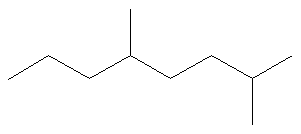
Carbons: 10
Hydrogens: 22
300
Explain the two forces that occur during capillary action:
cohesive force: molecule attraction wihtin the liquid
adhesive force: molecule attraction between liquid and tube
300
Answer these:
Solids tend to be present at ___ temp and ___ pressure.
Liquids tend to be present at ___ temp and ___ pressure.
Gases tend to be present at ___ temp and ___ pressure.
Solids: low and high
Liquids: high and high
gases: high and low
400
What is the difference between hydrogen bond acceptors and donors?
A hydrogen bond acceptor will posses a N or O atom with lone pairs.
Hydrogen bond donors will contain a N-H or O-H bond.
400
Define enthalpy of vaporization:
Draw the graph and label axes
energy needed to take 1 mol of a liquid and make it a gas (at constant P and T)
*instructor will draw graph
400
Identify all functional groups on the following molecule:
alcohol and carboxcylic acid
400
What is surface tension?
Liquids reducing their surface area, this generates stronger IMF's.
400
List the functional group shown in this molecule:
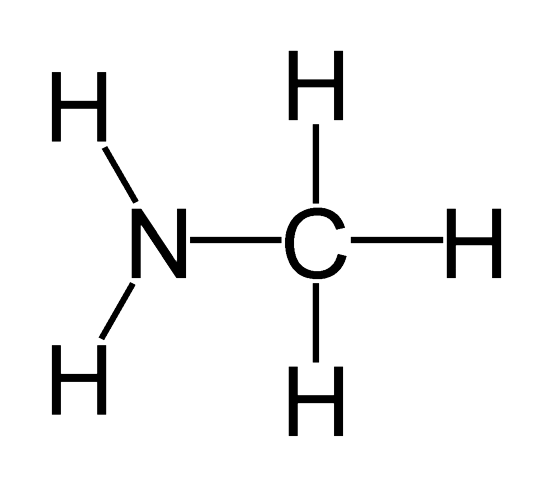
amine
500
Diethyl ether and n-butanol have the exact same molar mass (74.12 g). Explain why diethyl ether has a significanly lower boiling point (35°C) than n-butanol (117°)?
The difference in boiling point comes from n-butanol containing dispersion, dipole-dipole, and hydrogen bonds. Whereas diethyl ether has dispersion and dipole-dipole.
500
How is vapor pressure related to the IMF strength between molecules?
If a molecule has a low vapor pressure, then it's intermolecular forces are strong.
500
Explain why functional groups are important to the molecule?
Functional groups are important because they alter the physical and chemical properties of a molecule. This will affect reactions
500
Draw a phase change diagram. Label the point where solids, liquids, and gases all exist. Additionally, label the line where vapor pressure exists.
*insturctor will draw answer
500
How many carbons and hydrogens are in this molecule:
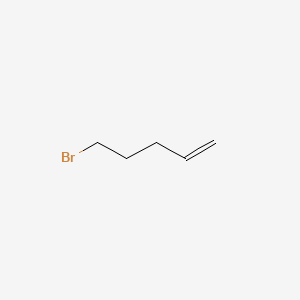
Carbons: 5
Hydrogens: 9