Salt Equilibria
Thermodynamics
Electrochemistry
Balancing Redox Reactions
100
Which would decrease the solubility of a 0.10 M solution of Ag2CO3 the most? Ksp of Ag2CO3 is 8.1 x 10⁻¹².
a) H+ and Ag+
b) 0.10 M H+
c) 0.10 M CO32-
d) 0.10 M Ag+
Ksp = [Ag+]2[CO32-]
d) 0.10 M Ag+
100
Would entropy increase or decrease if 100 g of Na2SO4(s) is dissolved in water?
Increase (solid to liquid)
100
What type of reaction occurs in the Galvanic cell?
Spontaneous redox reaction
100
What has to be the same in both half reactions to combine them?
They have to have the same number of electrons
200
Why can the complex ion formation increase the solubility of insoluble compounds?
The complex ions shift the equilibrium forward by removing the cation from the solution.
200
Would entropy increase or decrease if 1 mol of Ne(g) expands from 5.5 L to 12.0 L container?
Increase (more space)
200
Which compound has phosphorus with an oxidation number of +3?
a) FePO4
b) H3PO3
c) PH3
d) H3PO4
e) PCl5
b) H3PO3
200
What is the main difference in balancing in acidic vs basic conditions?
Acidic conditions: we use H+ to balance the reaction
Basic conditions: we use OH- neutralize H+ and balance the reaction
300
The Ksp of Ca(OH)2 is 1.3 x 10⁻⁶. Calculate the molar solubility of calcium hydroxide.
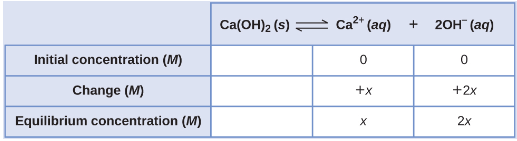
Ksp = [Ca][OH]2
x = 6.9 x 10⁻³ M
300
If DeltaH < 0 and DeltaS > 0 , the reverse reaction will be:
a) Spontaneous at all T
b) Nonspontaneous at all T
c) Spontaneous at low T
d) Spontaneous at high T
b) Nonspontaneous at all T
300
Given the following reduction potentials: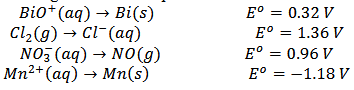
Build a galvanic cell with a cell potential of 0.40 V. Balance the redox reaction in basic solution.
Cl - red; NO - ox (flip); 1.36-0.96 = 0.40 V --> use these
8OH- + 3Cl2 + 2NO --> 6Cl- + 2NO3- + 4H2O
300
Write the balanced reaction between Cu(s) and HNO3(aq) to yield Cu2+ and NO(g) (acidic conditions).
3Cu(s) + 6H+(aq) + 2HNO3(aq) --> 3Cu2+(aq) + 2NO(g) + 4H2O(l)
400
The concentration of Mg2+ in sea water is 0.0537 M. Will Mg(OH)2 precipitate when enough Ca(OH)2 is added to give a [OH-] of 0.0010 M?
Mg(OH)2(s) <--> Mg2+(aq) + 2OH-(aq); Ksp = 8.9 x 10⁻¹²
Q = [Mg][OH]2 = 5.4 x 10⁻⁸ > Ksp => will precipitate
400
Calculate DeltaG at 298K under the conditions P(CO) = 1.4 atm P(CO_2) = 2.1 atm for:
Fe2O3(s) + 3CO(g) --> 2Fe(s) + 3CO2(g), DeltaGo = -28.0 kJ
DeltaG = DeltaGo + RTlnQ = -25.0 kJ
400
A voltage of 0.466 V was measured for:
8OH- + 3Cl2 + 2NO --> 6Cl- + 2NO3- + 4H2O Eocell = 0.40 V
Determine the pH for this solution. All aqueous solutions have a concentration of 1.2 x 10⁻⁴ M and all gases have a pressure of 1.4 atm.
Ecell = Eocell - (0.0592/n)logQ
Q = 2.05 x 10-7 = [Cl]6[NO3]2/[OH]8PCl3PNO2
[OH] = 6.7 x 10⁻⁴
pH = 10.82
400
Write the balanced reaction between MnO4- and Cr(OH)3 to yield MnO2 and CrO42- (basic conditions).
OH-(aq) + Cr(OH)3(s) + MnO4-(aq) --> CrO42-(aq) + MnO2(s) + 2H2O(l)
500
CoBr2: Ksp = 2.9 x 10⁻¹⁰, Co(NH3)62+: Kf = 1.6 x 1035.
a) Will a precipitate form if 0.072 M cobalt nitrate solution and 5.61 x 10⁻⁴ M sodium bromide are mixed together?
b) If 0.072 M cobalt nitrate is mixed with 1.7 M ammonia in a 1 L solution, how much cobalt ion will remain in the solution?
a) Co2+ + 2Br- <--> CoBr2(s)
Q = [Co2+][Br-]2 = 2.3 x 10⁻⁸ > Ksp so ppt will form
b) Co(NH3)62+ <--> Co2+ + 6NH3
Kc = 1/Kf
BA and ICE tables
[Co2+] = 1.1 x 10-37
500
Given the following data for the reaction:
5H2(g) + 2NO(g) --> 2NH3(g) + 2H2O(g)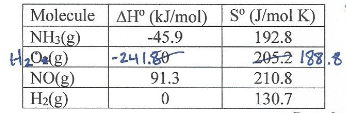
a) When is the reaction spontaneous (oC)?
b) What is the equilibrium constant for 105oC? Should it be spontaneous?
DeltaH = -757.8 kJ/mol
DeltaS = -311.9 J/mol K
a) T < 2156oC
b) DeltaG = -640 kJ/mol
lnK = 204
K = 2.4 x 1088
Spontaneous
500
Given the following reduction cell potentials:
Balance the redox reaction in an acidic solution for an electrolytic cell, determine the standard cell potential, draw the diagram with all parts labeled (use Pt electrode where necessary), and determine the amount (in grams) of Mn produced/lost if 22.4 A of current is supplied for 87.5 hours.
5Mn2+ + 6H2O + I2(s) --> 5Mn(s) + 2IO3- + 12H+
Eocell = -2.38 V
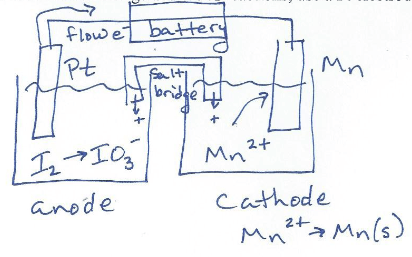
2007 g of Mn produced
500
Balance the following reaction, assuming it occurs in a basic solution:
NO3-(aq) + H2(g) --> NO(g)
2NO3-(aq) + 3H2(g) --> 2NO + 2H2O + 2OH-