Dynamic Equilibrium
ICE Tables
Bronsted-Lowry & Arrhenius
Le Chatelier's Principle
Random
100
Name three stressors that can be applied to an equilibrium system
what are Temperature, Concentration, Pressure/Volume
100
ICE stand for
what are Initial, Change, Equilibrium
100
The Bronsted-Lowry definition of an acid and a base
what is Acid: proton donor, Base: proton acceptor?
100
True or false: According to Le Chatelier's Principle, when a stressor is applied to a a system at equilibrium, the system will shift to oppose the change until a new equilibrium is established.
what is True
100
an indicator that works for a titration with an end point at pH= 2
What is Orange IV or thymol blue ?
200
the Kc value if products are favorable
what is greater than 1?
200
we use ICE tables for
what is going from initial concentration to equilibrium concentrations
200
Identify the bases in the following chemical equation
HSO4- (aq) + HPO42- (aq) <--> H2PO4- (aq) + SO42- (aq)
What are HPO42-, SO42-?
200
If the concentration of HF(g) increased, which direction would the equilibrium shift and would this produce more or less product?
CCl4(l) + 2HF(g) <--> CCl2F2(g) + 2HCl(g)
Equilibrium would shift right and more product would be produced
200
For a strong acid, the [H3O+] is ________ [HA]
what is greater than?
300
Write the Equilibrium Law expression for the following equation
Zn(s)+Cu2+(aq)↔Cu(s)+Zn2+(aq)
what is Kc = [Zn2+(aq)] / [Cu2+(aq)]
300
Consider the reaction for the decomposition of hydrogen iodine at 448°C. The initial concentration of HI(g) was 1.00mmol/L. Once an equilibrium was established, the concentration of HI(g) was measured to be 0.078mmol/L. Calculate the equilibrium constant (Kc)
2HI(g) < --> H2(g) + I2(g)
what is 2.7?
300
The product/s of this reaction
O2-(aq) + H2O(l) ⇄
What is 2OH- ?
300
If the volume of this system decreased, the equilibrium would
H2(g) + Cl2(g) < -- > 2HCl(g)
what is no shift?
300
If temperature increases in an exothermic reaction, the Kc will
what is decreases?
400
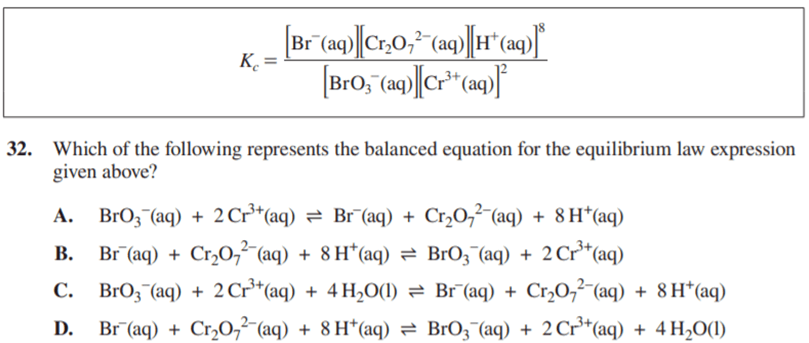
what is C ?
400
If a 100 mL sample of 0.344 mol/L unknown acid has a pH of 4.1 at 30 degrees, then the Ka is?
what is Ka = 1.8 x 10^-8 ?
400
Identify the conjugate acid base pairs from the following reaction
HCO3- (aq) + CN- (aq) < -- > CO32- (aq) + HCN (aq)
What are 1. HCO3-(aq) & CO32-(aq)
2. CN-(aq) & HCN(aq)
400
If the pH increases, the reaction will shift to the _____
H3O++ + F- ↔ H2O + HF
what is left?
400
a solution is made from 0.20 mol CH₃COOH and 0.15 mol CH₃COO⁻ in 1.0 L solution.
1) solution is called a _____________
2) The reaction that would happen if a strong acid is added is__________________
1) what is a buffer
2) what is H3O+ + CH₃COO⁻ ↔ H2O + CH₃COOH
500
In the following system: N2(g) + 3H2(g) ↔ 2NH3(g)
0.249 mol/L of N2(g), 3.21 X 10⁻² mol/L of H2(g) and 6.42 X 10⁻⁴ mol/L of NH3(g) are combined in a 1.00 L vessel at 375°C.
What is the Kc value for the reaction and are the products or reactants favored?
what is 0.0500 ?
what is Reactants ?
500
A student measures the pH of a 0.25 mol/L solution of carbonic acid to be 3.48. Calculate the Ka for carbonic acid from this evidence
what is Ka = 4.39x10^-7?
500
The predominant reaction if nitric acid is mixed with potassium fluoride
what is H3O+(aq) + F-(aq) --> H2O(l) + HF(aq)
500
2NO + Cl2 <--> 2NOCl + Heat
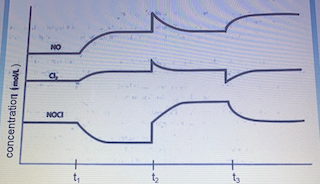
what are temp up, Concentration of NOCl up, Concentration of Cl2 down
500
what will happen to all the chemical entities in this equation if H3O+ was added to the reaction
OH- + HF ↔ H2O + F-
OH-: down
HF: up
H2O: down
F-: down