Chemical Bonding
Metal or Non-Metal
Lewis Dot Structure
Ionic Bonds
Covalent Bonds
100
What is chemical bonding
joining of atoms to form a compound or molecule
100
Where are metals located on the periodic table?
left
100
What do the dots on in the Lewis dot structure represent?
the electrons on the outermost electron shell (valence electrons)
100
What type of elements form ionic bonds
metals and non-metals
100
What type of elements form covalent bonds?
nonmetals
200
Why do atoms bond?
to become more stable (fill their outer shell of electrons)
200
Where are non-metals located on the periodic table?
right
200
How many valence electrons does oxygen have
6
200
What happens to electrons in an ionic bond
they are transferred
200
What happens to electrons in a covalent bond
they are shared
300
What determines how an atom will bond?
the number of electrons
the position of the elements on the periodic table
300
What type of element is oxygen?
non-metal
300
How many valence electrons does sodium have
1
300
What charge does a metal become after losing electrons
positive
300
Is this an example of a covalent bond? Explain why.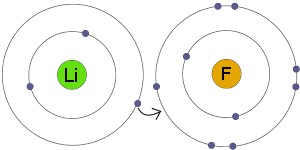
No, it is ionic. It show lithium (Li) and fluorine (F). Li is a metal and F is a non-metal.
400
What type of elements usually form bonds: metals, non-metals, or both?
both
400
What type of element is magnesium (Mg)
metal
400
What is the maximum number of electrons shown in a Lewis dot structure?
8
400
What charge does a nonmetal become after gaining electrons
negative
400
Name an example of a covalent bond. DO NOT USE LiF or H20!!!
answer should contain 2 nonmetals
500
What is a compound?
a substance made of two or more different elements chemically bonded
500
Is hydrogen a metal?
no, despite it being located on the left of the periodic table
500
Why are Lewis dot structures important?
they show how atoms will bond
500
What is an example of an ionic compound.
DO NOT USE NaCl!!!
answer should show a metal and nonmetal
500
Why do atoms share electrons in covalent bonds
to become more stable and to fill their outermost energy shell