The Basics
Nothing to do with Science
Reaction Rates
In Depth Reacting
100
In a Chemical Reaction these are broken or created to form new molecules.
What are bonds?
100
The movie we watched on Tuesday and Today?
What is Coco?
100
As more collisions in a system occur, there will be more combinations of molecules bouncing into each other, resulting in a higher chance that the molecules will complete the reaction and therefore the rate of that reaction will increase.
What is the Collision Theory?
100
The study of the amounts of substances involved in reactions.
What is Stoichiometry?
200
This common chemicsl reaction occurs when iron molecules react with oxygen molecules?
What is rusting?
200
The word most often used to start a Contexto game.
What is tree?
200
Temperature, energy, concentration, and pressure.
What are the factors that affect the rate of reactions?
200
The measurement of heat that chemists use.
What are Joules?
300
Finish this statement: "A reaction could include atoms compounds, molecules, or _______ of a single element.
What are ions?
300
The TSP teacher at Kenilworth Junior High School.
Who is Ms. Selna?
300
The only state of matter that changes its' reaction rates when pressure is either increased or decreased.
What is a gas?
300
The mass of reactants, mass of products, chemical equations, molecular weights of reactants & products, and formulas of various compounds.
What one might look at when studying Stoichiometry?
400
The two components that make up a reaction.
What are "products" and "reactants"?
400
The tallest plant in the large metal planter box outside.
What is a sunflower?
400
Substances that can speed up a reaction without being consumed in the process.
What are catalysts?
400
Represented by the variable 'K', this number is the sum of all the actions and conditions in a reaction.
What is the Equilibrium Constant?
500
The Type of reaction this image is an example of.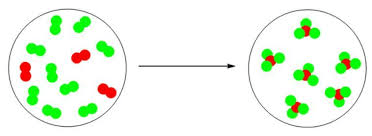
What is a synthesis reaction?
500
What the acronym TSP stands for.
What is the Therapeutic Support Program?
500
This is reached when the forward and reverse reactions occur at the same rate causing the concentrations of reactants and products to remain constant.
What is equilibrium?
500
When new molecules or substances are added that are not a part of the main reaction, when the temperature of the system is changed, when the pressure of the system is changed, when the concentrations are changed, and when the total volume of the system is changed.
What are the things that can change the "Equilibrium Point" during a reaction?