Atomic Structure
Bonding
Reactions
Thermodynamics
Organic Chem
100
Positively charged ions are deficient in this subatomic particle.
What are electrons?
100
This bond is the transfer of electrons between a nonmetal and a metal.
What is an ionic bond?
100
The product(s) of the following reaction: C3H8 + O2.
What are CO2 and H2O?
100
A measure of disorder in the universe.
What is entropy?
100
The suffix for fully saturated hydrocarbons, i.e., CnH2n+2.
What is -ane?
200
This is the name given to metals in the second group of the periodic table.
What are alkali-earth metals?
200
This bond is the unequal sharing of electrons between two nonmetals.
What is a polar covalent bond?
200
The precipitate product of the following reaction: NaCl + AgNO3.
What is AgCl?
200
The term for the energy "barrier" that molecules need to overcome in a collision for a reaction to occur.
What is activation energy?
200
The hybridization of carbon in ethene (CH2CH2).
What is sp2?
300
This element has the largest radius of any known element.
What is Francium?
300
The melting and boiling points of the halogens increase going down their group primarily due to this IMF becoming stronger.
What are LDFs?
300
The product(s) of the following reaction: CaCO3 + heat.
What are CaO and O2?
300
The relationship between the change in Gibbs free energy and the equilibrium constant of a reaction.
What is dG = -RTlnK?
300
The IUPAC name of CH3CH2COOH.
What is propanoic acid?
400
This is the noble gas electron configuration for Copper.
What is [Ar] 4s1 3d10
400
These are the strongest types of intermolecular forces between molecules of CHF3.
What are dipole-dipole forces?
400
The product(s) of the following reaction: Li + N2.
What is Li3N?
400
An endothermic reaction that decreases in entropy will be spontaneous under these conditions.
What is never?
400
The number of chiral centers in the pictured molecule.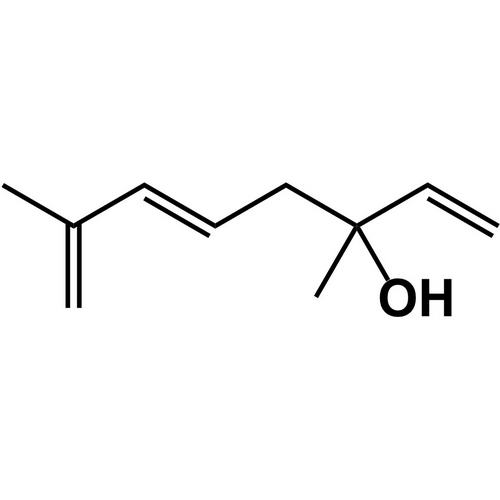
What is 1?
500
This element has the highest electron affinity of any element.
What is Chlorine?
500
This is the molecular geometry of XeF4.
What is square planar?
500
The product(s) of the following reaction: MnO4- + H+ + H2O2.
What are Mn2+, O2, and H2O?
500
This is the relationship between work w, heat q, and change in internal energy dU of a reaction.
What is dU = w + q?
500
The mechanism by which fluorethane (CH3CH2F) will react with sodium hydroxide (NaOH).
What is SN2?