Passing Gas
What a Problem
Very Problematic
What a Solid Guy
Misc.
100
What is a gas that follows the kinetic-molecular theory?
Ideal gas
100
What is the molar volume of any substance at STP?
22.4 L/mol
100
A handful of gas, which starts at 7.4 L and 23 oC, is heated to 51.2 oC at a constant pressure. What is the new volume?
8.1 L
100
What are the only intermolecular forces that work on nonpolar molecules?
London dispersion forces
100
What is a solid that splits or shatters into irregular fragments?
Amorphous solid
200
What is the ability of a gas to spread out uniformly to fill an entire volume over time?
Diffusion
200
What is the value of STP?
0 oC and 101.325 kPa
200
A 2.3 L sample of gas has a temperature of 74.2 oF. What is the volume is the temperature drops to 39 oF?
2.1 L
200
What is the temp and pressure at which a substance can exists in all three states of matter?
Triple point
200
Which gas law relates the pressure of a gas to its temperature in Kelvins?
Gay-Lussac's Law
300
What does Dalton's law of partial pressures state?
The total pressure of a mixture of gases equals the sum of the pressure of each individual gas
300
Between Chlorine gas and Oxygen gas, which one diffuses the fastest? By how much?
Oxygen is 1.47 times faster than Chlorine
300
What is the boiling point of ethylene glycol at 10 kPa?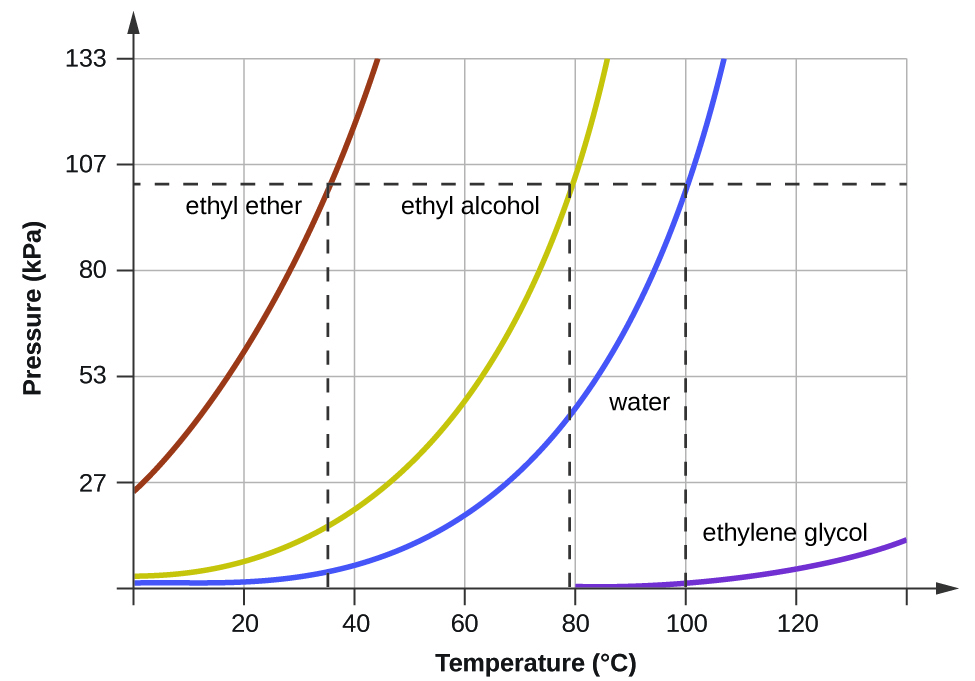
120 oC
300
What is lattice energy?
The energy released when gaseous particles form crystals
300
Hydrogen bonds form between Hydrogen and which three elements?
N
O
F
400
State Boyle's law
The volume of a gas is inversely proportional to its pressure, if temp is constant
400
What is the critical point of water?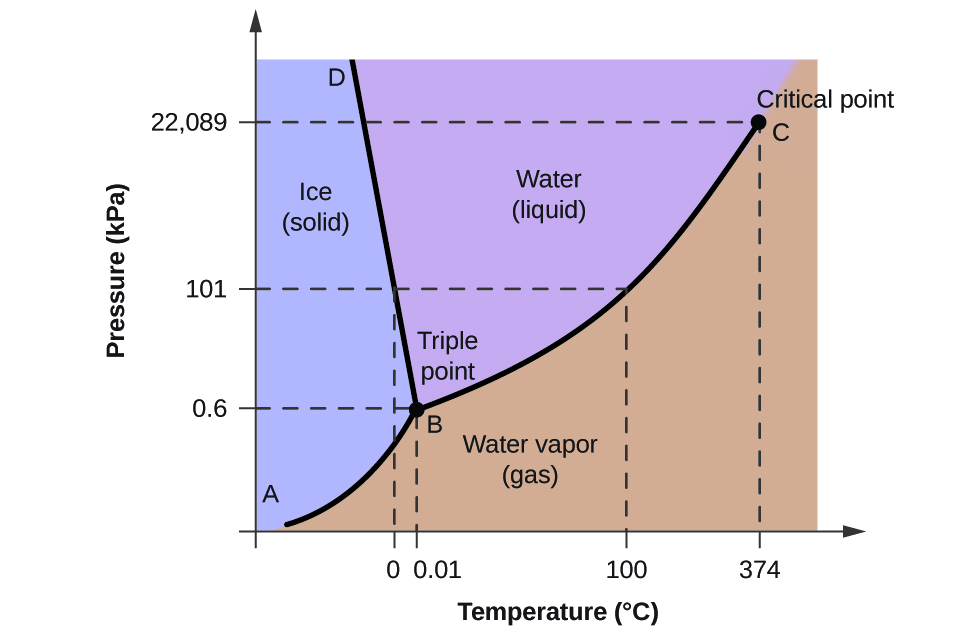
374 oC and 22089 kPa
400
38.2 g of hydrogen gas reacts with oxygen gas to produce water vapor. If this is happening at 200 K and at a pressure of 138.2 kPa. What is the volume of oxygen gas used?
28.7 mL
400
What is a meniscus and how does it form?
A meniscus is the curved surface of a liquid in a container. It forms because the attraction to the container exceeds the attraction to the liquid.
400
What is vapor pressure?
The pressure that is exerted by the evaporated particles over a liquid
500
List five characteristics of gases.
Consists of particles that are tiny compared with the great distances between them
Have particles that move in random direction at high velocities
Have particles that don't interact with each other except in momentary colisions
Whose collisions between particles are elastic (meaning they conserve energy)
Have an average kinetic energy that is proportional to its temp in Kelvins
500
A unknown gas has a molar density of 1.70 g/L. What is its molar mass? Which gas is it?
38.08 g/mol
Fluorine gas (F2)
500
A sample of 57.8 mL of Helium gas is collected over water at a temperature of 35.0 oC. Atmospheric pressure is 97.36 kPa. What is the volume of the sample at STP?
46.4 mL He
500
Between KCl and O2, which has the higher boiling point and why?
KCl, because dipole-dipole forces are stronger than london dispersion forces
500
State Graham's law of diffusion.
The rate of effusion for a gas is inversely proportional to the square root of the mass.