Quick Chemistry
Concentrate!
Miscellaneous
Terms
100
What is an intermediate substance that forms as the reactants transition into products?
Activated complex
100
What is a substance that changes a reaction's rate without being consumed by the reaction?
Catalyst
100
In a reaction, what are substances that are formed in one step and consumed in the other?
Intermediates
100
What is a substance that reduces a catalyst's undesired effects?
Inhibitor
200
Between kinetics and thermodynamics, which one is path-dependent?
Kinetics
200
What is how quickly reactants change into products?
Reaction rate
200
What is a biological catalyst?
Enzymes
200
What is the rate-determining step?
The slowest of the elementary steps
300
What is found at the apex of this diagram?
Activation energy
300
Make a graph showing the concentrations of each substance over time for 3O2 → 2O3
Blue is O3, Red is O2
300
For a reaction with the rate law "rate = k[A][B]2", what happens if I double the concentration of B?
The reaction is 4x faster
300
What is the study of the rates of reactions and the steps by which they occur?
Kinetics
400
What's the difference between a heterogenous and homogenous catalyst?
Heterogenous catalyst - combines with one of the reactants to form an intermediate compound that will react more readily with other reactants
Heterogenous catalyst - adsorbs reactant molecules on their surface
400
Determine the rate law for "H+ + OH- → H2O"
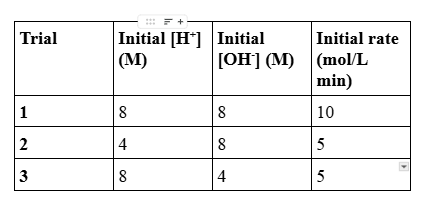
rate = k[H+][OH-]
400
Determine the rate law for CH3CHO → CH4 + CO
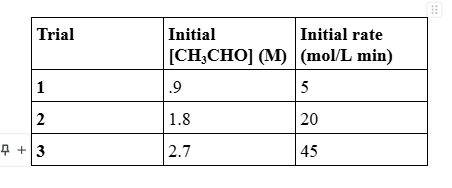
rate = k[CH3CHO]2
500
What three things must happen for a reaction to occur?
The particles must collide
The particles must collide in the proper orientation so that atoms and electrons can arrange in the right way
The collision must be energetic enough to form products
500
For the following reaction, give the intermediates, the rate determining step, and the net reaction.
Step 1: 2NO → N2O2 (fast)
Step 2: N2O2 + H2 → N2O + H2O (slow)
Step 3: N2O + H2 → N2 + H2O (fast)
Intermediates: N2O2, N2O
Elementary step two
2NO + 2H2 → N2 + 2H2O
500
Explain five factors that affect reaction rates.
Reactive substances react quickly
Higher concentration = faster reaction
Higher temps = faster reaction
Higher surface area increases reaction rates
Catalysts make reactions go faster by lowering its activation energy