Atomic Adventures
Bonding Basics
Functional Group Frenzy
Build it,
Break it
Break it
Water
Works
Works
100
Which three subatomic particles are found in atoms?
Protons, neutrons, and electrons
100
What type of bond forms when electrons are transferred from one atom to another?
Ionic bond
100
What functional group is this?:max_bytes(150000):strip_icc()/hydroxylfunctional-56a129e05f9b58b7d0bca5df.jpg)
Hydroxyl
100
What reaction breaks a dimer apart by adding water?
Hydrolysis
100
What type of bond forms between separate water molecules?
Hydrogen bond
200
Which subatomic particle determines an atom’s atomic number?
Protons
200
What type of bond involves equal sharing of electrons?
Nonpolar covalent bond
200
What functional group is this? :max_bytes(150000):strip_icc()/carboxylgroup-56a129e15f9b58b7d0bca5e9.jpg)
Carboxyl
200
What molecule is released as a byproduct during dehydration synthesis?
Water, H₂O
200
Which property of water helps maintain continuous columns of water in plant xylem?
Cohesion
300
Why do electrons generally best predict chemical behavior?
Because they can interact, be transferred, or be shared during chemical reactions
300
Why is the O–H bond in water classified as polar covalent?
Oxygen is more electronegative than hydrogen, so the electrons are shared unequally
300
What important functional group is in this?
Hydroxyl
300
During dehydration synthesis, what two pieces are removed from the reacting monomers to form water?
A hydrogen (H) and a hydroxyl group (OH)
300
What property of ice helps aquatic animals survive during cold winters?
Ice is less dense than liquid water, so it floats and insulates the water below.
400
An atom has 6 protons and 6 neutrons and 6 electrons. What is its approximate atomic mass?
12
400
Carbon has an electronegativity of 2.5 and oxygen has an electronegativity of 3.5. Calculate ΔEN and identify the bond type.
ΔEN = 1.0; polar covalent
400
What functional group or groups is/are present?
A carboxyl group
400
A reaction joins two monomers and releases H₂O. What type of reaction is this, and what happens to the monomers?
Dehydration synthesis; the monomers become joined by a covalent bond
400
Why is water such a useful solvent for transporting nutrients, ions, hormones, and wastes in organisms?
Because its polarity allows it to dissolve many substances and carry them in solution
500
An atom has 8 protons, 8 neutrons, and 8 electrons. What is its atomic number, approximate atomic mass, and what atom is it.
Atomic number: 8; atomic mass: about 16; Oxygen
500
Compare an ionic bond with a polar covalent bond in terms of what happens to the electrons.
Ionic bonds involve transfer of electrons; polar covalent bonds involve unequal sharing of electrons.
500
What functional group or groups is/are present?
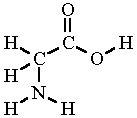
Amino and carboxyl groups
500
A polymer contains 12 monomers. Explain how many bonds must be broken to separate it completely and how many water molecules are required.
11 bonds must be broken, so 11 water molecules are required
500
A solution changes from pH 7 to pH 5. What happens to the hydrogen ion concentration, and by how much?
It increases by 100 times