Periodic Table
Chemical Reactions
Subatomic particles
Traits
Trends
100
An element that has a low first ionization energy and good conductivity of heat and electricity is classified as a
- metal
- metalloid
- nonmetal
- noble gas
What is... a metal
100
Which event must always occur for a chemical reaction to take place?
- formation of a precipitate
- formation of a gas
- effective collisions between reacting particles
- addition of a catalyst to the reaction system
What is... effective collisions between reacting particles
100
Which two particles have opposite charges?
- an electron and a neutron
- an electron and a proton
- a proton and a neutron
- a proton and a positron
What is...
an electron and a proton
100
The high electrical conductivity of metals is primarily due to
- high ionization energies
- filled energy levels
- mobile electrons
- high electronegativities
What is... mobile electrons
100
An increase in the average kinetic energy of a sample of copper atoms occurs with an increase in
- concentration
- temperature
- pressure
- volume
What is.... temperature
200
In which list are the elements arranged in order of increasing atomic mass?
- Cl, K, Ar
- Fe, Co, Ni
- Te, I, Xe
- Ne, F, Na
What is..... Cl, K, Ar
200
A compound whose water solution conducts electricity and turns phenolphthalein pink is
- HCl
- HC2H3O2
- NaOH
- CH3OH
What is... NaOH
Use table M
200
Which statement best describes electrons?
- They are positive subatomic particles and are found in the nucleus.
- They are positive subatomic particles and are found surrounding the nucleus.
- They are negative subatomic particles and are found in the nucleus.
- They are negative subatomic particles and are found surrounding the nucleus.
What is... They are negative subatomic particles and are found surrounding the nucleus.
200
One similarity between all mixtures and compounds is that both
- are heterogeneous
- are homogeneous
- combine in a definite ratio
- consist of two or more substances
What is... consists of two or more substances
200
Which phase change represents a decrease in entropy?
- solid to liquid
- gas to liquid
- liquid to gas
- solid to gas
What is... gas to liquid
300
Which Group of the Periodic Table contains atoms with a stable outer electron configuration?
- 1
- 8
- 16
- 18
What is... 18
300
According to Reference Table J, which of these metals will react most readily with 1.0 M HCl to produce H2(g)?
- Ca
- K
- Mg
- Zn
What is... K
300
Hydrogen bonding is a type of
- strong covalent bond
- weak ionic bond
- strong intermolecular force
- weak intermolecular force
What is... Strong IMF
300
Which phase change results in the release of energy?
- H2O(s) → H2O(l)
- H2O(s) → H2O(g)
- H2O(l) → H2O(g)
- H2O(g) → H2O(l)
What is...
H2O(g) → H2O(l)
300
The graph represents the heating curve of a substance that starts as a solid below its freezing point.
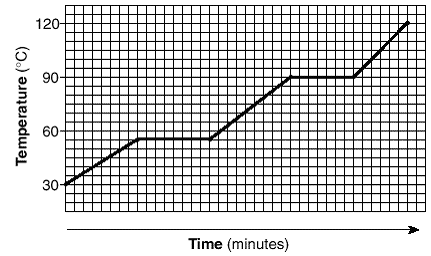
What is the melting point of this substance?
- 30°C
- 55°C
- 90°C
- 120°C
What is... 55°C
400
An atom of carbon-12 and an atom of carbon-14 differ in
- atomic number
- mass number
- nuclear charge
- number of electrons
What is... mass number
400
In which type of reaction do two or more substances combine to produce a single substance?
- synthesis
- decomposition
- single replacement
- double replacement
What is... synthesis
400
Which symbol represents an atom in the ground state with the most stable valence electron configuration?
- B
- O
- Li
- Ne
What is... Neon
Noble gases have stable electron configurations
400
When a mixture of water, sand, and salt is filtered, what passes through the filter paper?
- water, only
- water and sand, only
- water and salt, only
- water, sand, and salt
What is...
Water and salt only
400
The particles in which sample of LiCl(s) have the same average kinetic energy as the particles in a 2.0-mole sample of H2O( ) at 25°C?
- 1.0 mol at 75°C
- 2.0 mol at 50.°C
- 3.0 mol at 25°C
- 4.0 mol at 0°C
What is... 3.0 mol at 25°C
500
The strength of an atom’s attraction for the electrons in a chemical bond is the atom’s
- electronegativity
- ionization energy
- heat of reaction
- heat of formation
What is... electronegativity
500
An ionic compound is formed when there is a reaction between the elements
- strontium and chlorine
- hydrogen and chlorine
- nitrogen and oxygen
- sulfur and oxygen
What is...
strontium and chlorine (metal and a nonmetal)
500
Which statement describes how an atom in the ground state becomes excited?
- The atom absorbs energy, and one or more electrons move to a higher electron shell.
- The atom absorbs energy, and one or more electrons move to a lower electron shell.
- The atom releases energy, and one or more electrons move to a higher electron shell.
- The atom releases energy, and one or more electrons move to a lower electron shell.
The atom absorbs energy, and one or more electrons move to a higher electron shell.
An electron in its lowest possible energy level is in the ground state. The atoms absorb energy, and one or more electrons will move to a higher electron shell.
500
Which list of elements contains two metalloids?
- Si, Ge, Zr, Pb
- As, Bi, Br, Kr
- Si, P, S, Cl
- Zr, Sb, I, Xe
What is... Si, Ge, Zr, Pb
Metalloids touch the "staircase" on the periodic table
500
Each diagram below represents the nucleus of a different atom.
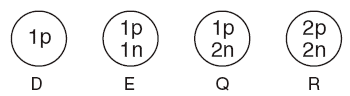
Which diagrams represent nuclei of the same element?
- D and E, only
- D, E, and Q
- Q and R, only
- Q, R, and E
What is...
D, E, and Q