What is Science?
Phases of Matter and Phase Shifts
Matter Trees
Physical vs Chemical Properties & Changes
Accuracy vs precision, sig figs, and Scientific notation
100
It is typically the first step of the scientific method, triggered by looking at the world around you.
What is an observation?
100
This state of matter has a definite shape and a definite volume, with particles tightly packed and vibrating in place.
What is a solid?
100
At the very top of the matter classification tree, matter is broadly split into two main branches: mixtures and these.
What are pure substances?
100
Bending a paperclip or chopping wood represents this type of change, where the form of matter alters but its chemical identity stays the same.
What is a physical change?
100
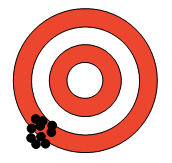
This bullseye demonstrates a certain kind of Accuracy and Precision.
What is low accuracy and high precision?
200
This educated guess or prediction is often formatted as an "If... then..." statement.
What is a hypothesis?
200
This phase change occurs when a liquid absorbs enough thermal energy to turn into a gas.
What is vaporization? (or boiling/evaporation)
200
This branch of pure substances consists of only one type of atom and cannot be broken down further by chemical means.
What is an element?
200
Rusting iron or baking a cake represents this type of change, where a substance reacts to form entirely new matter with new properties.
What is a chemical change?
200
This format allows scientists to easily write extremely large or small numbers by multiplying a coefficient between 1 and 10 by a power of 10.
What is Scientific Notation?
300
This factor is measured or observed to see how it responds to the manipulated changes.
What is the dependent variable?
300
Dry ice (solid carbon dioxide) skips the liquid phase entirely to become a gas through this dramatic process.
What is sublimation?
300
Formed when two or more elements chemically combine in a fixed ratio, this pure substance sits on the branch right next to elements.
What is a compound?
300
This chemical property describes how easily a substance will catch fire and burn in the presence of oxygen.
What is flammability? (or combustibility)
300
This value has a certain amount of significance figs: 298,100,00
What is 4 sig figs?
400
This term describes a well-substantiated, deeply tested explanation of the natural world, like gravity or evolution.
What is a scientific theory?
400
This shift occurs when water vapor in the air touches a freezing cold windshield and immediately turns into solid frost.
What is deposition?
400
This specific type of mixture, like salt water or air, has a uniform composition throughout and is found on the "mixtures" branch.
What is a homogeneous mixture? (or a solution)
400
This chemical property refers to the degree to which a substance can damage or harm organisms, tissues, or cells.
What is toxicity?
400
This value has to be rounded up to 3 sig figs: 566,800,000
What is 567,000,000
500
Unlike a theory, this is a descriptive statement or mathematical equation that reliably predicts what will happen under specific conditions.
What is a scientific law?
500
In these two states, matter does take the shape of a container.
What are Liquids and Gases?
500
This law states that a chemical compound always contains its component elements in a fixed, unchanging ratio by mass, keeping the compound branch predictable.
What is the law of definite proportions? (or Proust's law)
500
Calculated by dividing an object's mass by its volume, this physical property remains constant for a pure substance regardless of sample size.
What is density?
500
This value has to be written into Scientific Notation: 0.006504
What is 6.504 x 10⁻³