Civics
Unit 3 Civics
3rd Unit
C3
Also Civics Unit 3
100
The statement below is from a historical document.
Our current American political system reflects the content of the statement above in what way?
The president reviews legislation.
The Supreme Court enacts policies.
The Electoral College selects the Senate.
The voters elect Congressional members.
The voters elect Congressional members.
100
The passage below is from Federalist No. 47 written by James Madison in 1788.
Based on this passage, which constitutional principle does Madison describe?
judicial review
popular sovereignty
checks and balances
separation of powers
checks and balances
100
What check does the president have on Congress?
appointing judges
vetoing legislation
declaring laws unconstitutional
refusing to confirm appointments
vetoing legislation
100
How is living in a society run by the rule of law beneficial?
Government bureaucracy is reduced.
The will of the majority dictates government decisions.
Property rights are more important than individual freedoms.
People are protected from arbitrary and tyrannical government.
People are protected from arbitrary and tyrannical government.*
100
The statement below was made by Thomas Jefferson in a 1786 letter to John Jay.
Why should this freedom be guarded?
to provide the news media with a guaranteed profit
to keep the news media from controlling the political process
to provide the government with an accurate information source
to keep the government from becoming the primary information source
to keep the government from becoming the primary information source*
100
Which three rights are guaranteed by the Bill of Rights?
freedom of the press; freedom of religion; right to bear arms
right to bear arms; right to an education; right to a speedy trial
freedom of speech; right to vote; right to petition the government
freedom of religion; right to petition the government; right to work
freedom of the press; freedom of religion; right to bear arms*
100
Details about the United States government are diagramed below.
Which phrase completes the diagram?
The President using his powers as Head of State.
The President using his powers in relation to Congress.
The President using his powers as Commander in Chief.
The President using his powers as Chief Executive Officer.
The President using his powers in relation to Congress.*
100
What has been one long-term result of the constitutional protection of free speech?
a more informed society
a more accurate election
fewer laws limiting minority rights
fewer court cases involving minors
a more informed society*
100
How did the U.S. Supreme Court’s decision in Marbury v. Madison expand the role of the courts in the American system of government?
It established the right of the Supreme Court to expand its jurisdiction.
It expanded the role of the judicial branch by establishing judicial review.*
It allowed the Supreme Court to offer advisory opinions to the President.
It upheld the rights of the judicial branch to approve all lower court appointments.
It expanded the role of the judicial branch by establishing judicial review.*
100
The diagram below shows the steps in how a bill becomes a law
Which statement provides the next step in the process?
The bill is sent to a conference committee.
The bill is sent to the other house of Congress.
The bill is approved by three-fourths of the Congress.
The bill is approved by the President of the United States.
The bill is sent to the other house of Congress.*
100
Susan was accused of stealing items from a local convenience store. She was found “not guilty” by a jury during her trial. A month later, the manager of the store found a video recording showing Susan shoplifting the items. He took the new evidence to the prosecuting attorney. What will be the result of the new evidence?
As a result of the new evidence, Susan will be found “guilty”.
Susan cannot be retried for the crime because this would be double jeopardy.*
Since Susan was not read her rights before the taping, she cannot be convicted.
By showing Susan the evidence the prosecutor will have her confess to the crime.
Susan cannot be retried for the crime because this would be double jeopardy
100
Which of these actions is an example of an individual exercising a constitutional right?
double jeopardy
civil disobedience
forced internment
quartering soldiers
civil disobedience*
100
Which of the following statements describes concurrent powers?
The state governments lead and the federal government follows.
The federal government rules supreme over the state governments.
The federal government shares powers with the state governments.
The state governments follow standards set by the federal government.
The federal government shares powers with the state governments.*
100
The passage below is from the U. S. Supreme Court decision in Brown v. Board of Education (1954).
What was the impact of this U. S. Supreme Court decision?
States continued to ensure economic and social equality.
States were forced to end all segregation in public schools.
States ended segregation in elementary schools, but not high schools.
States could maintain separate schools if they were of equivalent quality.
States were forced to end all segregation in public schools.*
100
The passage below is from the U. S. Supreme Court decision in Tinker v. Des Moines (1969).
What was the conclusion of the U. S. Supreme Court in this case?
School sponsored publications could be censored.
Even in a school setting, students were entitled to free speech rights.
Statements that specifically identified other students could not be published.
Critical statements of government policies could not be published by students.
Even in a school setting, students were entitled to free speech rights.*
100
The statement below was made by Justice Oliver Wendell Holmes in the case of Schenck v. United States (1919).
What is the significance of the U. S. Supreme Court opinion statement above?
The Constitution limits individual rights.
The Constitution does not limit individual rights.
The Constitution allows expansion of individual rights.
The Constitution does not allow expansion of individual rights.
The Constitution limits individual rights.*
100
The graph below describes voter registration in Florida among blacks and whites.
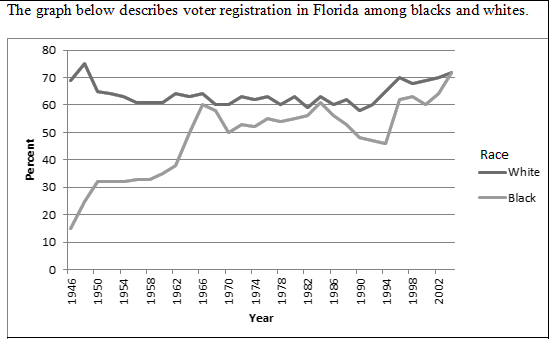
Using the information in the graph above, what inference can be made concerning voter turnout in Florida since the passage of the Voting Rights Act of 1965?
There has been a greater increase in voter involvement among blacks.
There has been a greater increase in voter involvement among whites.
There has been a greater decrease in voter involvement among blacks.
There has been a greater decrease in voter involvement among whites.
There has been a greater increase in voter involvement among blacks.*
100
According to the Constitution, what steps would be followed if there is convincing evidence that the President of the United States has committed treason?
The President would be forced to resign after being arrested.
The Supreme Court would impeach the president after a trial.
The President must be convicted in a court of law before being removed from office.
The House would impeach the President before the Senate would remove him from office.
The House would impeach the President before the Senate would remove him from office.*
100
Which of the following statements is an example of a Tenth Amendment issue?
War is declared by state governments.
Currency is created by state governments.
Elections are administered by state governments.
Trade agreements are set by the state governments.
Elections are administered by state governments.*
100
The most common method of amending the U. S. Constitution is shown in the diagram below.
Which statement provides the missing step in the diagram?
A constitutional convention is held by two-thirds of the states.
The amendment is approved by the President of the United States.
The amendment is ratified by three-fourths of the state legislatures.
Three-fourths of the House of Representatives ratify the amendment.
The amendment is ratified by three-fourths of the state legislatures.*