Chapter 1
Chapter 2
Chapter 3
Chapter 4
Chapter 5
Chapter 6
100
What does the Pythagorean Theorem say
and
on what kind of triangle can we apply it?
Pythagorean Theorem
a2+b2=c2
We can only use it on RIGHT triangles.
100
Draw one period/ one cycle of the graph
y=- sin x

100
Write each expression in terms of sines and/or cosines, and then simplify.
tan x/secx
sin x
100
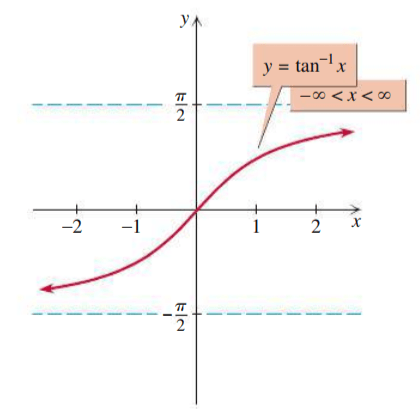
Graph
y=tan^{-1}(x)
Domain:
Range
Domain:
(-infty,\infty)
Range:
(-pi/2,pi/2)
Graph:
100
Determine the number of triangles with the given parts and solve the triangle.
\alpha=39.6^\circ,c=18.4, a=3.7
none
100
Perform the indicated operations with the complex numbers.
a.
(-2+3i)+(-4-9i)
b.
2i(3+i)
c.
(-3i)^2
a.
-6-6i
b.
-2+6i
c.
-9
200
Convert the radian measure to degree measure. DO not use calculator.
(5pi)/3
300^\circ
200
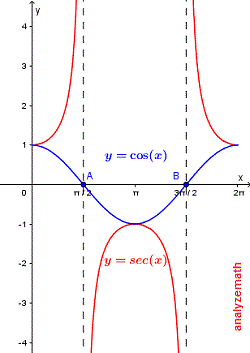
Draw one period/ one cycle of the graph y=sec(x).
200
Simplify each expression.
(1+sin(\alpha))(1+sin(-\alpha))
cos^2(\alpha)
200
Find the exact value of each expression without using a calculator or table.
a.
sin^{-1}(1/sqrt2)
b.
arcsin(1)
c.
cos^{-1}(-\sqrt3/2)
a.
pi/4
b.
pi/2
c.
(5pi)/6
200
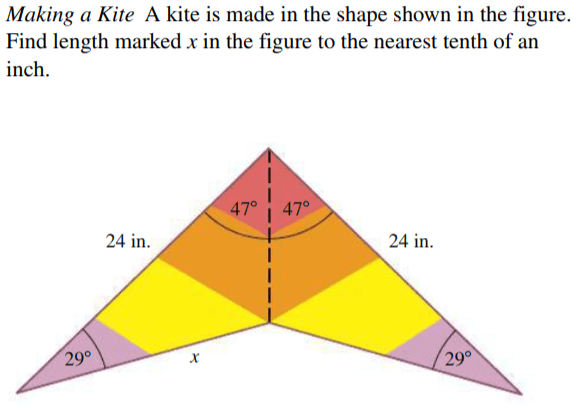
x=18.1 inches
200
Write the complex number in trigonometric form, using degree measure for the argument.
-\sqrt3+i
2(cos 150^\circ+isin 150^circ)
300
Find two positive and two negative angles using radian measure that are coterminal with
\pi/6
1.
(13\pi)/6
2.
(25\pi)/6
3.
-(11\pi)/6
4.
-(23\pi)/6
300
Which of the following equations will shift y=cos(x)
1. 3 units up 2. Amplitude is 2
3. Reflect it about the x-axis
4. to the right
pi/6
y=-2cos(x-pi/6)+3
300
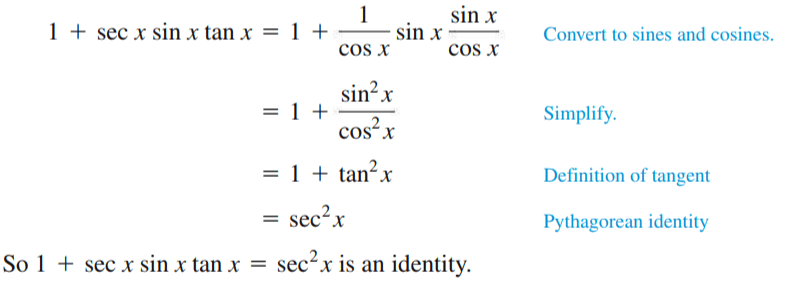
Verify the identity.
1+sec x sin x tan x = sec^2 x
300
Find all solutions, in degrees or radians:
tan \alpha=1
Degrees:
{\alpha|\alpha= 45^\circ+k180^\circ}
Radians:
{\alpha|\alpha=pi/4+pik}
300
Solve the triangle. Round to the nearest tenth.
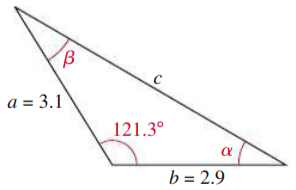
\alpha=30.4^circ, beta=28.3^circ,c=5.2
300
For the polar equation, write an equivalent rectangular equation.
r=1/(sin theta+cos theta)
x+y=1
400
Find the exact value of tan x if cos x=-(2/3) and x is not in quadrant III.
tan x=(-\sqrt(5))/2
400
Write an equation of the form y=Asin[B(x-C)]+D whose graph is the given sine wave.
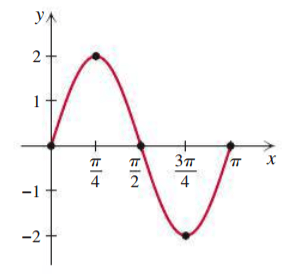
y=2sin(2x)
400
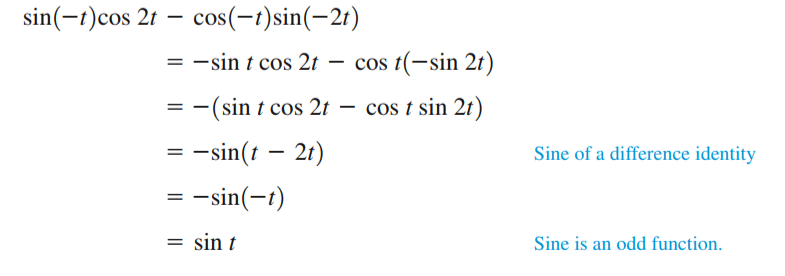
Prove the identity.
sin(-t)cos(2t)-cos(-t)sin(-2t) = sin t
400
Find the inverse of the function and state the domain and range of inverse function.
f(x)=1+tan(pi/2x) -1<x<1
Domain:
(-infty,infty)
Range:
(-1,1)
f^{-1}(x)=2/pitan^{-1}(x-1)
400
Let r=<3,-2> and t=<4,-6>
Find 2r+3t and write vectors in the form <a,b>
<18,-22>
400
Simplify each expression, by using trigonometric form and DeMoivre's theorem.
(\sqrt3-i)^4
-8-8i\sqrt3
500
Assume x is an angle in standard position.
Find the quadrant in which x lies if you know that
sin x >0 and sec x <0
Quadrant II
500
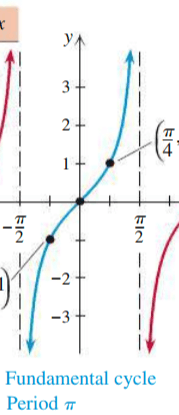
Graph one cycle of y=tan(x)
Period:
Domain:
Range:
Asymptotes:
Period:
pi
Domain:
(-pi/2,pi/2)
Range:
(-\infty,\infty)
Asymptotes:
x=-pi/2, x=pi/2
Graph:
500
Prove the identity.
2sin^2(x/2)=sin^2 x/(1+cos x)
use
sin (x/2)=\pm \sqrt((1-cos x)/2)
500
Find all solutions to the equation in the interval
[0,2pi]
sin(2x)+sin(pi/2-x)=0
{(7pi)/6,(11pi)/6,pi/2,(3pi)/2}
500
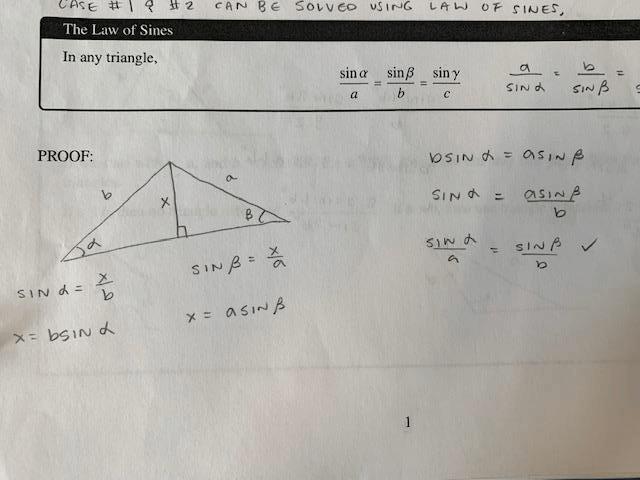
Prove the law of sines.
500
Find all complex solutions to the equation. express answers in the form a+bi.
ix^2+3=0
\sqrt6/2+\sqrt6/2i, -\sqrt6/2-\sqrt6/2i,