Sampling (Ch6)
Survey Design
(Ch 8)
(Ch 8)
Descriptive Statistics (Ch 9)
Testing for Differences
(Ch 10)
(Ch 10)
SPSS WILDCARD
100
•Beth wants to study how the people at her work feel about the employee cafeteria. She starts by getting a list of everyone in her company from H.R. This list of everyone who could possibly be included in her study is a _______________.
Sampling Frame p. 107
Also know the relationship between population/sampling frame/sample & generalizability
100
•Of the following, which is NOT a continuous variable:
–A. Ordinal
–B. Nominal
–C. Likert
–D. Semantic Differential
–E. Ratio
B. Nominal (this is nominal/discrete/categorical) p.86-88; 153-154
100
•What are the three measures of central tendency?
Mean, Median & Mode (p. 173-174). Make sure you can define each.
100
•Jim has conducted a survey of employee satisfaction with healthcare at his work. He wonders if men and women differ in their reported relationship status (married, partnered, dating, single). If Jim wants to test the differences in two nominal variables, he should use the ___________ test.
Chi-Square test (X2) - see p. 189-190
100
•Amy asked faculty at BYU how they felt like they were treated by the university.
–Scale 1 = Very well; 9 = Very Poorly.
•She then ran descriptive statistics on her data:

•Given this output, what is her 𝑥 ̅? (that should be a letter x with a line over top of it)
the 𝑥 ̅ (that should be a letter x with a line over top of it) is a symbol that stands for mean (average). In that chart, the average/mean score is 2.06.
so the correct answer is 2.06.
200
•Weber wants to survey its students about student satisfaction. To do so, students are first divided by class (freshmen, sophomores, etc.) Weber then randomly select participants from EVERY group. What kind of sampling are they using?
Stratified Random Sample p. 112-113
Make sure to distinguish this from a Cluster Random sample in your mind.
200
•Identify the following type of data:
I believe that my doctor clearly communicated the treatment plan to me.
1=Strongly Agree
2=Agree
3=Neutral
4=Disagree
5=Strongly Disagree
Likert (Interval Scale), p. 154-156
200
•What are the two measures of dispersion?
Range & Standard Deviation (p. 175-177).
Make sure you can define each.
200
•Mary wants to collect data on how men and women rate their listening abilities. She asks 50 men and 50 women a series of scale questions about their listening. If she wants to test whether men and women report different scores on her listening scales, what test would Mary use?
Independent t-test (see p. 193)
200
•Amy asked faculty at BYU how they felt like they were treated by the university. She then ran descriptive statistics on her data:
–Scale 1 = Very Well; 9 = Very Poorly

What was Amy's sd on this question?
sd= standard deviation.
on this question, the sd = 1.934
300
Lynn is searching for people to participate in her study on second marriages. As such, she intentionally asks people she knows who have remarried to participate in her study. Which sampling strategy is characterized by the researcher selecting a person to be in the study because the person is thought to be a good example of the type of person desired for the research study?
Convenience or Purposive or Network (any are correct -- the key is just to know this is nonrandom). p. 114, 116
300
•All of the questions on Bens survey are followed by a list of answer choices. Because Ben does not allow his participants to answer any questions in their own words, all of Ben’s questions are _________ questions.
Closed Ended 153-154
300
•Annabeth is doing a clinical trial for a new medication. Because the dangers of being wrong are so great, she has decided to only accept a 1% error rate. As a result, she sets her ___________ at .01.
Significance Level (see p. 180)
300
•Alia is teaching Comm 3150 next semester, and she wants to know if her students really learned information about research over the semester. So, she plans to give her students a pre-test and post-test for the class and then compare the scores. What test would you use to compare a group to itself (the same students) on a continuous score?
paired-sample t-test p. 193
300
•Dan hypothesized that at his company, women were more likely than men to have taken a vacation in the past month. He used a Chi-Square test to test his hypothesis. Given these results, was his hypothesis supported. Why or why not?
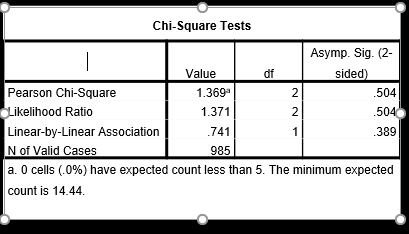
X2 = 1.369
p = .504
No, his hypothesis is rejected because p=.504>.05
400
•Tiffany decides to survey students in the union about their opinion of the WSU bookstore. She selects a random number (n), and then she speaks to every nth person who walks in the door. What kind of sample is she using?
Systematic Random Sample p. 112
400
•What does it mean to pilot test a survey? (and why would you do it?)
See p. 159-161
400
•For the following hypothesis, what is the NULL hypothesis?
–H1: Freshman are more likely than other students to rate classes at WSU as “difficult.”
Freshman are less likely or equally likely than other students to rate classes at WSU as difficult.
see discussion of null/alternative on p. 70; 181-183
400
•Logan is teaching Comm 3000 and he is interested in whether the Freshman, Sophomores, Juniors and Seniors in his class differ in their final exam scores. This type of statistical test is performed to determine if there are differences between two or more different groups of the independent variable on a continuous level dependent variable.
One-Way Anova (p. 198)
400
Matt decided to test whether male students and female students differed in their overall satisfaction with the current WSU fall break. He used a t-test to test his hypothesis. Given these results, was his hypothesis supported. Why or why not?
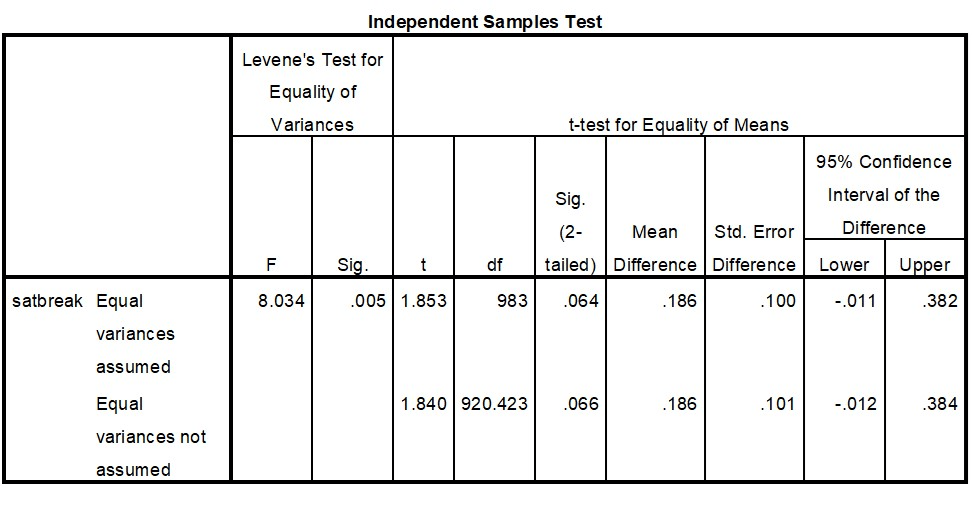
t = 1.853
p = .064
No, his hypothesis is NOT supported because p = .064> .05 (so reject)
500
•Alan decides that he wants to survey parents at his daughter’s school about the desire for after-school programs. He puts everyone's name into a hat and draws 10 names. Every person has an equal chance of being selected; individuals are selected one at a time and independently. What kind of sample is Alan using?
Simple Random Sample p. 111-112
500
•What are the disadvantages of online surveys (as compared to paper-and-pencil surveys)?
See Chart 8.1 p. 150
500
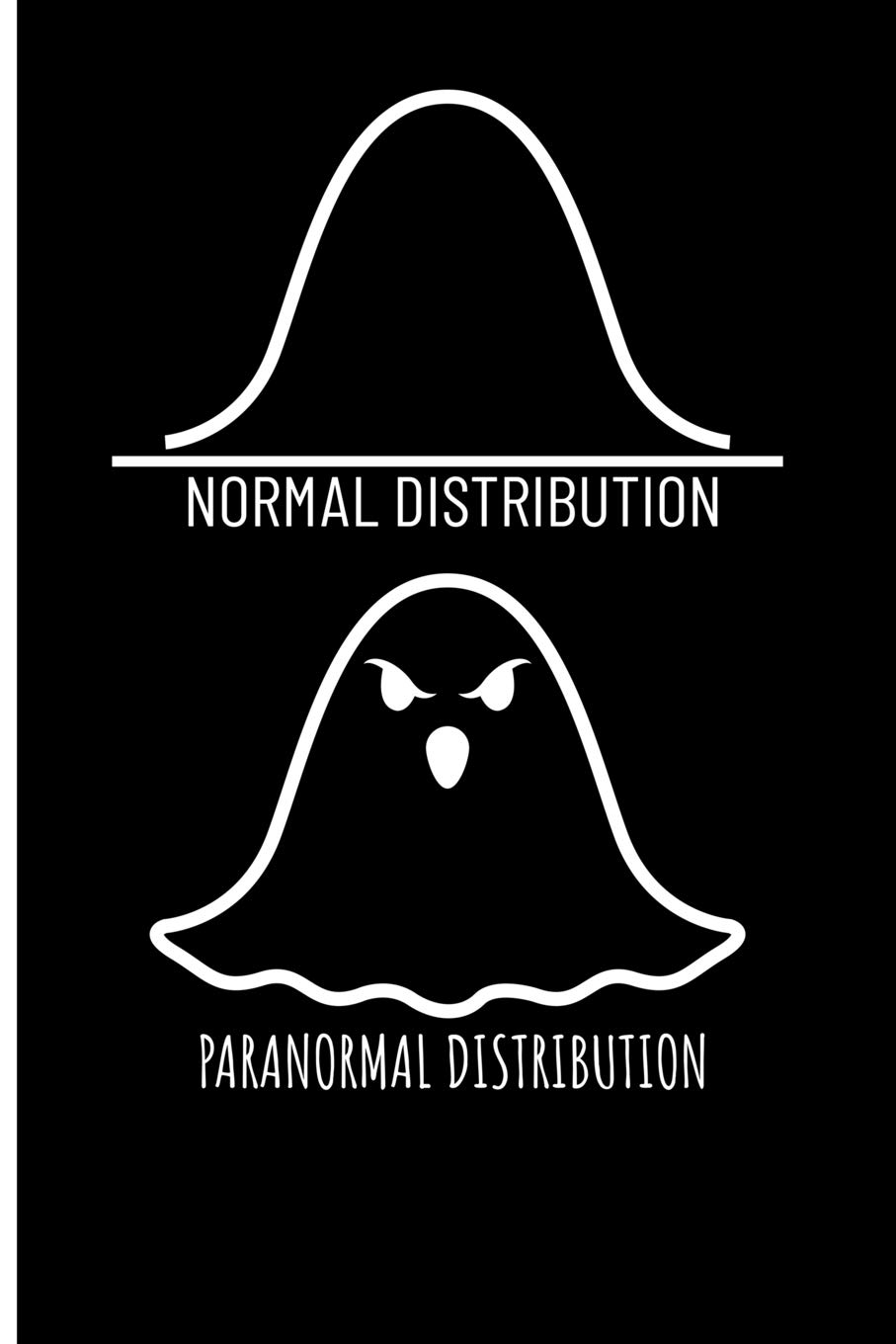
•Explain why a curve representing the sample might be “skewed” instead of “normal.”
500
•ANOVA stands for:
Analysis of Variance (symbol F) p. 195-198
500
Jordan decided to test the hypothesis that different types of employees (faculty, staff, etc.) at WSU differed in their opinion of WSU’s current fall break. He ran an ANOVA to test his hypothesis. Given these results, was his hypothesis supported? Why or why not?
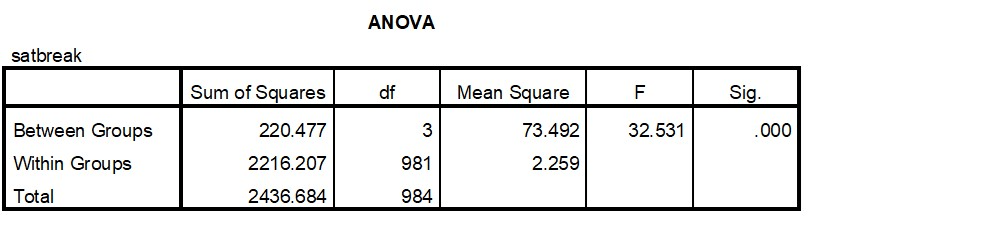
F = 32.531
p = .000
Yes, the hypothesis is accepted because P = .000 < .05