S
N
O
W
Y
100
Why is random sampling important?
A) It ensures the sample is biased
B) It allows accurate conclusions about a population C) It guarantees identical answers
D) It makes the survey take longer
B) It allows accurate conclusions about a population
100
Marcus surveyed students in the cafeteria. He chose students at random and recorded the color of their backpacks.
B G R B G
R B G B R
G B R G B
B R B G G
KEY
B = black
G = gray
R = red
Based on the sample, what is the least common backpack color in the school?
Count each color:
Black (B): 8
Gray (G): 6
Red (R): 6
Least common color: Gray and Red (tie)
100
On a box and whisker plot, Q2 is also referred to as what?
Median
100
Which of the following can you not find from a box and whisker plot?
A. Q1
B. Mean
C. Q2
D. Minimum
E. Maximum
F. Q3
B. Mean
You cannot find the mean from a box and whisker plot. You can, however, find Q1, Q2, Q3, Minimum, and Maximum
100
What's the perimeter of the following shape?
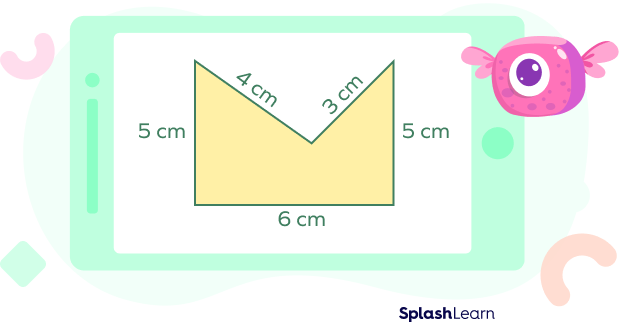
23 cm
Perimeter = 5cm+4cm+6cm+5cm+3cm
200
Maya wants to know how many of the 300 sixth graders at her school walk to school each day. Which is the best method for her to use?
A. Survey 30 students who live in her neighborhood.
B. Survey 30 students randomly selected from the school band.
C. Survey 30 students randomly selected from a list of all sixth graders.
D. Survey 30 students who Maya sees walking to school.
C. Survey 30 students randomly selected from a list of all sixth graders.
200
A student wants to estimate how many minutes 7th graders spend exercising each day. Which method is most reliable?
A) Surveying her best friends
B) Asking all students in her PE class
C) Randomly selecting 25 students from the 7th-grade roster
D) Asking only students on sports teams
C) Randomly selecting 25 students from the 7th-grade roster
200
Which option is the best example of a random sample?
A) Asking only people in your homeroom
B) Choosing every 12th name from a list
C) Asking students who sit near you at lunch
D) Surveying only students in band
6. B: Choosing every 12th name is systematic, which is a type of random sampling.
200
Is the following an unbiased or biased situation? Why?
Marcus wants to find out the most popular sport at his school. He decides to ask six members of the school’s basketball team during practice what their favorite sport is. Since all of them say “basketball,” Marcus concludes that basketball is the most popular sport in the entire school.
Biased because he asked BASKETBALL players what their favorite sport is.
To make the situation unbiased, Marcus could've randomly chosen 5 students from each homeroom.
200
Emma is buying coffee at a café. The first cup costs $2.50, and each additional cup costs $1.00. Emma has $6.50 to spend on coffee. How many cups of coffee can she buy?
She can buy up to 4 cups of coffee.
1.00x + 2.50 ≤ 6.50
Step 1: Subtract 2.50 from each side
Step 2: 1.00x ≤ 4.00
Step 3: Divide both sides by 1
300
True or False: A box-and-whisker plot shows every single data point.
True or False: The interquartile range (IQR) tells how spread out the middle 50% of the data is.
True or False: The whiskers always show the mean (average).
True or False: In a box plot, the maximum value is always inside the box.
True or False: The median divides the data into four equal parts.
False: A box-and-whisker plot shows every single data point.
True: The interquartile range (IQR) tells how spread out the middle 50% of the data is.
False: The whiskers always show the mean (average).
False: The maximum value is always inside the box.
False: The median divides the data into four equal parts.
300
A notebook cost the store $1.20. Find the price of the notebook if it is sold with a 50% markup.
A. $1.50
B. $1.70
C. $1.80
D. $2.40
Correct Answer: C. $1.80
Cost: $1.20
Markup: 50% of 1.20 = 0.50 × 1.20 = $0.60
Selling Price: 1.20 + 0.60 = $1.80
300
A smoothie shop offers three popular flavors: strawberry, mango, and blueberry. The employees surveyed 60 customers at random about their favorite smoothie flavor. The results are shown in the table below.
Strawberry 28 ; Mango 20 ; Blueberry 12
Based on the sample, which flavor is the least preferred?
Blueberry
300
A school wants to know the average number of snacks students eat after school. They select every 10th student who enters the cafeteria. What type of sampling is this?
A) Convenience sampling
B) Random sampling
C) Voluntary response
D) Systematic sampling
D) Systematic sampling: "They select every 10th student who enters the cafeteria."
Having a SYSTEM for how to conduct the sample
300
Maria has 200 stickers. She decides to keep 40 for herself and divide the rest equally among 10 of her friends. How many stickers will each friend receive?
Each friend will get 16 stickers!
200 - 40 =160
160/10 = 16
400
Find the following based on the data set below:
16, 12, 4, 3, 16, 95, 24, 39, 67, 41
Mean:
Median:
Range:
Q1:
Q3:
IQR:
Sorted: 3, 4, 12, 16, 16, 24, 39, 41, 67, 95
Mean: 31.7
Median: 20
Range: 92
Q1: 12
Q3: 41
IQR: 29
400
Which action would reduce the variability of a sample mean?
A) Taking a smaller sample
B) Taking a larger sample
C) Sampling only volunteers
D) Using only students in one class
B) Taking a larger sample
400
What is the range of 1st period and 2nd period?
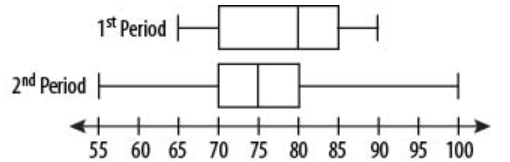
1st Period: 25
2nd Period: 45
400
Carlos is buying a pair of shoes that regularly cost $80. The store is offering a 30% discount on the regular price. After the discount is applied, a 7% sales tax will be added to the purchase.
How much will Carlos pay for the shoes, including tax?
Carlos will pay $59.92 for the shoes.
Step 1: Find the discount amount
Regular price = $80
Discount = 30% of $80 = 0.30 × 80 = $24
Step 2: Subtract the discount to get the sale price
Sale price = 80 − 24 = $56
Step 3: Calculate sales tax
Sales tax = 7% of 56 = 0.07 × 56 = $3.92
Step 4: Add tax to the sale price
Total price = 56 + 3.92 = $59.92
400
How do you find the area of a rectangle?
How do you find the perimeter?
Area = length times width (l*w)
Perimeter = add up all the sides
500
A backpack used to cost $45.00, but now sells for $54.00. Calculate the percent increase in price.
Answer: 20% increase
Step 1: Find the increase in price
New price − Original price = 54 − 45 = $9
Step 2: Calculate the percent increase
increase / original price x 100
9 /45 x 100 = 0.2 x 100 = 20%
500
A smoothie shop offers three popular flavors: strawberry, mango, and blueberry. The employees surveyed 60 customers at random about their favorite smoothie flavor. The results are shown in the table below.
Strawberry 28 ; Mango 20 ; Blueberry 12
Based on the sample, if the shop orders 200 pieces of smoothie, _____ pieces will be mango.
20 / 60 = x / 200
x = 66.67
About 67 pieces will be mango
500
The price of a loaf of bread was $4.00. The price went up by 25% and then went down by 25%. Sophia thinks that since the price both rises and falls by 25%, the price of the bread is back to $4.00. Her teacher tells her that she is incorrect.
Explain why Sophia’s reasoning is incorrect.
Determine the price of a loaf of bread after the 25% increase and 25% decrease.
Sophia is incorrect because the 25% decrease is taken from the new price ($5.00), not the original price ($4.00). A percent decrease after a percent increase does not return the value to its original amount.
Final price of the bread = $3.75
$4.00 x .25 = 1
$4.00 + $1.00 = $5
$5 x .25 = $1.25
$5 - $1.25 = $3.75
500
The graph below shows a random sampling of players’ heights in a junior basketball league.
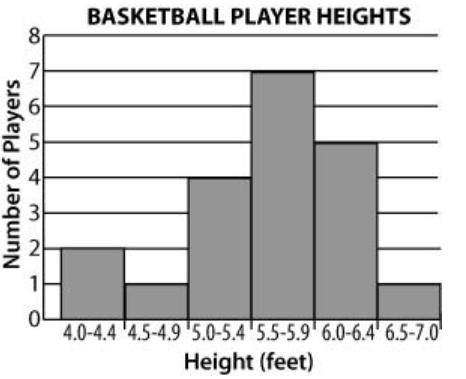
There are a total of 240 players in the league. Based on the sample, how many of the players in the league have a height more than 5.4 feet?
x / 240 = 13 / 20
x=156
156 players are more than 5.4 feet
500
In the morning, the temperature in the city was 10 °C. By noon, the temperature had dropped 8 °C. Two hours later, it dropped 5 °C more. What increase in temperature is needed to return to the original temperature of 10 °C?
An increase of 13 °C is needed to return to the original temperature.
Step 1: Find the total decrease in temperature
First drop: 8 °C
Second drop: 5 °C
Total decrease = 8 + 5 = 13 °C
Step 2: Find the temperature after the decreases
Original temperature = 10 °C
After decrease = 10 − 13 = −3 °C
Step 3: Find the increase needed to return to the original temperature
Increase needed = 10 − (−3) = 10 + 3 = 13 °C