Diffusion
Osmosis
Membrane Structure
Transport
Everything
100
What is diffusion?
The movement of particles from an area of high concentration to an area of low concentration
100
What is it called when the outside solution has a higher concentration of solute compared to inside the cell, and what happens to the cell?
Hypertonic, the cell will shrink
100
Which macromolecule are cell membranes made of?
Lipids (phospholipids)
100
What is passive transport and what are the three types?
The movement of substances across a cell membrane without the use of cellular energy (ATP), moving from an area of higher concentration to an area of lower concentration //simple diffusion, facilitated diffusion, osmosis
100
Why does water have trouble passing through the membrane?
Because the membrane has a hydrophobic portion
200
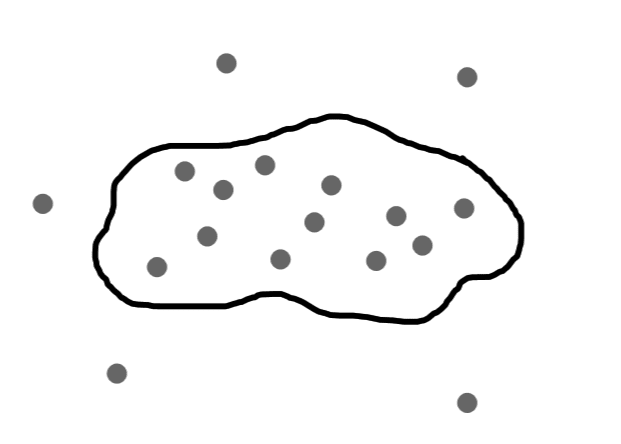 Based on this picture, where will the particles move?
Out of the cell
200
What is it called when the outside solution has a lower concentration of solute compared to the cell, and what happens to the cell?
Hypotonic, the cell will swell and possible burst
200
What do we call the cell membrane, and how many layers are there?
The Phospholipid Bilayer, 2
200
What is the movement of small, non-polar molecules directly through the cell membrane from an area of higher concentration to an area of lower concentration
Simple diffusion
200
How is water transported through the membrane?
Water is very small, and it can occasionally pass through the membrane from simple diffusion in small amounts OR in larger amounts, aquaporins (transport proteins) allow water to pass through them in larger amounts and more efficiently through facilitated diffusion
300
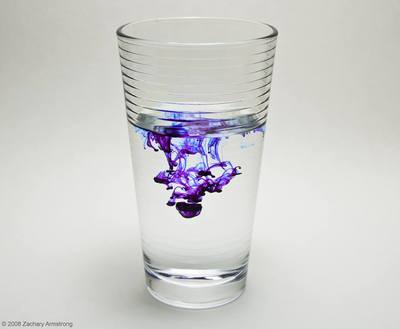 Where is there a low concentration of dye?
At the bottom of the glass
300
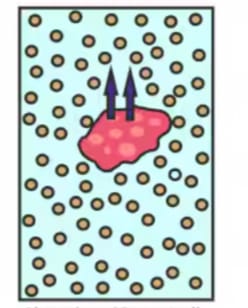 This image is showing what kind of an outside solution?
Hypertonic
300
What are the two parts of the phospholipid?
The phosphate head and the fatty acid tail
300
What is the process where cell membranes move larger or polar/charged molecules across the cell membrane from an area of higher concentration to an area of lower concentration, and what do membranes use to help that process?
Facilitated diffusion, transport proteins
300
How are passive and active transport like riding a bike?
For a cell, moving materials through the cell membrane by passive transport is like cycling downhill (moving from high --> low)
Active transport requires the cell to use its own energy, its like cycling uphill (moving from low --> high)
400
Give an example of diffusion
Food dye, tea, air freshener, perfume, etc.
400
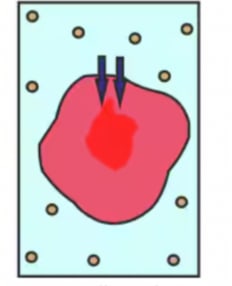 This image is showing what kind of an outside solution?
Hypotonic
400
The phosphate head is... and the fatty acid tail is...
Phosphate head is hydrophilic and the fatty acid tail is hydrophobic
400
What is active transport?
The movement of substances across a cell membrane from an area of lower concentration to an area of higher concentration using energy (ATP) and transport proteins
400
What is homeostasis?
The process by which an organism maintains a stable internal environment (such as temperature, pH, and concentrations of substances) despite changes in the external environment
500
What is osmosis?
Diffusion of water through a membrane
500
What happens in an isotonic solution?
Water moved into and out of the cell equally, so the cell stays the same size. There is the same concentration of solute outside the cell as there is inside the cell.
500
Why is the cell membrane semi permeable?
Because there is a hydrophilic and a hydrophobic portion that only allows certain kinds of materials through
500
What is bulk transport and what are the two types (explain them)
When larger molecules can be transported by movements of the cell membrane
Endocytosis: process of taking materials into the cell
Exocytosis: process of cells releasing material out of the cell
500
How does the cell membrane help to keep homeostasis in the body?
- Passive transport: helps move substances into balance without using energy
- Oxygen diffuses into cells where it’s low
- Water moves in or out to keep cells from shrinking or bursting
- Facilitated diffusion: allows necessary molecules that can’t pass through the membrane on their own to still enter or leave cells when needed
- Salt, glucose
- Active transport: uses energy to move substances against the concentration gradient, which is essential for:
- Nerve cell signaling
- Muscle contraction