Pathogen Detective
Transmission Station
Outbreak Alert
Immune System
Treatment and Prevention
Final Jeopardy
100
A student has a respiratory illness. The doctor says antibiotics will not help because the illness must run its course.
What type of pathogen most likely caused the illness?
Virus
100
Malaria is transmitted by this organism.
Mosquito
100
An infectious disease spreads rapidly throughout several neighborhoods in Boston but does not spread widely outside the region.
Is this most likely an epidemic or pandemic?
Epidemic
100
These proteins recognize specific pathogens and help the body fight them.
Antibodies
100
Antibiotics are used to treat infections caused by what type of pathogen?
Bacteria
100
THE OUTBREAK
A new infectious disease appears in a city.
Over four weeks:
- Cases increase each week.
- People travel to other cities and countries.
- Cases eventually appear in multiple countries.
- Health officials recommend handwashing, staying home when sick, and avoiding close contact.
- Cases begin decreasing.
Your team must answer THREE questions:
1. What type of pathogen could cause the disease?
2. How could the disease spread?
3. What evidence suggests that public health measures may have worked?
🏆 FULL-CREDIT ANSWER
Answers will vary for #1 and #2, but students must provide scientifically reasonable evidence. For #3, students should identify the decrease in cases after the public health measures were introduced. This matches the reasoning students are expected to use on the test.
200
A pathogen reproduces using spores.
What type of pathogen is it most likely?
Fungus
200
A person with the flu coughs near another person, who later becomes sick.
What is the most likely mode of transmission?
Respiratory droplets/airborne transmission
200
A disease spreads across many countries and continents.
What term describes this large-scale outbreak?
Pandemic
200
A blood test shows increased antibodies and white blood cells after someone is exposed to a virus.
What does this suggest?
The immune system is responding to the infection.
200
Why don't antibiotics work against viruses?
Antibiotics target bacteria and do not kill viruses.
300
A parasite lives at the expense of a host.
Why is the host important to the parasite?
The parasite depends on the host for resources needed to survive.
300
A contagious disease begins in one city. After many people travel, cases appear in 32 countries.
What factor contributed to the spread?
Increased travel.
300
A disease begins with 9,800 confirmed cases in one country. Over several months, cases increase to millions and countries reporting cases increase from 1 to 185.
What does the data suggest?
The disease spread on a pandemic scale
300
What is one major job of white blood cells?
Help fight pathogens/infections.
300
A person takes antibiotics. The medicine kills harmful bacteria but also affects other bacteria living in the body.
What does this demonstrate about bacteria?
Some bacteria are helpful, while others cause disease
400
A student says, "All bacteria are harmful."
Use evidence to explain why this statement is incorrect.
Some bacteria are helpful, while others can cause disease.
400
Treating people with malaria is not enough to completely stop its spread.
Why?
Mosquitoes can continue transmitting the parasite to other people, so preventing mosquito bites and controlling mosquito populations are also important.
400
Health officials notice:
Weeks 1–4: Cases increase
Weeks 5–8: Cases decrease after people are encouraged to stay home when sick, wash their hands, and avoid close contact.
What conclusion is best supported?
The public health measures may have helped reduce the spread.
400
A virus enters the body. The immune system produces antibodies that recognize the virus.
Why is this response useful?
The antibodies can recognize and help the immune system respond to the pathogen.
400
Over 20 years, the percentage of bacteria that remain sensitive to an antibiotic decreases.
What happened to antibiotic resistance?
Antibiotic resistance increased over time
500
Scientists discover an organism that:
- is made of many cells
- reproduces using spores
- can cause disease
What type of pathogen is it? Explain your reasoning.
Fungus
500
Your town has an outbreak of a disease spread through respiratory droplets.
Your team gets $1 million to stop the outbreak.
Name THREE actions your team would recommend and explain how each could reduce transmission.
Stay home when sick, handwashing, avoiding close contact, masking, vaccination if available, isolation, etc.
500
📊 DATA CHALLENGE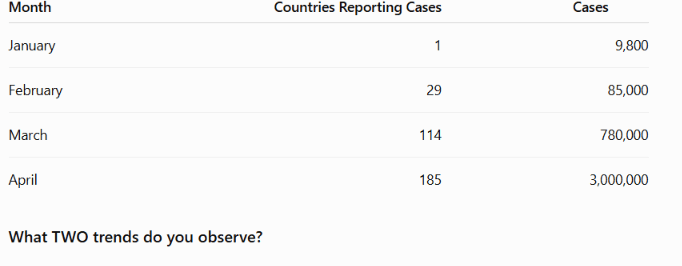
- The number of countries reporting cases increased.
- The number of confirmed cases increased dramatically.
500
🧠 THINK LIKE A SCIENTIST
Two students are exposed to the same virus.
Student A has a strong immune response.
Student B has a weaker immune response.
Predict how their illnesses might differ and explain why.
Student A may fight the infection more effectively and potentially recover more quickly because their immune response is stronger.
500
🧪 ANTIBIOTIC RESISTANCE CHALLENGE
A doctor prescribes an antibiotic for a bacterial infection.
Some bacteria survive the treatment. Those bacteria reproduce, and eventually more of the bacteria are resistant.
Explain how this could make the antibiotic less effective over time.
Resistant bacteria survive and reproduce, increasing the proportion of resistant bacteria in the population.