Division Patterns with Decimals
Divide Decimals By Whole Numbers Using a Model
Estimate Quotients of Decimals
Divide Decimals Using A Model
Divide Decimals
Dividing Decimals Vocabulary
100
36 ÷ 100.
What is 36.
100
Explain which base-ten blocks must be used to model 4.24 ÷ 4. Then solve.
What are 4 ones, 2 tenths and 4 hundredths divided by 4 ones? The quotient is one and six hundredths in each of the 4 groups.
100
Estimate 3.7 ÷ 5, and then solve.
What is thirty-five tenths divided by five ones equals seven tenths.
100
Create a model to complete the number sentence 1.2 ÷ 0.3 = using base-ten blocks.
What are one whole and two tenths divided by three tenths equals four groups of four tenths.
100
Solve 0.72 ÷ 0.08, and explain where should the decimal point be placed in the quotient.
What is 9. The decimal point was moved two places to the right in the dividend and quotient to solve the problem using whole numbers.
100
I am the answer to a division problem.
What is the quotient?
200
6.5 ÷ 101.
What is zero and sixty-five hundredths?
200
Explain how to model 3.21 ÷ 3 and then solve.
What are 3 ones, 2 tenths, and 1 hundredth divided by 3 ones. The quotient is 3 groups with one and seven hundredths in each group.
200
Estimate 17.9 ÷ 9 and then solve.
What is eighteen divided by 9 equals 2.
200
Create a model to the division sentence 1 ÷ 0.5 using base-ten blocks.
What is one whole divided by five tenths equals two groups of five tenths.
200
The quotient for 3.45 ÷ 1.5.
What is two and three tenths?
200
I represent the total amount in a division problem that needs to be divided.
What is the dividend?
300
560 ÷ 102.
What is five and 6 tenths or five and 60 hundredths.
300
Explain the error in this decimal model of 3.21÷3 = 1.07, and then correct the mistake.
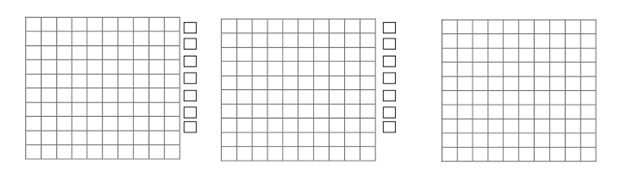
What is failing to properly decompose the decimal. You must break up 21 tenths into three groups, and place one whole in each group, and you will get a quotient of one and seven hundredths.
300
Estimate $144.15 ÷ 31, and then solve.
What is one hundred fifty dollars divided by thirty equals five dollars.
300
A model of four groups of 0.24 gives you a dividend of what?
What is 0.96 hundreds?
300
Complete the pattern. 175 ÷ 25 equals blank, 17.5 ÷ blank equals 7, and blank ÷ 0.25 equals 7.
What are seven, two and five tenths and one and seventy-five hundredths?
300
I divide the dividend into groups.
What is the divisor?
400
12.7 ÷ 10 = 127. Is this answer correct? If not, explain how do you know and what should be done to correct the answer.
Possible Response: No, the answer is not correct because the decimal point moved one place to the right, which increases the quotient 10 times as much as. However, the decimal point needs to move one place to left to decrease the quotient by 1/10, which would make the answer one and twenty-seven hundredths.
400
Bonus Question:Look at the decimal model, and give the division sentence.
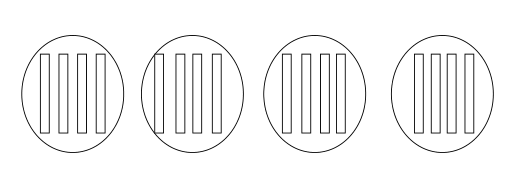
What is one and six tenths divided by four equals zero and four tenths.
400
Terry bicycled 64.8 miles in 7 hours. Deterine the best estimate of how many miles she biked in 1 hour. Estimate and then solve.
What is sixty-three miles divided by seven hours equals approximately nine miles an hour.
400
What is the divisor of a division sentence with a dividend of 2.4 and a quotient of 3.
What is zero and eight tenths.
400
Bonus Question: Explain if this division sentence is correct 1.96 ÷ 0.14 = 1.4. If not, explain the error and then correct it.
What is a quotient of 14 instead of 1.4 as the decimal point was in the wrong place? That is because the divisor and dividend were multiplied by 10 in an effort to make them both whole numbers when the divisor and dividend should have been multiplied by 100.
400
I separate the whole numbers from the fractions in a decimal. Name another word to describe me.
What is the decimal point? What is "And."
500
Bonus Question: Complete the pattern, and then explain how you can determine where to place the decimal point in 456 ÷ 103.
456 ÷ 100 = 456
456 ÷ 101 = 45.6
456 ÷ 102 = 4.56
The quotient is zero and four-hundred fifty-six thousandths. I can use a pattern of powers of 10. The decimal point will move three places to the left because there are three zeros represented in the exponent.
500
If Sam can ride his bike 4.5 kilometers in 9 minutes and Amanda can ride her bike 3.6 in 6 minutes, which rider might go farther in one minute? Solve, and then explain.
Who is Amanda? That's because four and five tenths divided by 9 ones equals five tenths or 50 hundredths, which is how far Sam rode. Three and six tenths divided by 6 ones is sixth tenths or 60 hundredths, which is how far Amanda rode. Six tenths is greater than 5 tenths.
500
Bonus Question: Juliette will cut a piece of string that is 45.1 feet long into 7 smaller pieces. Each of the 7 pieces will be the same length. Write a division sentence using compatible numbers to estimate the quotient. Explain your response.
What is forty-two feet long ribbon divided by seven smaller pieces equals six pieces. We rounded forty-five and one tenth to forty-two because it is a multiple of seven, which makes forty-two and seven compatible numbers. Then we divided, and got a quotient of six.
500
Bonus Question: Look at the model. Explain what division sentence the model represent. Explain your reasoning.
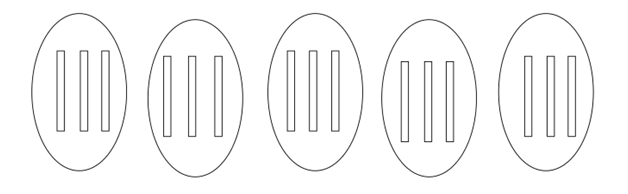
The model represents one and five tenths divided by zero and three tenths, which equals a quotient of five. My reasoning is the dividend represents one and five tenths, the divisor of zero and three tenths and the quotient represents 5 groups of three tenths.
500
Explain if the following division sentences are greater than, less than or equal to each other. 6.93 ÷0.3 is blank to 9.24 ÷ 0.4.
Six and ninety-three hundredths is equal to nine and twenty-four hundredths as they both have a quotient of twenty-three and one tenth. I determined this by first multiplying the divisor zero and three tenths by ten to make it a whole number, and then I multiplied the dividend by ten as well and got sixty-nine and three tenths. Sixty-nine and three tenths divided by three ones equals twenty-three and one tenth, and in nine and twenty-four hundredths divided by zero and four tenths, I multiplied the divisor zero and three tenths by ten to make it a whole number. Then I multiplied nine and twenty-four hundredth to get ninety-two and four tenths, which gave me a quotient of twenty-three and one tenth, making both division sentences equal.
500
I make up the total amount of groups represented in a division decimal problem, and there are two words used to describe me.
What are the dividend and the decimal or decimal number.