DNA replication
Nucleic Acids
Enzymes
Diagrams
Challenge
100
These are the building blocks of DNA
Nucleotides are joined by phosphodiester bonds to form DNA.
Each nucleotide is made of three parts: a phosphate group, a sugar, and one of the four nitrogenous bases.
100
Which of the nitrogenous bases are purines?
A, G
100
What does ligase do?
it is the enzyme responsible for linking the discontinuous fragments from DNA replication
100
What are the different nitrogenous bases in DNA?

G, C, A, T
100
Which of the following is FALSE?
A. DNA includes the nitrogenous base uracil
B. DNA is a nucleic acid
C. RNA has a sugar, phosphate, and a nitrogenous base
D. RNA contains the sugar ribose
A.
200
How does DNA polymerase know when to start replication?
Replication always starts at specific locations on the DNA, which are called origins of replication
200
What is the name of the sugar found in DNA?
Deoxyribose
200
What is the enzyme works to relieve built-up tension during DNA replication?
gyrase or topoisomerase
200
What do the dotted lines represent?

The hydrogen bonds that hold the nitrogenous bases together.
200
Why does a DNA strand grow only in the 5' to 3' direction?
Because DNA polymerase can only add nucleotides to the 3' end of the growing molecule (at the -OH)
300
What is the leading strand?
The new strand runs in the 5' to 3' direction towards the replication fork and is synthesized continuously.
300
What nitrogenous base does RNA contain that DNA does not?
Uracil
300
Describe the function of DNA polymerase III.
it adds a DNA nucleotide to the RNA primer and then continues adding DNA nucleotides to the growing end of the DNA strand
300

what model of DNA replication does this picture show?
semiconservative
300
In the analogy of a DNA molecule as a ladder, the STEPS corresponds to what?
Hydrogen bonds between nitrogenous bases
400
What are mutations?
Permanent changes in the DNA sequence.
These can be caused by:
- errors made by DNA polymerase III when synthesizing DNA
- reactive chemicals (such as pesticides and pollutants)
- radiation (X-rays)
400
Which enzyme breaks apart the hydrogen bonds between two strands of DNA?
Helicase
400
What does DNA polymerase I do?
it replaces the RNA nucleotides of the adjacent primer with DNA nucleotides (it removes the primer)
400

What number are single-strand binding proteins?
1
400
Given the strand of DNA,
5' GGTACTAC 3'
What will be the complementary strand of DNA produced during DNA replication? Include the sequence and directionality.
3' CCATGATG 5'
500
What does it mean that the DNA strands are antiparallel?
One strand is in the 5' to 3' direction, and the other is in the 3' to 5' direction.
The DNA polymerase can only synthesize new DNA in the 5' to 3' direction.
The two strands are complementary to each other.
500
A template strand of DNA is 3' TAGGCATTGCA 5'
What is the complementary DNA strand?
5' ATCCGTAACGT 3'
500
What is the primer?
this is a short stretch of RNA that initiates the synthesis of a polynucleotide.
500
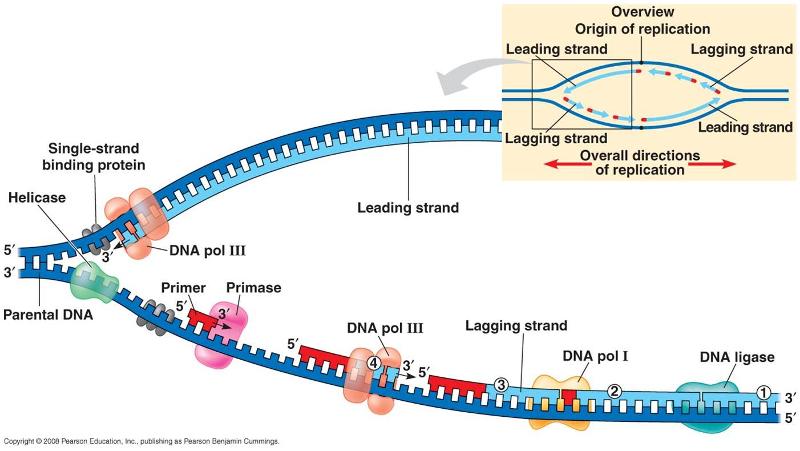
What does primase do?
it synthesizes short RNA sequences called primers. These primers serve as the starting point of DNA synthesis.
500
As demonstrated in the Hershey-Chase experiment, when a T2 bacteriophage infects an E. coli cell, what part of the bacteriophage enters the bacterial cytoplasm?
Only the DNA