Molecular & Empirical Formulae
Chemical Equations
Ideal Gasses
Stoichiometry
Experimental Programme
100
What is the empirical formula of C₆H₁₂O₆?
CH₂O
100
Write a balanced equation for magnesium reacting with hydrochloric acid (include states).
Mg(s) + 2HCl(aq) → MgCl₂(aq) + H₂(g)
100
What does SATP stand for and what are the conditions?
Standard Atomspheric Temperature and Pressure (273.15 K, 100 kPa)
100
Calculate the mass of PbO formed when 2.67 g PbCO₃ decomposes completely. (Molar masses: PbCO₃ = 267, PbO = 223)
PbCO₃(s) → PbO(s) + CO₂(g)
2.23 g
100
List all separation techniques that can be used to separate a precipitate from the supernate.
Filtration and Evaporation
200
What concentration results when 1.0 cm³ of 0.500 mol/dm³ HNO₃ is diluted to 50.0 cm³?
0.01 mol/dm³
200
Balance this equation:
__NH₃ + __O₂ → __NO + __H₂O
4 NH₃ + 5 O₂ → 4 NO + 6 H₂O
200
If you have 2.0 moles of gas at STP, what volume does it occupy?
45.4 dm³
200
When 10.0 g of calcium carbonate is decomposed by heating, 4.8 g of calcium oxide is produced. Calculate the percent yield.
CaCO₃(s) → CaO(s) + CO₂(g)
(Molar masses: CaCO₃ = 100, CaO = 56, CO₂ = 44)
85.7%
- Moles of CaCO₃ = 10.0 / 100 = 0.10 mol
- From equation: 1 mol CaCO₃ produces 1 mol CaO
- Moles of CaO produced = 0.10 mol
- Theoretical yield of CaO = 0.10 × 56 = 5.6 g
- Percent yield = (actual / theoretical) × 100
- = (4.8 / 5.6) × 100 = 85.7%
200
What is this piece of glassware called?
What is the measurement uncertainty value?
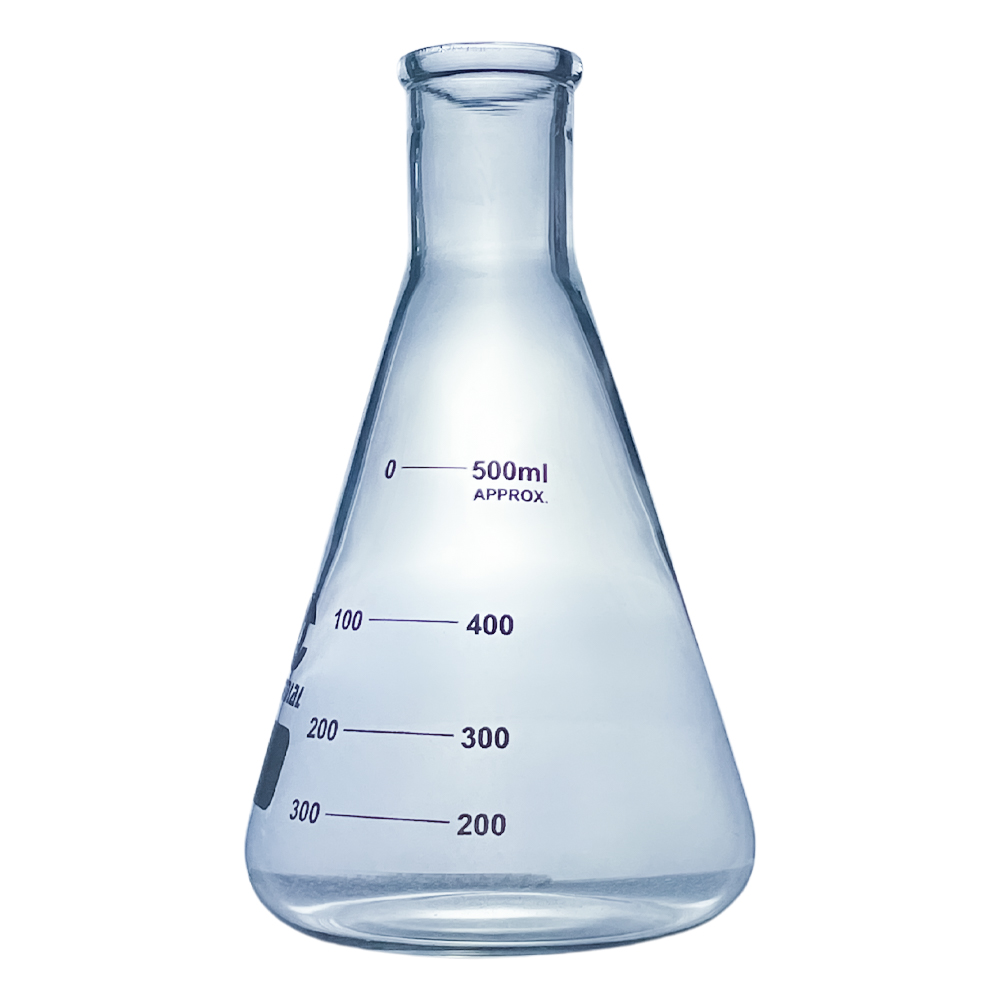
500ml Erlenmeyer flask ± 50ml
or
500ml Conical flask ± 50ml
300
A student prepares 120.0 cm³ of 0.150 mol dm⁻³ aluminum sulfate solution. How many sulfate ions are in the solution?
3.25 × 10²² sulfate ions
300
Write a balanced equation for the complete combustion of ethanol, C₂H₅OH (include states).
C₂H₅OH(l) + 3O₂(g) → 2CO₂(g) + 3H₂O(l)
300
State three assumptions made about ideal gases in kinetic molecular theory.
Answer (any 3 of the following):
- Gas particles have negligible/zero volume (compared to the container volume)
- There are no intermolecular forces between gas particles (or particles don't attract/repel each other)
- Gas particles are in constant, random motion
- Collisions between particles and container walls are perfectly elastic (no energy is lost)
- The average kinetic energy of particles is directly proportional to absolute temperature (in Kelvin)
300
C₇H₆O₃(s) + C₄H₆O₃(l) → C₉H₈O₄(s) + C₂H₄O₂(aq)
(salicylic acid + acetic anhydride → aspirin + ethanoic acid)
Calculate the atom economy for the production of aspirin in this reaction.
(Molar masses: C₇H₆O₃ = 138, C₄H₆O₃ = 102, C₉H₈O₄ = 180, C₂H₄O₂ = 60)
75.0%
- Atom economy = (mass of desired product / total mass of reactants) × 100
- = (180 / (138 + 102)) × 100
- = (180 / 240) × 100
- = 75.0%
300
A measurement of 15.0cm is made using this ruler, write out the measurement with the correct measurement uncertainty.

15.0 ± 0.1 cm
0.1 / 2 = 0.05 , uncertainty applied for both ends on a ruler therefore 0.05 + 0.05 = ±0.1cm
400
A compound contains
52.2% C, 13.0% H, and 34.8% O by mass.
What is its empirical formula?
C₂H₆O
400
Write the balanced equation for calcium carbonate reacting with ethanoic acid (include state symbols).
CaCO₃(s) + 2CH₃COOH(aq) → Ca(CH₃COO)₂(aq) + H₂O(l) + CO₂(g)
400
Draw a graph to represent the relationship between volume and pressure in an ideal gas.

400
Calculate the volume of H₂ produced when 0.200 g Li reacts with water at 22.5°C and 103 kPa.
348 cm³ (or 3.48 × 10⁻⁴ m³)
400
A student needs to prepare 200.0 cm³ of 0.250 mol dm⁻³ copper(II) sulfate solution. Calculate the mass of copper(II) sulfate pentahydrate (CuSO₄·5H₂O) crystals needed.
12.5 g
500
If the empirical formula is CH₂ and the molar mass is 42 g/mol, what is the molecular formula?
C₃H₆
500
Write a balanced chemical equation, including state symbols, for the following reaction:
Indium metal reacts with copper(II) nitrate solution to produce indium nitrate solution and copper metal.
2In(s) + 3Cu(NO₃)₂(aq) → 2In(NO₃)₃(aq) + 3Cu(s)
500
Calculate the volume of H₂ produced when 0.200 g Li reacts with water at 22.5°C and 103 kPa.
348 cm³
500
Zn(s) + 2HCl(aq) → ZnCl₂(aq) + H₂(g)
A student reacts 3.25 g of zinc metal with 50.0 cm³ of 2.00 mol dm⁻³ hydrochloric acid. Calculate the volume of hydrogen gas produced at STP.
(Molar masses: Zn = 65, molar volume at STP = 22.7 dm³ mol⁻¹)
HCl is limiting; 1.14 dm³ (or 1140 cm³) H₂ produced
500
A student needs to prepare 250.0 cm³ of 0.100 mol dm⁻³ hydrochloric acid from a stock solution of 2.00 mol dm⁻³ hydrochloric acid.
(a) Calculate the volume of stock solution that needs to be transferred.
(b) State all most appropriate piece of glassware to use
(a) 12.5 cm³
(b) 20 or 25ml graduated cylinder or pipette and a 250ml volumetric flask