Driver's Ed #1
Driver's Ed #2
Driver's Ed #3
Driver's Ed #4
Driver's Ed #5
100
If a crossing guard is directing traffic in a school zone, you must:
A: Follow the directions given by the crossing guard.
B:Copy what surrounding traffic is doing, despite the crossing guard's instructions.
C: Assume the guard is not supposed to be directing traffic.
D: Follow rules that would be in place if no children were present.
A: Follow the directions given by the crossing guard.
100
If someone is driving aggressively behind you, you should:
A: Try to get out of the aggressive driver’s way.
B: Stare at the driver as he or she is passing you.
C: Speed up as he or she is passing you.
D: Block the passing lane.
A: Try to get out of the aggressive driver’s way.
100
On a freeway, you realize you missed your turn or exit. You should:
A: Make the turn quickly from your lane of travel.
B: Stop and back up.
C: Continue driving until you reach the next turn, exit, or other location where you can safely turn around.
D: Signal other drivers to stop so you can turn
C: Continue driving until you reach the next turn, exit, or other location where you can safely turn around.
100
If another driver cuts you off in traffic, you should:
A: Pull next to the driver and yell at them.
B: Let it go.
C: Flash your high beams at the driver.
D: Get back at the other driver by cutting them off.
B: Let it go.
100
A flashing red light at a railroad crossing means:
A: Stop. Do not proceed until signals are deactivated.
B: Slow down and proceed if the tracks are clear.
C: Proceed with caution.
D: You have the right-of-way.
A: Stop. Do not proceed until signals are deactivated.
200
From top to bottom, the following is the proper order for traffic lights:
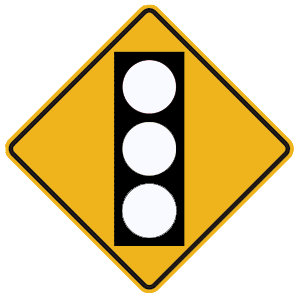
A: Red, yellow, green.
B: Red, green, yellow.
C: Green, red, yellow.
D: Green, yellow, red.
A: Red, yellow, green.
200
When approaching a stopped school bus with its red lights flashing and its stop arm extended, you must:
A: Stop five feet away from the bus.
B: Stop only if you see children are present.
C: Stop and remain stopped until it appears safe to proceed.
D: Stop and remain stopped until the red lights stop flashing and the stop arm has been withdrawn.
D: Stop and remain stopped until the red lights stop flashing and the stop arm has been withdrawn.
200
If your turn signals fail, you should use ____ to indicate that you are turning.
A: Your horn
B: Your headlights
C: Hand signals
D: Your emergency flashers
C: Hand signals
200
If you are following a truck that swings left before making a right turn at an intersection, you should remember that it is very dangerous to:
A: Try to squeeze between the truck and curb to make a right turn.
B: Apply your brakes until the truck has completed the turn.
C: Violate the four-second following distance rule.
D: Honk your horn at the truck driver.
A: Try to squeeze between the truck and curb to make a right turn.
200
Teenagers should try to get at least ____ of sleep each night to avoid the risk of crashing due to lack of sleep.
A: Seven hours
B: Six hours
C: Eight hours
D: Nine hours
C: Eight hours
300
You may turn right on red if you:
A: Stop first and check for traffic and pedestrians.
B: Are facing a red arrow.
C: Are in the left lane.
D: Slow down first.
A: Stop first and check for traffic and pedestrians.
300
This sign means:
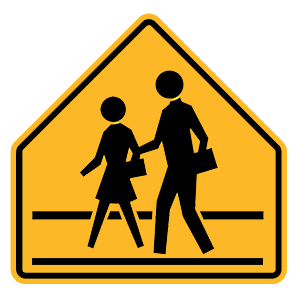
A: Pedestrians only.
B: Intersection ahead.
C: Hiking trails ahead.
D: School crossing ahead.
D: School crossing ahead.
300
If your blood alcohol level is 0.04 percent, you:
A: Are two to seven times more likely to have a crash than a person who has not consumed any alcohol.
B: Are above the legal blood alcohol limit but fine to drive.
C: Can be very sure that you will drive safely.
D: Should drink plenty of coffee before getting behind the wheel of your car.
A: Are two to seven times more likely to have a crash than a person who has not consumed any alcohol.
300
Traffic fatalities in work zones are most commonly the result of:
A: Tire blowouts.
B: Hydroplaning due to water sprayed on the roadway.
C: Loss of steering control after driving over wet paint.
D: Carelessness and speeding.
D: Carelessness and speeding.
300
Look over your shoulder to check your blind spot when:
A: Pulling toward or away from a curb.
B: Turning left or right.
C: Changing lanes.
D: All of the above.
D: All of the above.
400
From the center lane, which maneuver(s) can you perform?
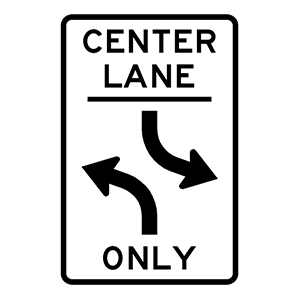
A: You may make left turns.
B: You may make U-turns.
C: You may pass slow-moving traffic.
D: All of the above.
A: You may make left turns.
400
You are coming to an intersection and have a green light. Pedestrians are crossing against the red. You should:
A: Honk your horn.
B: Speed up and pass in front of the pedestrians.
C: Stop to let the pedestrians cross safely.
D: Drive close to the pedestrians and frighten them so they’ll think twice before crossing against a red light.
C: Stop to let the pedestrians cross safely.
400
“Highway hypnosis” is a driving condition that can result from:
A: Staring at the roadway for long periods of time.
B: Frequent rest stops.
C: Too much sleep the night before your trip.
D: Short trips on expressways.
A: Staring at the roadway for long periods of time.
400
Drivers entering a roundabout or traffic circle:
A: Must always stop before entering.
B: Must yield to drivers already in the roundabout or traffic circle.
C: Have the right-of-way if there is one lane.
D: Have the right-of-way if there are two lanes.
B: Must yield to drivers already in the roundabout or traffic circle.
400
Before switching on the ignition, you should:
A: Be sure only backseat passengers have buckled their seat belts.
B: Be sure only adult passengers have buckled their seat belts.
C: Be sure only child passengers have buckled their seat belts.
D: sure all of the vehicle's occupants have buckled their seat belts.
D: Be sure all of the vehicle's occupants have buckled their seat belts.
500
As you near an intersection, the traffic light changes from green to yellow. Your best action is to:
A: Speed up to beat the red light.
B: Apply the brakes sharply to stop.
C: Be prepared to stop in the center of the intersection.
D: Be prepared to stop before the intersection.
D: Be prepared to stop before the intersection.
500
If your car breaks down on a highway, you should:
A: Sit in your car and wait for help.
B: Use your four-way flashers to warn other drivers.
C: Sound your horn at passing motorists.
D: Flash your headlights at oncoming traffic.
B: Use your four-way flashers to warn other drivers.
500
When driving on an interstate:
A: Stop on the shoulder of the road if you are tired.
B: You should always use cruise control.
C: Signal, check mirrors, and check blind spots before changing lanes.
D: You should change lanes often.
C: Signal, check mirrors, and check blind spots before changing lanes.
500
When driving on a freeway entrance ramp, you should look for a gap in freeway traffic by:
A: Looking in the inside rearview mirror only.
B: Looking in the side view mirror only.
C: Looking in both the rearview and side view mirrors.
D: Looking in your mirrors and turning your head to look over your shoulder.
D: Looking in your mirrors and turning your head to look over your shoulder.
500
When changing lanes on a highway, you should:
A: Signal a lane change.
B: Check your rearview and outside mirrors.
C: Check your blind spot by glancing over your shoulder.
D: All of the above.
D: All of the above.