Fossil Fuels
Sedimentary Rock
Landforms
Weathering and Erosion
Surprise me!
100
How long does it take coal and other fossil fuels to form?
Millions of years.
100
Sedimentary rock is easily identified by its ______________.
Layers
100
What forces cause the formation of landforms?
wind and water
100
What is weathering?
Weathering is the breakdown of rock into smaller pieces.
100
What does the CON in CONserve stand for?
Coal, oil, natural gas. We must CONserve our fossil fuels.
200
Why are fossil fuels called nonrenewable resources?
Fossil fuels like coal, oil, and natural gas take millions of years to form and, therefore, cannot be replaced or “renewed”.
200
What step is missing from the formation of sedimentary rocks like sandstone?
Weathering – Erosion – Deposition - _______?____ - Cementation
Compaction
200
Strong winds are most likely to change the shape of which landform?
While strong winds can weather hard rock over time, SAND DUNES would be most affected by strong winds.
200
Ms. Haley moved from Chattanooga which is a valley. What does this tell you about Chattanooga?
Chattanooga is a low area of land between two mountains/higher areas of land.
(A valley is a low area of land between two higher areas of land.)
200
While I was hiking in the mountains, I found a trail I wanted to try next time. However, when I came back, I found the trail was blocked by lots of large rocks that weren't there before. How could this change have happened so quickly?
Landslides can cause rocks to move to a new locations.
300
Where do fossil fuels originate?
Fossil Fuels come from dead organic matter like plants, animals, and microorganisms.
300
Sedimentary rock is formed by the layering of sediments. What causes these sediments to form layers?
Sediment gets eroded by wind and water. It DEPOSITS in layers in new locations.
300
How do deltas form?
Over time, more and more sediments build up and cause the river to form a new branch.
300
What is likely to cause the formation of a valley?
A glacier sliding down and eroding the side of a mountain.
300
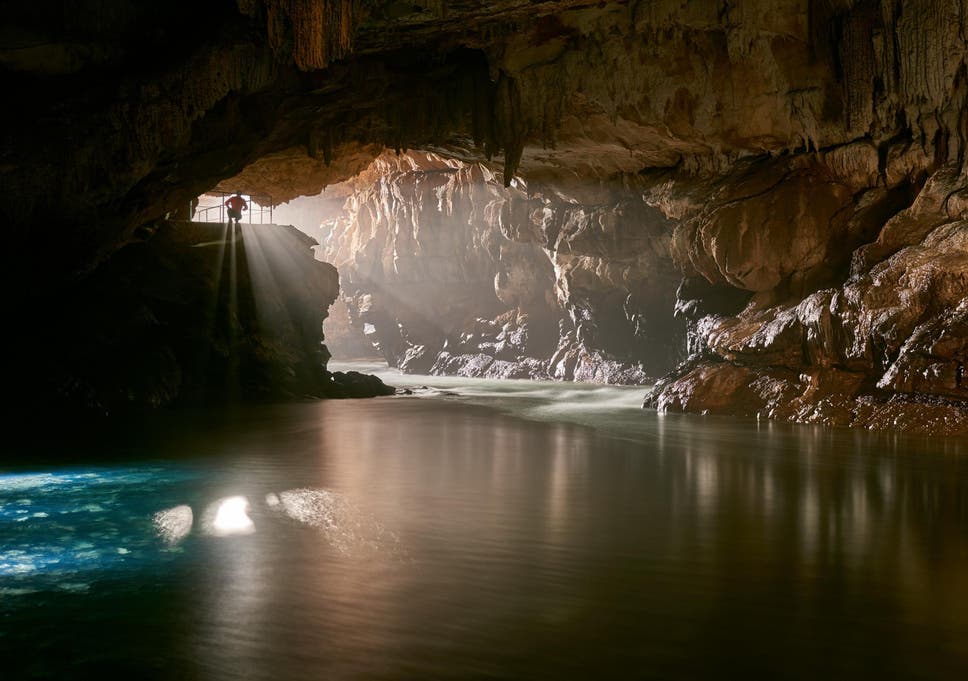
How is this landform created?
Caves are formed when water flows underground and carries away the minerals and sediment.
400
How is the fossil fuel oil formed?
Microorganisms living in the ocean die and are buried by layers of sediment for millions of years.
400

Which layer is the oldest layer? How do you know?
A is the oldest layer because it is at the bottom. Over time, other layers have been deposited on top.
400
Canyons, like the Grand Canyon, are primarily formed by what?
Moving water.
400
How can ice weather a rock?
Water fills cracks in the rocks. When it freezes it forces the cracks wider. Over time, this thawing and freezing causes the rocks to break into smaller pieces.
400
A waterfall has been dropping onto the land for a long period of time. After millions of years, this waterfall has formed what landform?
A canyon.
500
Describe the process that forms the fossil fuel coal.
Peat moss in a swamp gets buried by sediment. Water is squeezed out by the pressure of the above layers and the peat decays. More layers means more and more heat. Heat and pressure turn the organic matter into coal.
500
What is something that both sedimentary rock and fossil fuels have in common?
Some answers could be: They are both formed over a long period of time. They both require pressure to be formed. They both involve layers of sediment being deposited.
500
Coastal areas often experience radical changes in their coastline. What mostly causes these changes?
Erosion of the coastline is caused by moving water from waves and storms.
500
How might a weathered mountain appear different from an unweathered mountain?
The weathered mountain would appear rounder and smoother in shape.
500
Why do we use fossil fuels?
They are relatively inexpensive (cheap) to produce, and they can be found within Earth's lithosphere.