Earth Structure
Rocks
Rocks (again)
Plate Tectonics
Weathering & Erosion
100
What are the four layers of the Earth?
Inner core, outer core, mantle, crust.
100
What are the three types of rocks?
Igneous, metamorphic, sedimentary
100
What rock is formed using heat and pressure inside the Earth?
Metamorphic
100
Name two types of plate boundaries.
Two of: divergent, convergent, transform, subduction.
100
What is weathering?
The breaking down of rocks into smaller pieces by physical, chemical, or biological processes.
200
What is the difference between magma and lava?
Magma is within the Earth in the mantle. Magma becomes lava when it exits a volcano.
200
What is the relationship between rocks and minerals?
Minerals are substances with a specific chemical formula and crystal arrangement. When lots of minerals come together, they form rocks.
200
Which rock type would you find fossils in? Where would the oldest fossils be in this rock?
Sedimentary rocks. The oldest fossils would be at the bottom of the rock formation.
200
State the two types of crust, and compare their differences.
Oceanic and continental. Continental crust is thicker and less dense than oceanic crust.
200
How does erosion differ from weathering?
While weathering breaks the rocks down, erosion is the movement of broken-down rock (sediments) by wind, water, ice, or gravity.
300
How are the inner core and outer core similar and different to each other?
While the inner core is solid and the outer core is liquid, they both contain iron and nickel.
300
What are the two types of igneous rocks, and how does their formation differ?
Extrusive: Lava that has been exposed to air or water and cools quickly (small crystals)
Intrusive: Magma that doesn't reach the Earth's surface and cools slowly (large crystals)
300
What is cementation, and what rock type does it create?
Cementation: The process where dissolved minerals bind sediments together, forming solid rock. It creates sedimentary rocks.
300
Describe how temperature and pressure change as you move towards the Earth's core.
As you move close to the centre of the Earth, temperature & pressure both increase.
300
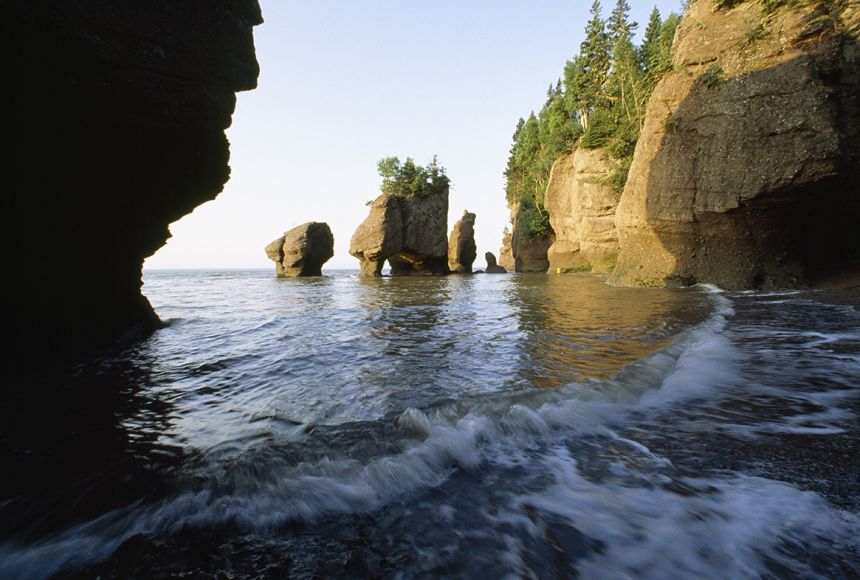 Is this weathering or erosion?
Erosion. The water has physically eroded the land away.
400
How do volcanoes form?
When two plates move away from each other, magma from below the Earth’s surface rises to fill the gap, forming new earth crust and volcanoes.
400

What is the name of this rock? What type of rock is it?
Quartzite, metamorphic.
400
What is the name of this rock? What type of rock is it?
Sandstone, sedimentary
400
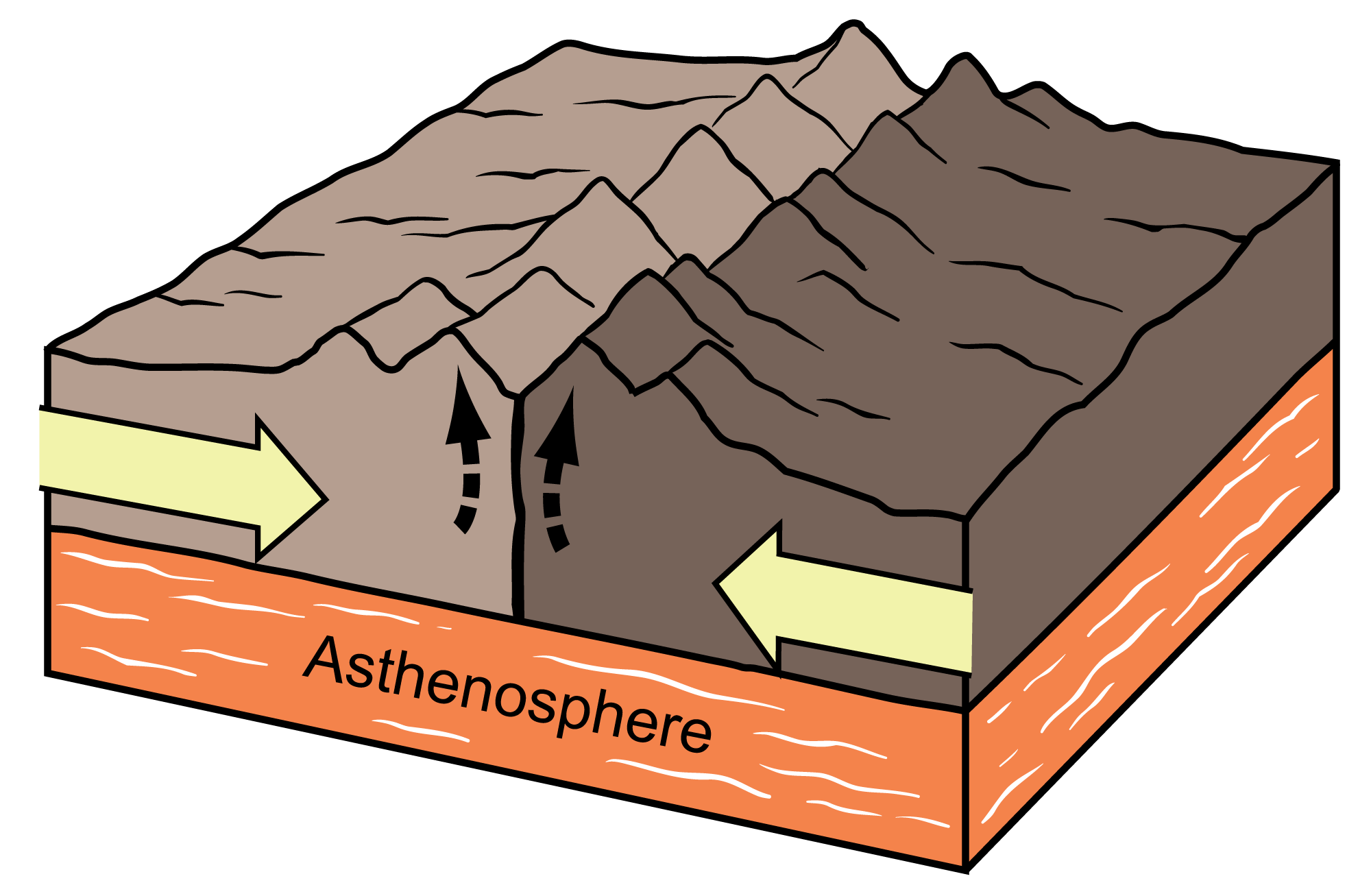
What is this plate boundary called? What geological landform is usually created as a result? Give a real world example of this formation.
Convergent plate boundaries create mountain ranges. An example of this is the Himalayas.
400
What are the three types of weathering?
Physical forces: Temperature changes causing expansion and contraction.
Chemical reactions: Minerals reacting with water, oxygen, or acids, eg acid rain dissolving minerals from the rock to form caves.
Biological activity: Tree roots or burrowing animals breaking apart rock.
500
Explain how and why tectonic plates move.
Tectonic plates float on magma in the mantle. Heat from the Earth’s core warms the magma and causes it to move around (in a convection current), carrying the crust with it.
500
 What is the name of this rock? What type of rock is it? How is it formed?
Obsidian, igneous. Formed when lava meets water and cools quickly (quenching).
500
 What is the name of this rock? What type of rock is it? How is it formed?
Conglomerate, sedimentary. Made from mudslides/floods moving lots of rocks to one area.
500
How do tectonic plate boundaries impact geological processes and landforms?
Tectonic plate boundaries drive geological processes like earthquakes, volcanic activity, and mountain building by causing plates to collide, separate, or slide past each other.
500
What are four ways erosion occurs to create sediments? Where would these sediments typically be deposited?
Water, ice, wind and gravity. They would deposit where water meets land, as the slow moving water would allow sediments to settle.