Lesson 39
Size of Universe
Size of Universe
This unit is used to measure vast distances in space.
Light year
These are the the tiny particles that carry light energy are called these.
Photons
The Moon is classified as this type of object.
Natural satellite
This phase occurs when the Moon is between Earth and the Sun.
New Moon
What causes the different seasons on Earth?
It's tilted axis.
Stars begin forming inside giant clouds of gas and dust called these.
Nebula
The Milky Way is classified as this type of galaxy.
Spiral
Astronomy depends heavily on observing this.
Light
1/4th the size
What causes the phases of the Moon?
The Moon’s position relative to Earth and the Sun
What degree is Earth tilted?
23.5 degrees
Which stage of a star’s life lasts the longest?
Main sequence
How many miles make up 1 light year?
Approx 5.8 trillion
Hotter stars emit which color light?
Blue
How did scientists think the Moon formed?
A planet-sized object hit Earth.
This term describes the point in the Moon's orbit when it is farthest from the Earth.
Apogee
What causes day and night on Earth?
It revolving on it's axis.
The process that powers stars by combining hydrogen into helium is called this.
Nuclear Fusion
Astronomers estimate the average galaxy contains about this many stars.
100 billion
This is the galaxy closest to the Milky Way.
Andromeda Galaxy
What is the fine layer of dust covering the Moon’s surface called?
Regolith
This orbital shape causes the Moon to sometimes be closer to Earth and sometimes farther away.
Elliptical orbit
This is Earth's journey around the Sun.
Revolution
What type of star is our Sun classified as?
Yellow dwarf
This is the study of the origin and development of the universe.
Cosmology
According to the diagram, this wave carries more energy. 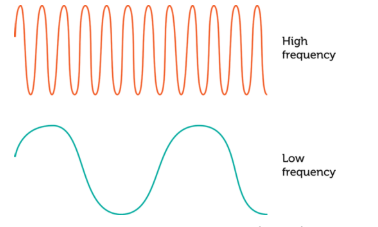
High frequency
The Moon is not locked in place. Instead, it spins at the same rate that it orbits Earth, a phenomenon known as this.
Synchronous rotation
A full moon occurring near perigee is commonly known by this name.
Supermoon
This type of light occurs when the Sun's rays hit Earth at a shallow angle. This happens in areas that are tilted away from the Sun.
Indirect light
A star remains in equilibrium because these two opposing forces are balanced.
Gravity and gas pressure
I hold billions of stars in my embrace,
Yet I am only one place in space.
Spirals and ellipses are often my form,
What am I, where stars are born?
Galaxy
I'm measured crest to crest with care,
Long or short, I'm always there.
I help determine energy's might,
What am I describing in light?
Wavelength
Though meteors struck me by the score,
My scars remain forevermore.
No wind or rain to wear them down,
What are these circles all around?
Craters
Each night I grow a little more,
Until a bright full face I show.
What word describes my growing light?
Waxing
Twice a year I bring balance to all,
Equal day and night for large and small.
What am I?
Equinox
Not quite a star but getting hot,
Gathering mass is what I've got.
What stage am I?
Protostar