Elements
Compounds
Mixtures
Density
Properties
100
An element consists of __________ kind of atom throughout.
one
100
A compound consists of ______________ kinds of atoms chemically bonded to each other.
two or more
100
In heterogeneous mixtures, particles are distributed or spread ________________. ( Evenly or Unevenly)
unevenly.
100
What is the formula for density?
D= M/V
100
A sparkler is an example of what property and why?
Chemical property- reacts with oxygen to produce light and heat.
200
What is the smallest unit of an element that maintains all the properties of that element?
Atoms
200
A compound differs from a mixture in that a compound always has a
a. Homogeneous composition
B. Heterogenous composition
c. Minimum of three components
D. maximum of three components
A.
200
In homogeneous mixtures, substances are ____________ distributed. ( Evenly or Unevenly)
evenly
200
Water is MOST dense in which form?
Liquid
200
What is the definition of a physical property?
A characteristic of a pure substance that can be observed without changing it into another substance
300
Where are the electrons, protons, and neutrons
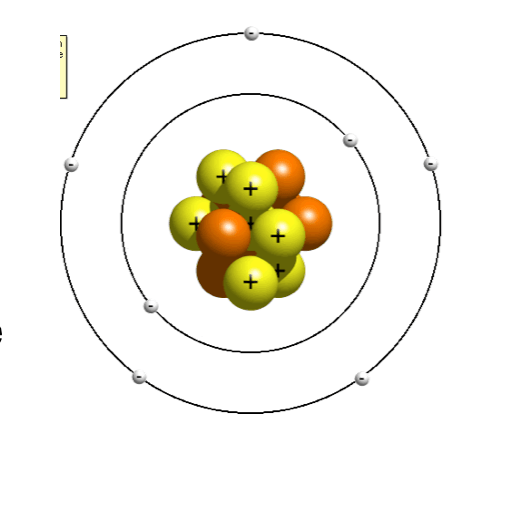
The electrons are on the outside, the protons and neutrons are in the middle
300
2Na + Cl2 ----> 2NaCl
The-______ sodium combines with the_______ chlorine to form the________ sodium chloride.
A. Compound; Compound; Element.
B. Element; Compound; Mixture
C. Element; Element; Compound.
D. Compound; Element; Mixture
C. Element, element , compound
300
Provide 2 examples of heterogeneous mixtures.
vegetable soup, oil and water, cereal, muddy water, salad etc
300
If a ball with a density of 1.5g/mL is placed in a beaker of liquid with a density of 2.33g/mL, what will happen to the ball?
The ball will float on top of the liquid in the beaker.
300
What does luster refer to?
How shiny something is
400
Atomic number of an element is determined by the __________
Number of protons
400
Which picture represents an element and which one represents a compound.
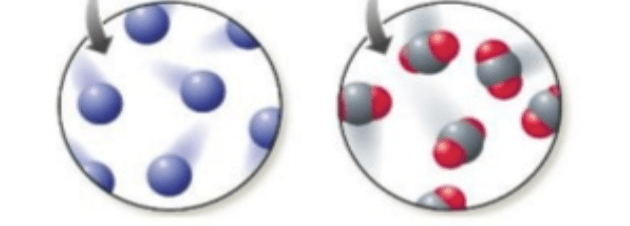
The picture fit the left are one element because it shows the atoms from one substance. The picture on the left is a compound because it shows bonded atoms.
400
Does mixing oil and water create a homogeneous mixture? Why or why not?
Mixing oil and water creates a heterogeneous mixture because we can see the oil and the water.
400
What type of property is density?
Physical Property
400
Is boiling point a physical or chemical property and why?
Physical property- it changes state from a liquid to a gas, but its chemical formula and molecular structure stay exactly the same
500
Magnesium, Barium, Radium and Beryllium are elements in Group 2 of the Periodic Table of Elements as shown below. What does it mean when elements are grouped together like these 4 elements?
They have similiar properties
500
Which of these statements are true about compounds? ( you may choose more than one)
A. Compounds can be found in the periodic table.
B. Compounds are pure substances.
C. Compounds are made up of two or more pure substances.
D. Compounds can be separated by physical means.
B and C
Compounds are pure substances and are made up of two or more elements.
*Elements can be found in the periodic table.
*Compounds can only be separated by chemical means.
500
What defines a mixture?
A. A mixture can be broken down into its basic substances through physical means.
B. A mixture cannot be broken down into its basic substances through physical means.
C. A mixture is created through a chemical reaction
D. A mixture is described by a chemical formula
A.
500
Explain:
A penny floats on liquid mercury because the penny is less dense than the mercury
500
What do the chemical properties we've discussed in class have in common?
They react with oxygen
600
How many atoms are represented in the formula CaCO3?
5
600
State any two differences between a compound and a mixture
compounds can not be separated by physical means while mixtures can
Compounds are pure substances, mixtures are not
600
Air is a mixture of about 78% nitrogen and 21% oxygen. Would air be a heterogeneous or homogeneous mixture? Why?
Homogenous mixture, the different gases cannot be distinguished
600
What is the density of on object with a mass of 120 g and a volume of 7mL?
17.14g/mL
600
List 5 physical properties and 2 chemical properties:
PP: boiling point, melting point, solubility, color, odor, malleability, density
CP: ability to burn, ability to rust/oxidize