Vocab & Definitions
Chapter 4
Chapter 5
Chapter 6
100
This measures how responsive buyers or sellers are to a change in price.
Elasticity
100
When the price of a good rises by 10% and the quantity demanded for the good falls by 25%, the elasticity of demand for this good is considered:
Elastic
100
If Rob is willing to pay $50 for an answer key to my exam, Joe is willing to pay $150, and Brady is willing to pay $300, who would purchase the answer key if I were willing to sell it for $100?
Joe and Brady
100
A price floor set below the equilibrium price is considered _________.
Non-binding
200
The difference between what a seller receives for a good and the minimum price they were willing to sell for.
Producer Surplus
200
If income elasticity of demand for a good is negative, we would consider this good to be a(n) _______ good.
Inferior
200
The most efficient allocation of goods is the allocation that maximizes _______.
Total surplus
200
A non-binding price ceiling, will likely ______ the quantity demanded and _______ the quantity supplied.
(increase, decrease, no effect)
No effect on either quantity demanded or supplied
300
A binding price ceiling results in this
Shortage
300
Cross-price elasticity tells us whether two items are ______ or ______.
Complements or substitutes.
300
Which type of demand curve creates no deadweight loss, but puts all of the tax burden on the consumer?
Perfectly inelastic
300
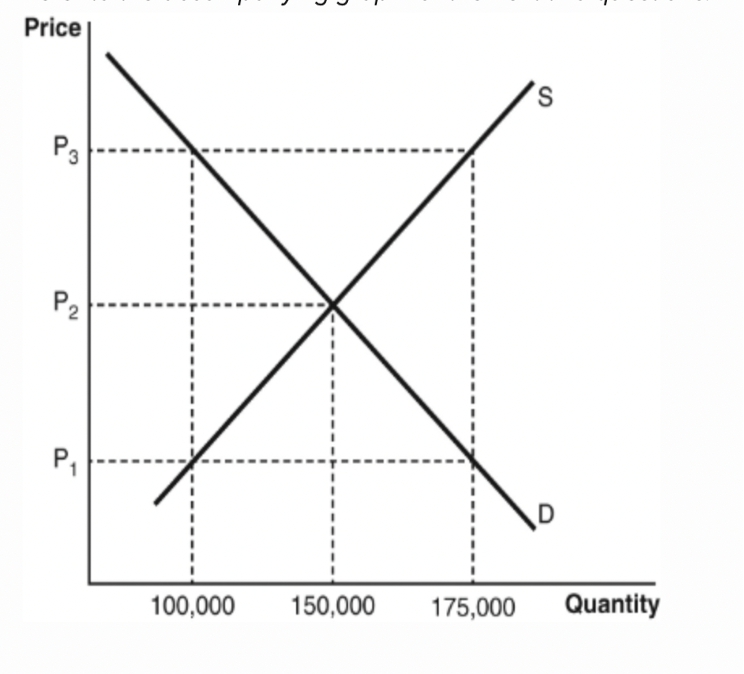
Which price would result in a binding price floor?
P3
400
The actual distribution of a tax burden between buyers and sellers, regardless of who legally pays it.
Tax incidence
400
A good with the demand curve below has what type of elasticity?
Perfectly inelastic demand
400
If demand is more elastic than supply, consumers will pay _______ (more/less) of the tax burden than producers.
Less
400
Price ceilings such as price gouging laws are intended to protect _______.
Consumers
500
This is created when an excise tax is placed on an item, it's a loss of efficiency that goes to no one.
Deadweight loss
500
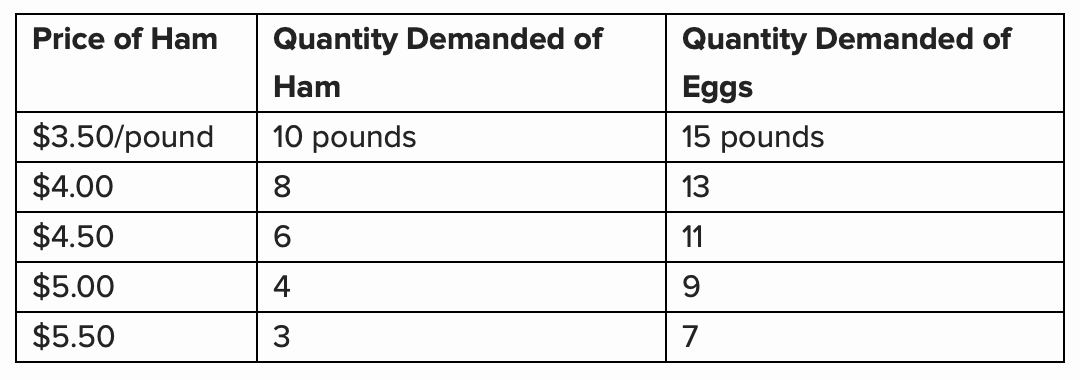 The price of ham increases from $4.50 to $5.00, what is the cross price elasticity of demand for eggs (use the midpoint method)?
-1.9
500
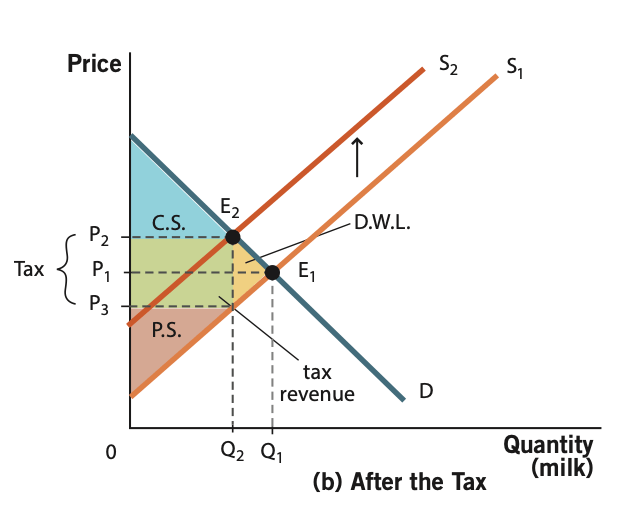
Draw a supply and demand curve in initial equilibrium, then place a tax on producers (draw that shift).
Label: consumer surplus, producer surplus, tax revenue, deadweight loss after the tax
500
Name an unintended consequence of rent controls.
(can vary)
Likely will contain: lower quality apartments, higher search costs for finding an apartment, landlords charging more fees, worse maintenance, etc.