Chapter 7
Chapter 8
Chapter 9
Vocabulary
Equations
100
True or false: A negative externality means the market produces too little of a good.
False: this means the market produces too MUCH of the good.
100
True or false: A firm's economic profit is always greater than or equal to its accounting profit.
False; economic profit will always be smaller because it subtracts implicit costs that accounting profit does not.
100
True or false: In a perfectly competitive market, an individual firm can raise its price above the market price to earn higher profits.
False: firms are price takers! If they put their price above market price, no consumers will purchase their product.
100
I am the term for a cost or benefit from a market activity that falls on someone who is not part of that transaction. What am I?
Externality
100
A firm produces 10 units with a total cost of $200, and 11 units with a total cost of $218. What is the marginal cost of the 11th unit?
$18
200
Fishermen have unrestricted access to a shared lake. Each fisher has an incentive to catch as much as possible, eventually depleting the fish population. What is the name of this phenomenon?
The Tragedy of the Commons
200
A firm has fixed costs of $500 and produces 50 units with total variable costs of $250. What is the firm's average total cost?
TC = 500+250=750
ATC=TC/Q=750/50= $15
200
A student says: 'I already paid $800 in non-refundable tuition, so I have to finish the semester even though I hate this class.' What economic mistake is the student making?
The Sunk Cost Fallacy
200
I am the cost of producing one additional unit of output. Mathematically, I equal the change in total cost divided by the change in quantity. What am I?
Marginal Cost
200
A firm sells 200 units at a price of $25 each. Its total fixed cost is $1,000 and its total variable cost is $3,000. Calculate the firm's profit or loss.
$1,000
300
What is one method used to correct for or internalize a positive externality?
- finance or subsidize production and consumption of the good
- laws requiring consumption
- encouraging research and development of similar goods
300
When increases in input are associated with a slower rise in output, what is this called?
Diminishing Marginal Product
300
A wheat farmer is currently producing a quantity where marginal revenue is $8 and marginal cost is $5. Should she increase production, decrease it, or keep it the same? Why?
Increase production. Since MR>MC, each unit adds more revenue than cost, meaning she is missing out on potential profit.
300
True or false: A club good is both rival and nonexcludable.
False: a club good is nonrival and excludable.
300
A firm has revenues of $90,000, explicit costs of $70,000, and implicit costs of $15,000. What is its accounting profit? What is its economic profit?
Accounting: $20,000
Economic: $5,000
400
A city installs streetlights. Anyone walking by benefits, and there is no way to stop them. What type of good are streetlights, and what problem does this create for private provision?
Streetlights are a public good: they are both nonrival and nonexcludable. This creates the free-rider problem, and private markets would under-provide them.
400
At which point in this graph is profit maximized?
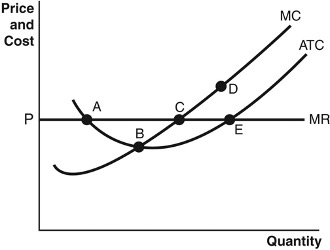
Point C
400
According to the graph below, what is the break-even price for this firm?
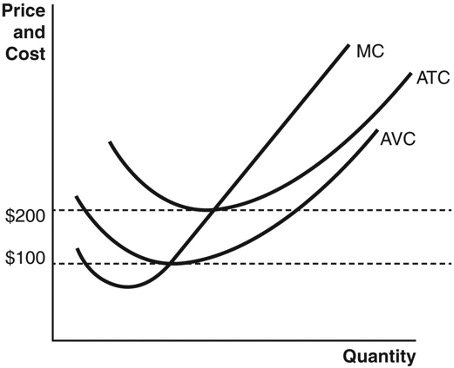
$200
400
True or false: A price taker is a firm with enough market power to set its own price above the equilibrium.
False: a price taker has no ability to influence the market price
400
A competitive firm currently produces 8 units. At that quantity, MR = $10 and MC = $10. Its ATC at 8 units is $7. What is the firm's total profit?
Profit = (P-ATC)*Q = $24
500
A firm locates next to a lake and produces good x. Rather than pay for waste removal, the firm dumps its waste into the lake. Fishermen, who earn their livelihood in the lake, are affected because the waste kills many of the lake's fish ($2000 per year in damage). The cheapest way to eliminate the pollution problem is to buy pollution control equipment which costs $1000 per year to operate and maintain.
If the firm is granted property rights to continue polluting the lake, what would happen according to the Coase Theore?
Since the firm has been given the right to continue polluting, they will. The firm must then choose whether it is worth it to pay for their own pollution control equipment. In this case, it is, they will spend $1000 per year on their own equipment to prevent $2000 of losses.
500
A small bakery doubles the size of its kitchen and staff, but output more than doubles. Is this an example of economies of scale, diseconomies of scale, or constant returns to scale?
(hint: what is happening to ATC?)
Economies of scale: ATC falls as it expands production
500
A firm's price is $12, its average total cost is $15, and its average variable cost is $10. Should the firm operate or shut down in the short run?
It should operate. Since the firm can cover its average variable costs, it should keep producing to minimize its losses.
500
I am the level of output at which a firm's average total cost is at its lowest point. Economists call me this because the firm is getting the most output for the least average cost. What am I?
The efficient scale
500
True or false: If a firm's price is $20 and its average total cost is $20, the firm's economic profit per unit is $20.
False: the firm's economic profit per unit = P-ATC=$0