Vocabulary
Niches, Food Chains, Food Webs
Matter Cycles, Photosynthesis, and CR
Species Interactions and Types of Ecosystems
Equilibrium
100
Organisms that are genetically related and can breed with each other.
Species
100
A consumer that eats both plants and animals.
Omnivore
100
Which three cycles did we study in clas?
Water, carbon, nitrogen
100
What species interaction is the following an example of: flatworms feed on the mucus inside coral, ruining the coral.
Parasitism
100
Succession on brand new soil or bare rock, for example, after a volcanic eruption.
Primary succession
200
Provide the definition of an ecosystem
All of the living things interacting with each other and the non-living things in a particular area.
200
Why are decomposers important?
They break down dead and decaying organisms and return nutrients to the Earth.
200
In the water cycle, water that moves across the land and moves into bodies of water.
Run-off
200
A large geographical region with specific climate, vegetation, and wildlife.
Biome
200
When a species no longer exists in the wild in a specific area.
Extirpated
300
The solid, rocky portion of the Earth.
Lithosphere
300
In a food chain, how much energy is passed onto the next consumer?
10%
300
Provide the full word equation for photosynthesis.
carbon dioxide + water (with sunlight) --> oxygen + sugar
300
What species interaction is the following an example of: birds build nests in trees, using the tree from shelter and protection without harming it.
Commensalism
300
List 3 ways humans threaten biodiversity. Hint: CHIPPO
Climate change, habitat loss, invasive species, pollution, population growth, overexploitation
400
Any factor that restricts the size of a population. For example: temperature, acidity, salinity.
Limiting factor
400
In which trophic level is the snake?
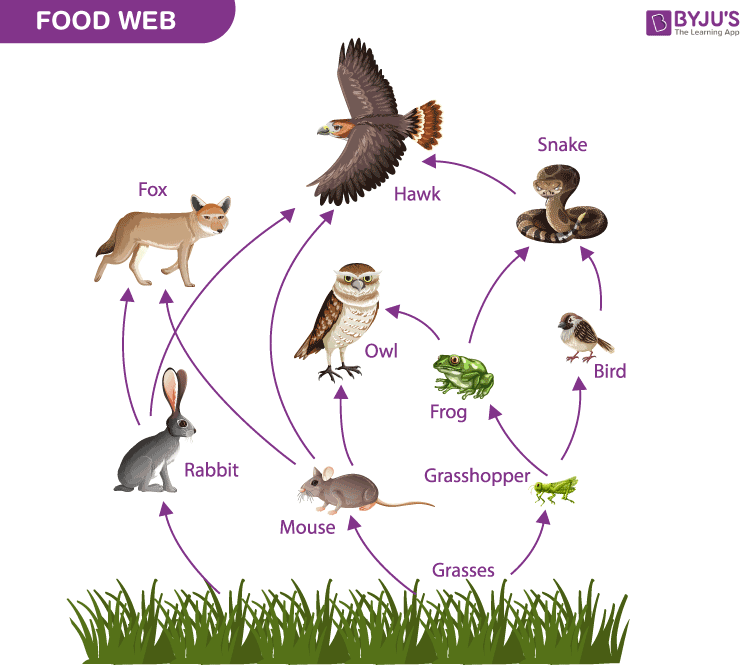
4th trophic level (tertiary consumer)
400
What are nitrogen-fixing bacteria?
Bacteria in soil that convert nitrogen from atmosphere into a form that is useable by plants.
400
Some stationary bodies of freshwater, such as ponds, are oligotrophic. What does this mean?
Low in nutrients
400
Describe one negative impact of invasive species.
Can comment on something related to ecosystem, economy, tourism, health.
500
A range for an abiotic factor that a species can survive within.
Tolerance range.
500
Which species has the most energy available to it?
Grass
500
Explain why photosynthesis and cellular respiration are complementary processes.
They each use the products of the other. Photosynthesis requires CO2 made during CR, and CR requires O2 made during photosynthesis.
500
List 2 of the 5 biomes in Canada
Mountain forest, boreal forest, temperate deciduous forest, grassland, tundra
500
Using this image, describe the difference between bioaccumulation and biomagnification.
Bioaccumulation - the buildup of toxin in an individual organism over time due to it being difficult to excrete.
Biomagnification - the build up of a toxin as you move up a food chain