Vocab
Energy & Trophic Levels
Symbiosis
Population
Nutrient Cycles
100
A cat stalks, kills, and then eats a bird. Based on its behavior, which ecological term best describes the cat?
Predator
100
What trophic level are herbivores?
Primary consumers (second trophic level)
100
What is symbiosis?
A close, long-term interaction between two different biological species
100
What is a population?
A group of organisms of the same species living in the same area
100
Which process releases carbon dioxide into the atmosphere?
a. photosynthesis
b. respiration
c. nitrogen fixation
d. transpiration
b. respiration
200
What is an abiotic factor?
A nonliving part of the environment
200
What is the 10% rule?
Only ~10% of energy transfers to the next level
200
What is mutualism?
Both organisms benefit
200
What type of population graph has a J-shape?
Exponential
200
What process do plants use to take in carbon dioxide?
Photosynthesis
300
What is carrying capacity?
The maximum population size of a species that an environment can sustain
300
What are the three types of ecological pyramids we discussed?
Energy, mass, and numbers
300
A kitten has roundworms living in its intestines and taking nutrients from it. What type of symbiotic relationship is this?
Parasitism
300
What type of growth does the graph below best represent? 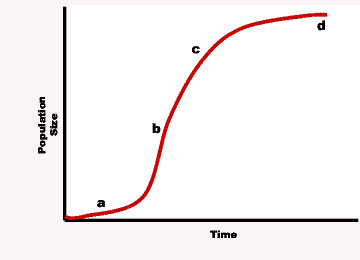
Logistic
300
Bacteria convert nitrogen gas from the air into a form plants can use. What process is this?
Nitrogen fixation
400
What is a niche?
The role of an organism (how it lives, eats, interacts
400
What type of pyramid best describes the image below?
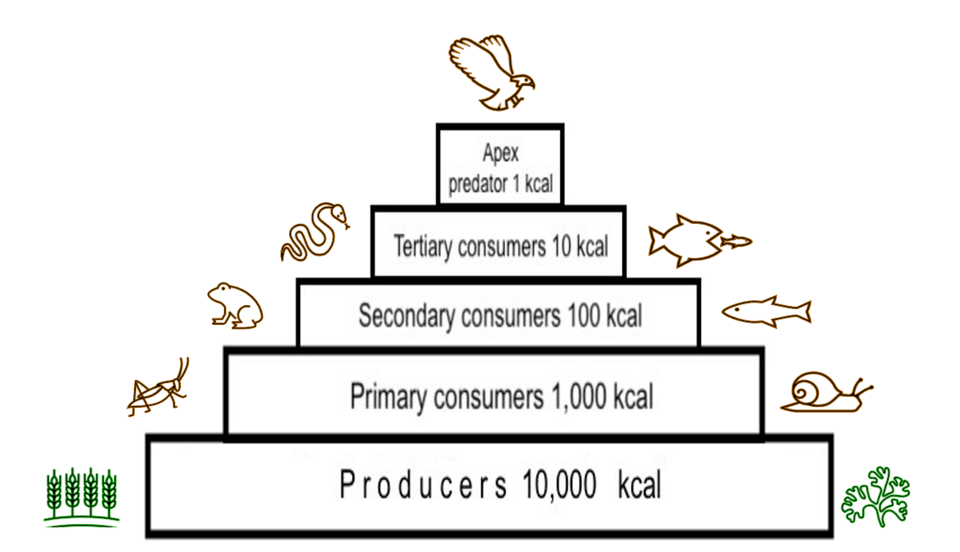
Energy pyramid
400
What type of relationship is this?

Mutualism
400
A wildfire destroys a large portion of a forest, reducing the population of organisms regardless of population size. What type of factor is this?
a. density-dependent
b. density-independent
c. biotic
d. symbiotic
b. density-independent
400
Which process returns nitrogen gas to the atmosphere?
a. nitrification
b. nitrogen fixation
c. denitrification
d. assimilation
c. denitrification
500
A deer population stops growing even with space available. Why?
Limiting factors (food, disease, predators, water, etc.)
500
Top predator population increases. What is a possible effect?
Decrease in prey, increase in competition, possible ecosystem imbalance
500
What type of relationship is this?

Commensalism
500
A disease spreads more quickly as population density increases. What type of limiting factor is this?
a. density-independent
b. density-dependent
b. density-dependent
500
How does deforestation most directly affect the carbon cycle?
a. It increases nitrogen levels in soil
b. It decreases carbon dioxide in the atmosphere
c. It reduces photosynthesis, increasing atmospheric CO₂
d. It stops decomposition completely
c. It reduces photosynthesis, increasing atmospheric CO₂