Consumers
Producers
Decomposers
Endangered Species
Mr Amodeo's Favourite Animals
100
What do we call a consumer that eats only producers (plants)?
Herbivore
100
Producers don't go to the grocery store. Where do almost all producers on Earth get the initial energy to start their food-making process?
The sun
100
If you have a bin in your backyard where you throw fruit peels and grass clippings to turn them into soil, what is that process called?
Composting
100
This black-and-white bear from China spends 10 to 16 hours a day eating bamboo. What is it?
The Giant Panda
100
What is the name of this animal?
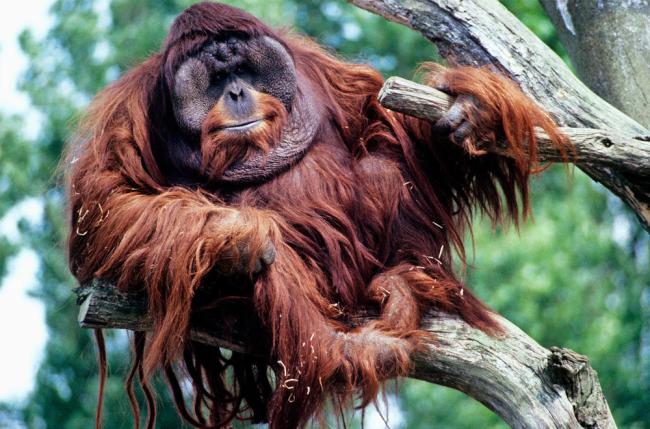
Orangutan
200
Humans, bears, and raccoons eat both plants and animals. What is the scientific term for this?
Omnivore
200
During photosynthesis, producers breathe in a gas that humans breathe out. What is that gas?
CO2 (Carbon Dioxide)
200
When a piece of bread sits out too long and gets fuzzy green spots, what specific type of decomposer is eating your lunch?
Mold
200
Polar bears look white so they can hide in the snow, but what color is their skin underneath all that fur?
Black
200
How long do Koala's sleep each day? (Your answer must be within 3 hours of the correct answer to receive points)
About 20 hours a day (I wish that was me)
300
What is the term for a consumer at the very top of the food chain that has no natural predators?
An Apex Predator.
300
To perform photosynthesis, plants need a special green pigment to "trap" sunlight. What is this pigment called?
Chlorophyll
300
What is the main job of a decomposer in an ecosystem?
To break down dead plants and animals and recycle nutrients back into the soil.
300
Sea turtles are endangered globally. The temperature of the sand decides if the babies will be boys or girls. Does warm sand usually create more boys or more girls?
Girls
300
If a dog lived in a world where they didn't have fingerprints, what part of their body could be used to identify them because the pattern is 100% unique to every dog?
Their Nose (The "Nose Print").
400
Why are Flamingos pink?
Their diet is rich in natural, red-orange pigments called carotenoids, specifically beta-carotene, found in algae, brine shrimp, and crustaceans.
400
Not all producers are trees or flowers. What microscopic, plant-like organisms live in the water and produce about 50% of the Earth's oxygen?
Phytoplankton (algae)
400
What is the main difference between a Scavenger (like a vulture) and a Decomposer (like bacteria)?
Scavengers eat large pieces of dead organic matter; Decomposers break down what’s left on a molecular/cellular level.
400
This whale lives in the icy Arctic waters of Canada and is famous for the long, spiral "horn" (which is actually a tooth) sticking out of its head. What is it?
The Narwhal
400
Elephants can communicate with each other from miles away without making a sound you can hear. How do they "feel" the messages sent by other elephants?
Through their feet. (They pick up seismic vibrations in the ground).
500
Butterflies taste their food using which part of their bodies?
Their feet
500
Plants don't just make "food"; they specifically make a type of sugar. What is the name of this sugar?
Glucose
500
If all decomposers suddenly went extinct, what would eventually happen to the Producers (plants)?
They would die out because the soil would run out of nutrients (like nitrogen and phosphorus) that are normally recycled by decomposers.
500
Tigers are endangered and very territorial. According to scientists, what snack food does tiger urine smell like?
Buttered Popcorn
500
If you look at a beaver’s front teeth, they aren't white like ours; they are actually bright orange. What metal is found in their teeth that makes them strong enough to chop down trees?
Iron