Charging & Particles
Forces & Static
Materials & Charging
Current & Circuits
Ohm's Law & Units
Think like a Scientist
100
What are the three main subatomic particles, and what is the charge of each?
Proton: positive; electron: negative; neutron: neutral.
100
What is an electroscope used for?
To detect the presence of electric charge.
100
Define a conductor.
A material through which electrons move easily.
100
What is electric current?
The net movement/flow of electric charge in one direction through a path.
100
What are the units of voltage, current, and resistance?
Voltage: volts (V); current: amperes (A); resistance: ohms (Ω).
100
If resistance is reduced to one-fourth while voltage stays constant, what happens to current?
Current becomes four times as large.
200
An atom has 6 protons and 4 electrons. What is its net charge?
Positive (+2)
200
When an electroscope is charged, what happens to its leaves?
They spread apart because like charges repel.
200
Name two common insulators.
Examples: plastic and glass.
200
What kind of current is supplied by household outlets? What kind do batteries provide?
Outlets: alternating current (AC); batteries: direct current (DC).
200
State Ohm’s law and give the formula for current.
V = I × R; rearranged, I = V/R.
200
A 60 Ω bulb is connected to a 1.5 V battery. How could you increase the current through it?
Increase the voltage while keeping resistance the same, or reduce the circuit’s total resistance. To match a 30 Ω bulb at 1.5 V, use 3.0 V across the 60 Ω bulb.
300
What is charging by contact?
Charge transfer through touching or rubbing.
300
What happens to electric force when charged particles move closer together?
The force increases.
300
True or false: wet skin generally creates a greater electric-shock risk than dry skin. Explain.
True. Water and dissolved substances lower skin resistance, allowing more current to flow.
300
What must an electric circuit have for current to flow continuously?
A closed conducting path and a voltage difference supplied by a source.
300
A lamp has 120 V across a resistance of 480 Ω. Calculate the current.
I = V/R = 120 V / 480 Ω = 0.25 A.
300
A lamp designed for 120 V and 480 Ω is plugged into 240 V. Assuming resistance stays 480 Ω, what current flows?
I = 240 V / 480 Ω = 0.50 A, twice the original current. In real life, the lamp may overheat or fail.
400
A charged balloon attracts a neutral stream of water without touching it. What explains the attraction?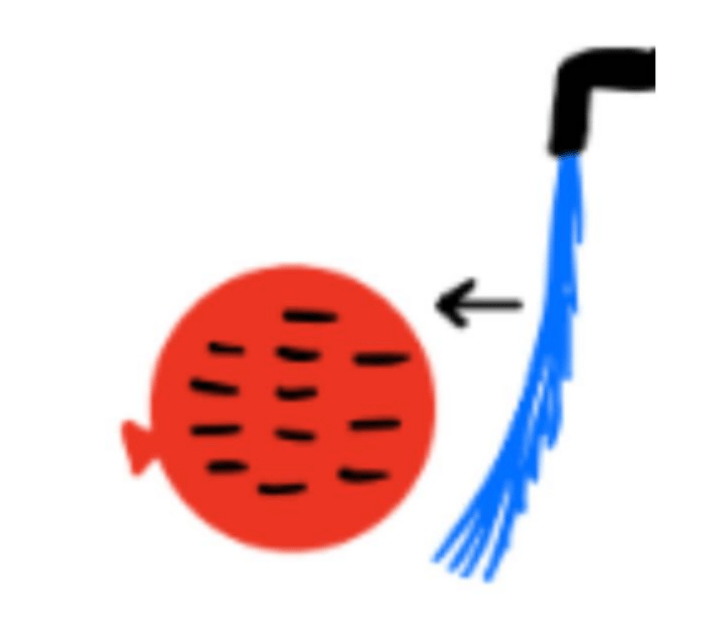
Induction/polarization: charges in the water shift slightly, so the nearer region is oppositely charged and attracted.
400
How does a thundercloud build up static electricity?
Moving air masses separate electric charges within the cloud.
400
How is charging by induction different from charging by contact?
Induction charges/rearranges charge without direct touching; contact transfers charge through touching.
400
What happens to current if the battery is removed from a simple circuit?
The current stops because the source no longer maintains a voltage difference.
400
A 9 V battery produces a current of 0.3 A. Calculate resistance.
R = V/I = 9 V / 0.3 A = 30 Ω.
400
What is one difference between current through a circuit and a static discharge?
Circuit current is a sustained flow through a closed path; static discharge is a brief, rapid transfer of accumulated charge.
500
Two identical metal spheres touch. A has 6 protons and 4 electrons; B has 6 protons and 6 electrons. What happens?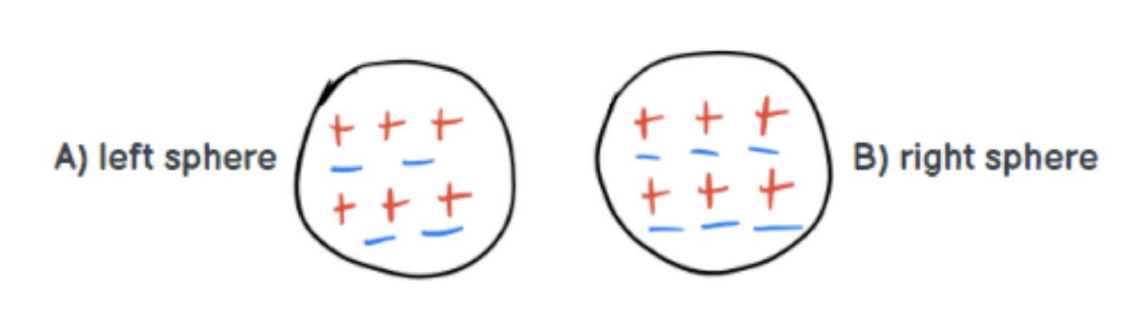
Electrons move from sphere B to the electron-deficient sphere A until charge redistributes. Total charge is conserved; if identical, each ends with net +1.
500
What is lightning?
A large electrostatic discharge caused by a rapid transfer of charge between clouds or between a cloud and the ground.
500
Can electric charge be created or destroyed when objects become charged? Explain.
No. Charge is conserved; electrons transfer from one object to another or redistribute.
500
What is the conventional direction of current in a simple circuit?
From the positive terminal toward the negative terminal through the external circuit; electron flow is opposite.
500
A generator supplies 45 V to a 10 Ω lamp. Calculate the current.
I = V/R = 45 V / 10 Ω = 4.5 A.
500
A resistor converts some electrical energy into what form of energy?
Often thermal energy (heat), though other forms may also result depending on the device.