Force
Charge distribution
Gauss
Fields
100
Two small spheres have equal charges q and are separated by a distance d. The force exerted on each sphere by the other has magnitude F. If the charge on each sphere is doubled and d is halved, the force on each sphere has magnitude
(A) F (B) 2F (C) 4F (D) 8F (E) 16F
(E) 16F
100
A flat square sheet of side length L has a uniform surface charge density σ. What is the total charge on the sheet?
a) σL b) σL2 c) σL3 d) σ/L2 e) σ/L3
b) σL2
100
Determine the electric flux for a Gaussian surface that contains 100 million electrons.
-1.8 Nm2/C
100
The electric field E just outside the surface of a charged conductor is
(A) directed perpendicular to the surface
(B) directed parallel to the surface
(C) independent of the surface charge density
(D) zero (E) infinite
(A) directed perpendicular to the surface
200
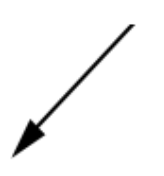
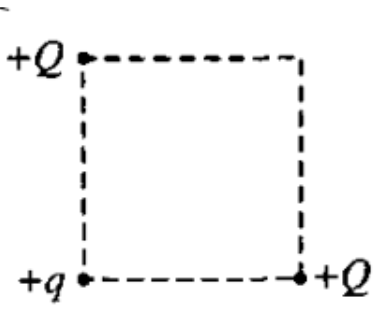 What is the direction of the force on the test charge due to the two other charges? (draw an arrow)
**do force 300 directly after
200
A rod of uniform linear charge density = +1.5 x 10⁻⁵ C/m is bent into an arc of radius R = 0.10 m. Determine the total charge on the rod.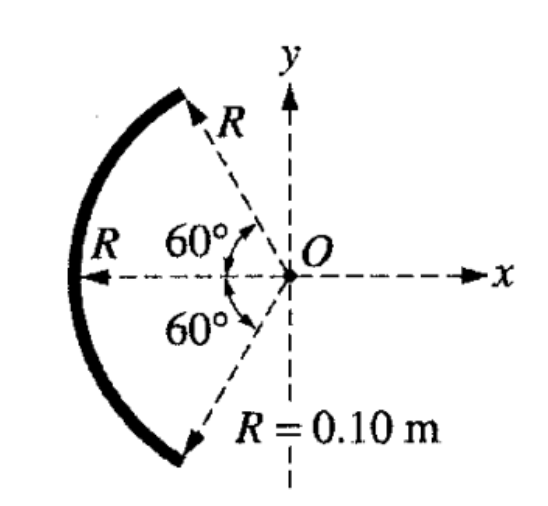
3.1*10-6 C
**Charge distributuon 300 next
200
A charge q is placed at one of the corners of a cube of side a, as shown below. Find the magnitude of the electric flux through the shaded face due to q. Assume q>0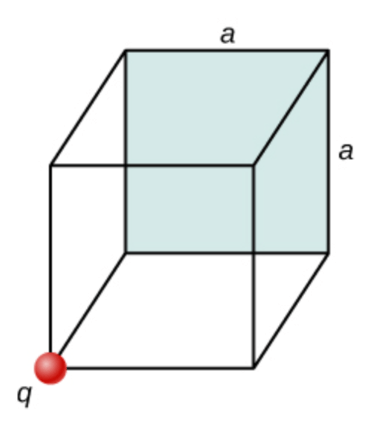
q/(24ε)
*Put q in the middle of a larger cube and find the flux through a side of the big cube, then divide by 4
200
Two positive charges of magnitude q are each a distance d from the origin A of a coordinate system as shown to the right. At which of the following points is the electric field least in magnitude?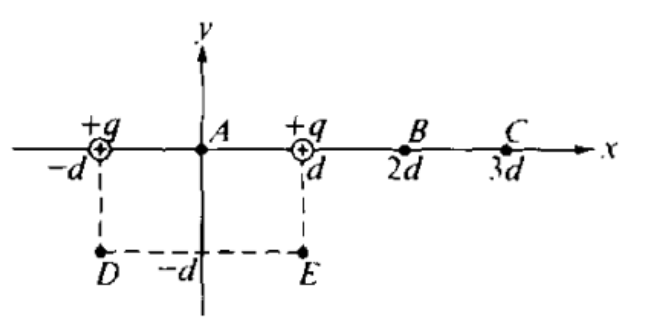
A
300
Point charges q1=10μC and q2=−30μC are fixed at r1=(3.0i−4.0j)m and r2=(9.0i+6.0j)m. What is the force of q2 on q1?
0.01985 N
300
A rod of uniform linear charge density = +1.5 x 10⁻⁵ C/m is bent into an arc of radius R = 0.10 m. Determine the magnitude and direction of the electric field at the center O of the arc.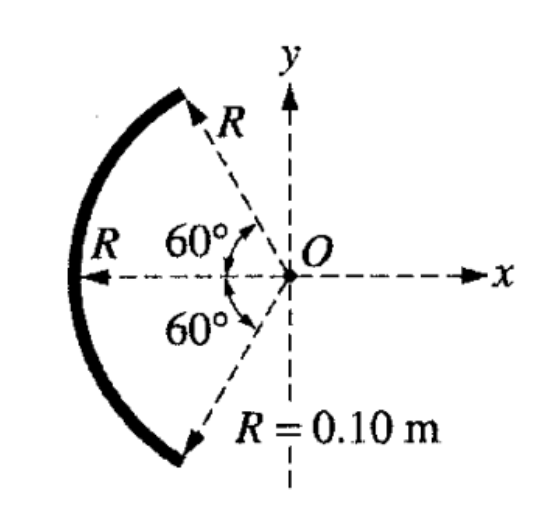
2.3*106 N/C
300
Draw a uniform line of charge and a concentric Gaussian cylinder, and use Gauss's Law to derive the equation for the electric field near a line of charge.
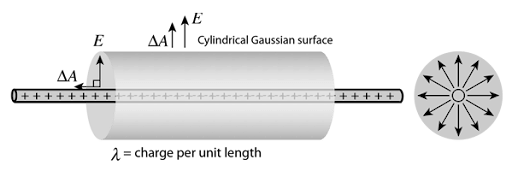
E=lambda/(2pirepsi)
300
Two large insulating planes each hold 1.8 C of excess charge. One plane is charged negatively and the other is charged positively. The planes are separated by a very small distance. Each plane is 1000 m wide and 1000 m long. Determine the magnitude of the E-field inbetween the planes and outside the planes
Outside = 0 N/C (E fields cancel)
Inside = 2.03*105 N/C
E=σ/ε=(Q/A)/ε
400
Two isolated charges, + 2q and -5q, are 2 centimeters apart. If F is the magnitude of the force acting on charge -5Q, what are the magnitude and direction of the force acting on charge + 2q ?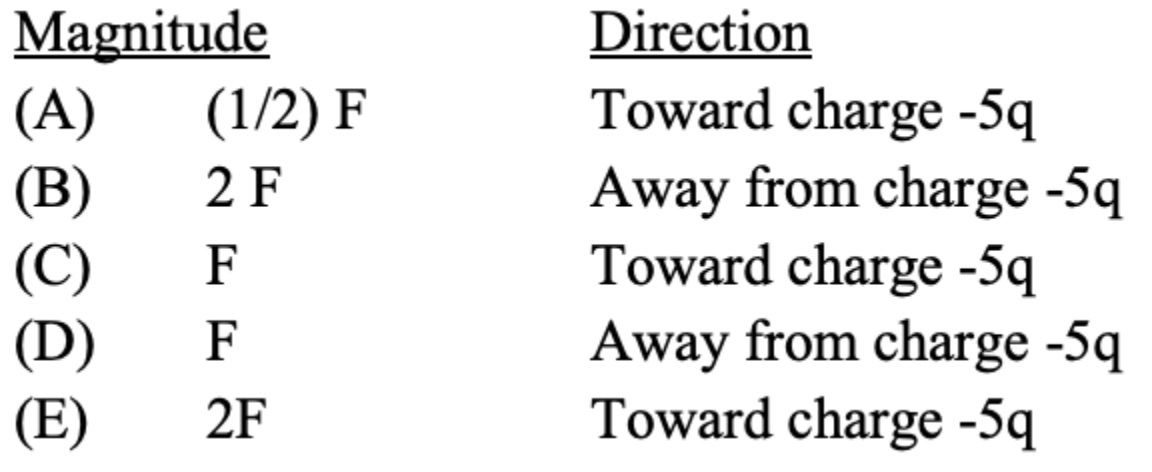
C
400
A sphere of radius R has a charge density rho=rho_o (r / R) where rho_0 is a constant and r is the distance from the center of the sphere. What is the total charge inside the sphere?
rho_opiR^3
400
A very long solid cylinder of length L and radius R has charge distributed uniformly throughout its volume. At a distance r from the axis, where r < R, the electric field strength is measured to be Er. What is the total charge of the cylinder?
Q=(2piepsiR^2LE_r)/r
400
Positive charge Q is uniformly distributed over a thin ring of radius a that lies in a plane perpendicular to the x-axis. with its center at the origin 0. Write a function for the electric field at any point on the X-axis.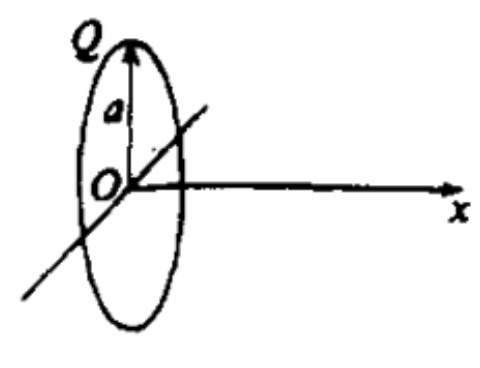
E(x)=(kQx)/(x^2+a^2)^(3/2)