Electricity
Current
Voltage
Resistance
Circuits
100
Materials that allow electricity to move through it easily
Conductors
100
The "flow" of electrons
Current
100
The potential to "push" electrons is called
Voltage (measured in Volts)
100
What is the unit for resistance?
ohms
100
This circuit has more than 1 path for electrons
Parallel
200
Atoms with electrons that are HARD to remove.
Insulators.
200
Tool that is allows you to measure both voltage and current.
Multimeter
200
In a series circuit, the sum of the voltage drops of each resister is equal to....
The voltage of the battery
200
How does resistance impact current?
More resistance = slower current
200
A circuit with only one path for electrons
Series Circuit
300
Atoms with electrons that are easily transferred.
Conductors
300
What unit is current measured in?
Amperes (Amps/A)
300
An increase in voltage will result in an increase in...
Current
300
What is the relationship between resistance and electric power? (Assume circuit voltage is fixed.)
If you increase the total resistance in a fixed-voltage circuit, the power decreases because less current flows.
300
What type of circuit is shown in this image?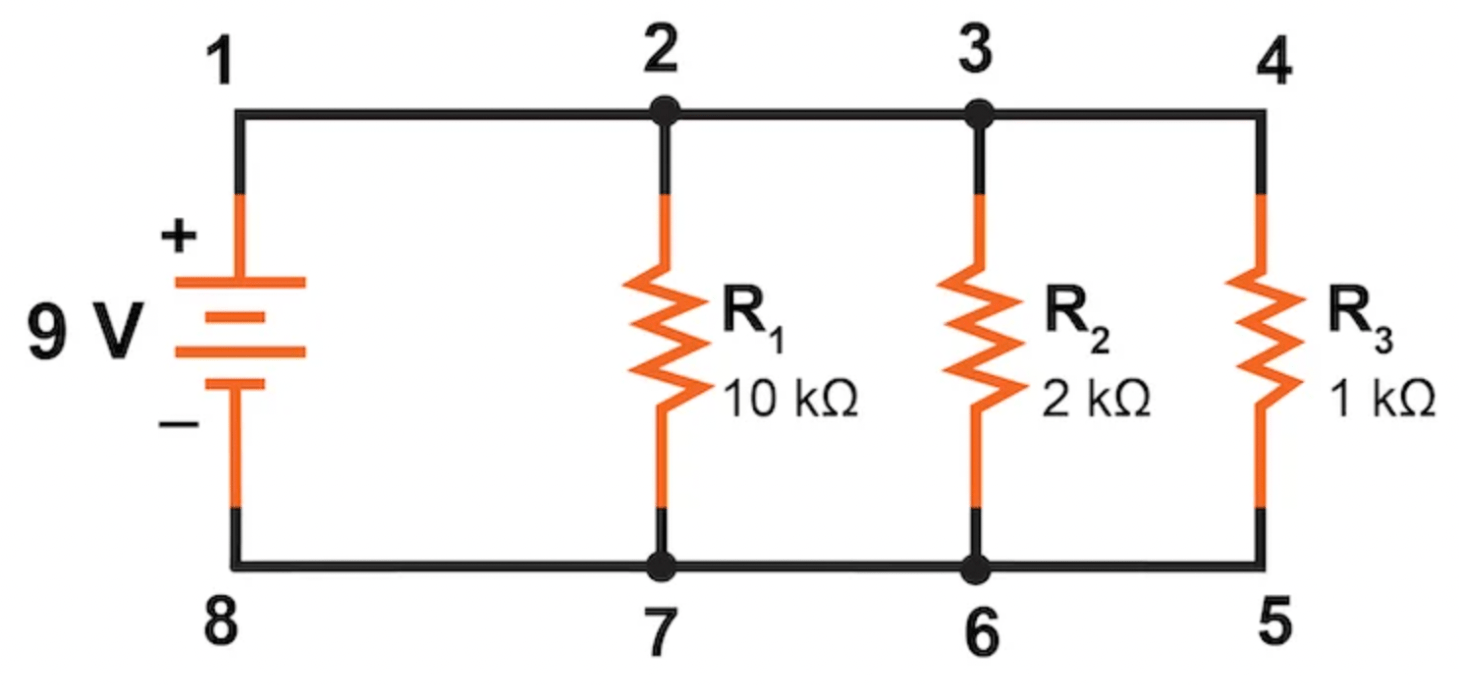
Parallel Circuit
400
The power source that contains a chemical reaction resulting in extra electrons.
A battery
400
What happens to current in a parallel circuit?
It divides into each branch
400
In a parallel circuit, resistors all have the same ___________ as the battery.
Voltage
400
What law describes the linear relationship between voltage, current, and resistance?
Ohm's Law
400
In this type of circuit, if one lightbulb goes out, the others will not be affected
Parallel
500
The rate of energy delivery measured in watts
Electrical Power.
500
When measuring the electric current in circuit, how should your multimeter be connected?
In series with the component so that current flows THROUGH the meter
500
According to Ohm's Law (V = I × R), what is the voltage if a current (I) of 3 A flows through a 2-ohm (R) resistor?
6V
500
If you add an additional resistor in parallel to an existing circuit branch that already contains a single resistor, what happens to the total equivalent resistance of the circuit?
It decreases
Think: adding an extra highway lane = more pathways to travel = less resistance
500
What happens to the brightness of identical bulbs in a series circuit if you add more bulbs?
They get dimmer because total resistance increases and current decreases.