Theorems
Limits
Shape of a Graph
Rates of Change
Grab Bag
100
Determine whether the Mean Value Theorem applies to y=1/x on the interval [0, 3] .
No, because it isn't continuous at x=0 .
100
Evaluate the limit.
\lim_{x\rightarrow 0}\frac{x^2-4}{x+2}
-2
100
A graph of f'(x) is shown. Where does f(x) have a local maximum?
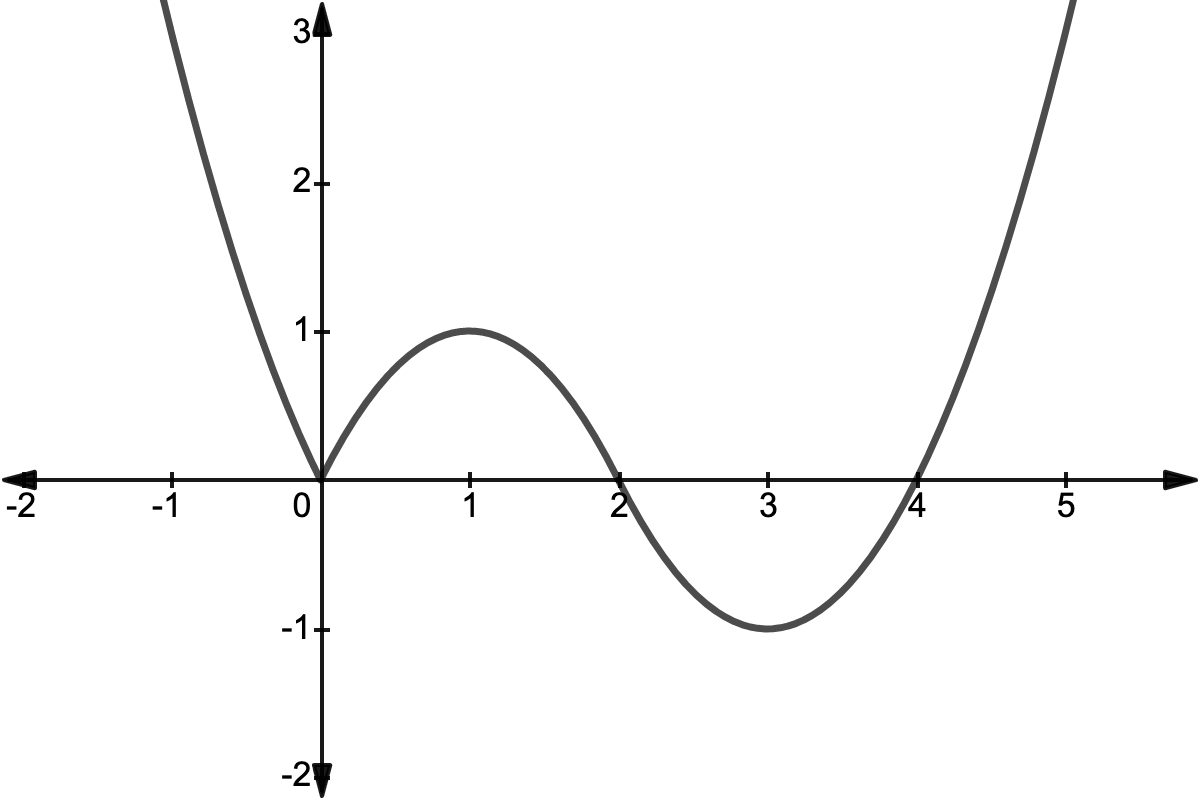
x=2
100
A particle moves on a number line, and its velocity v(t) in meters per second is shown in the graph. When is the particle changing direction?
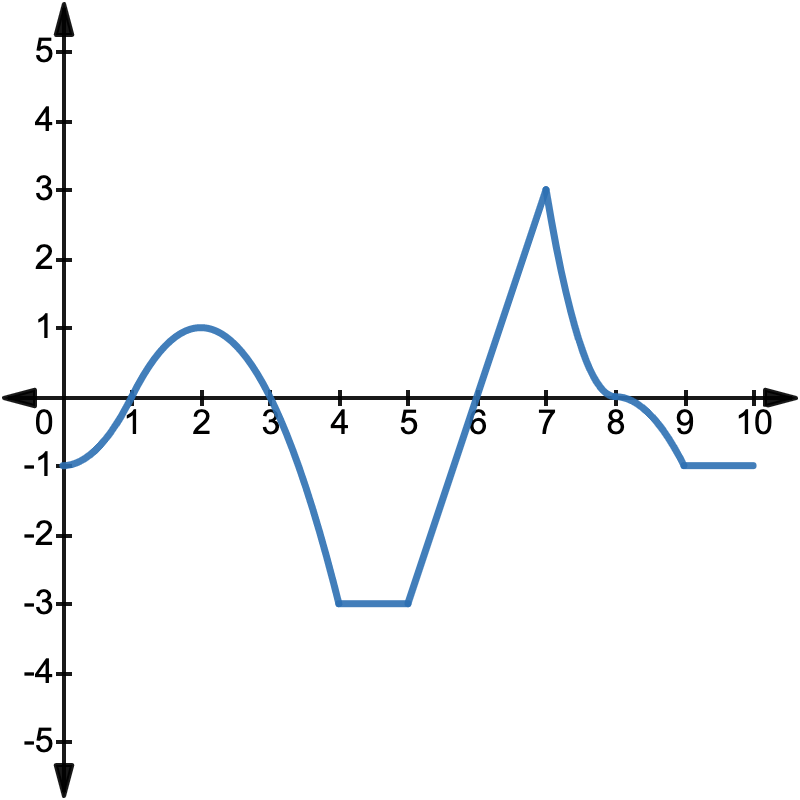
t=1, \ \ t=3, \ \ t=6, \ \ t=8
100
Use an appropriate linear approximation to estimate the value of \sqrt{39}.
25/4 \ \ \text{or} \ \ 6.25
200
Evaluate
\frac{d}{dx}\int_2^{x^3}\sin^2(t)\ dt
3x^2\sin^2(x^3)
200
Evaluate the limit.
\lim_{x\rightarrow 0}\frac{1-e^{-2x}}{\sinx+3x}
1/2
200
A graph of f'(x) is shown. Where does f(x) have inflection point(s)?
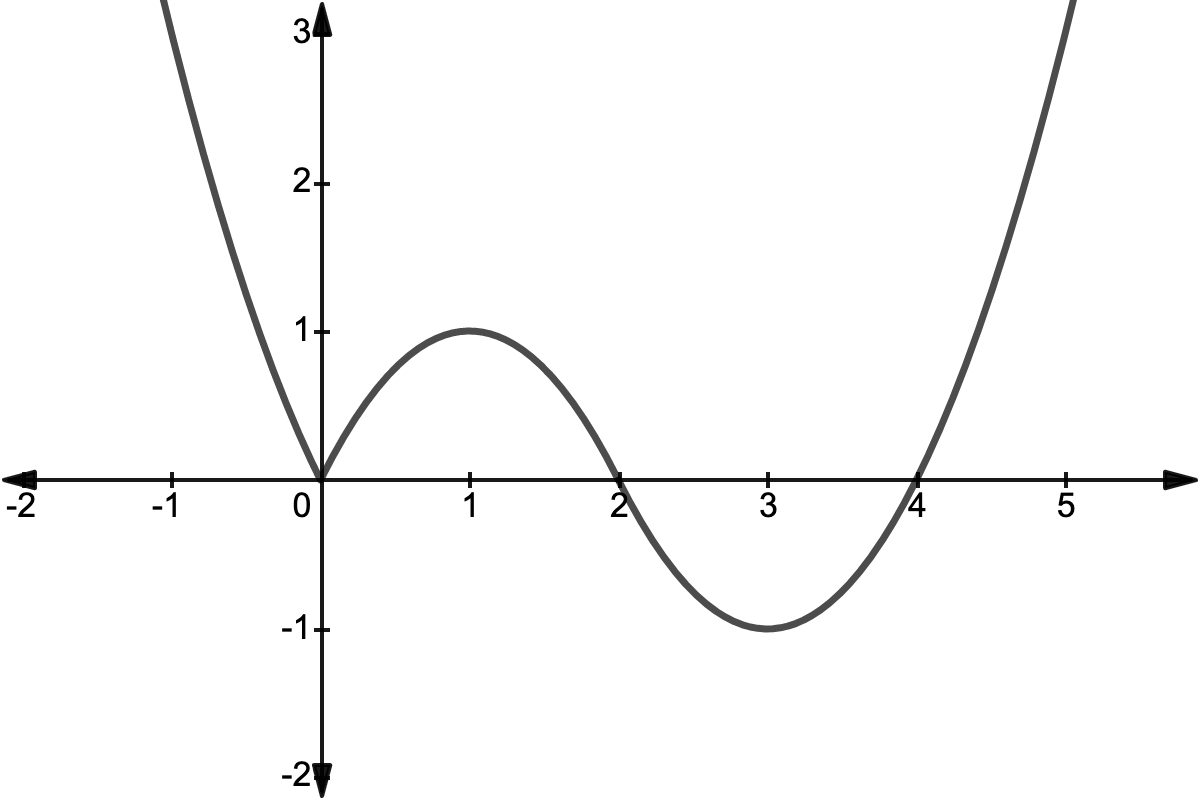
x=0, \ \ x=1, \ \ x=3
200
The temperature of a cup of coffee (in degrees Celsius) at select times during a 30-minute interval is given in the table. Use the data to estimate the rate of change of the temperature of the coffee at t=20 minutes.
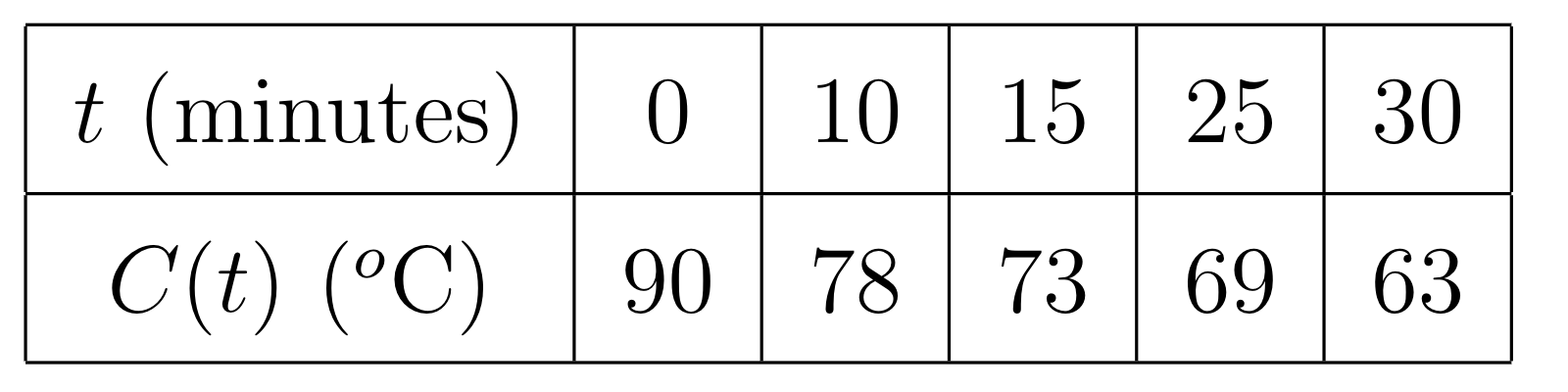
-2/5 \ { \ ^{\circ}C}/min
200
Find the absolute extrema of the function f(x)=x^2-4x+3 on the interval [1, 4] .
The absolute maximum is at (4, 3) and the absolute minimum is at (2, -1) .
300
Evaluate
\int_0^\pi \sin(x) \ dx
2
300
Evaluate the limit.
\lim_{h\rightarrow 0}\frac{\sin(x+h)-\sin(x)}{h}
\cos x
300
Where is the function f(x) = x^4-4x^3+1 increasing?
(3, \infty)
300
A particle moves on a number line, and its velocity v(t) in meters per second is shown in the graph. When is the particle slowing down?
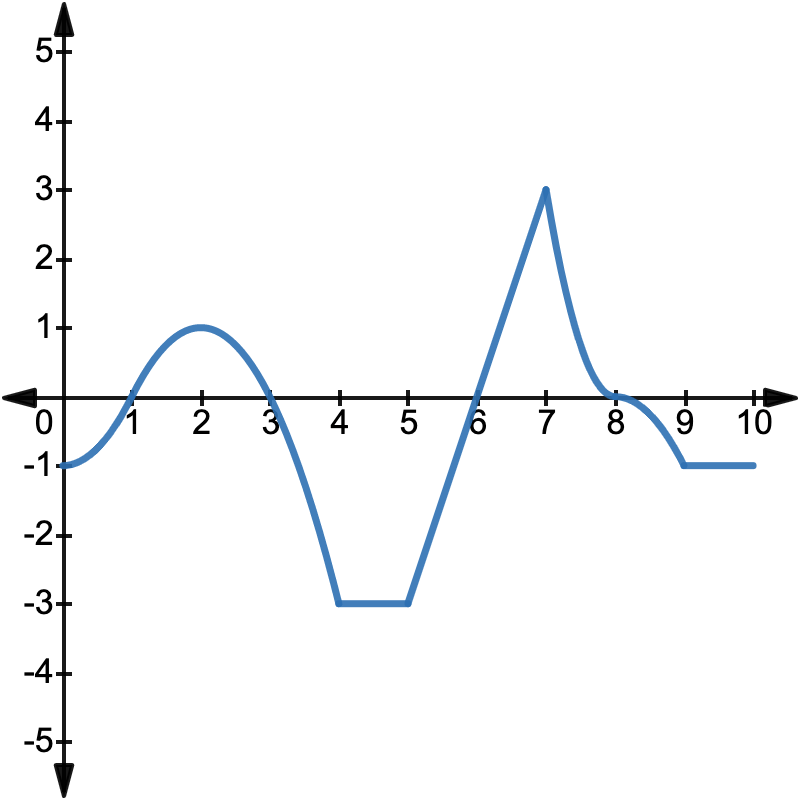
(0,1)\cup(2,3)\cup(5,6)\cup(7,8)
300
A box with an open top is to be constructed from a square piece of cardboard, 4 ft wide, by cutting out a square from each of the four corners and bending up the sides.
Find the largest volume that such a box can have.
128/27 \ \text{ft}^3
400
Find the value, c , guaranteed by the Mean Value Theorem for the function f(x)=x^2-4x+3 on the interval [1, 4] .
c=5/2
400
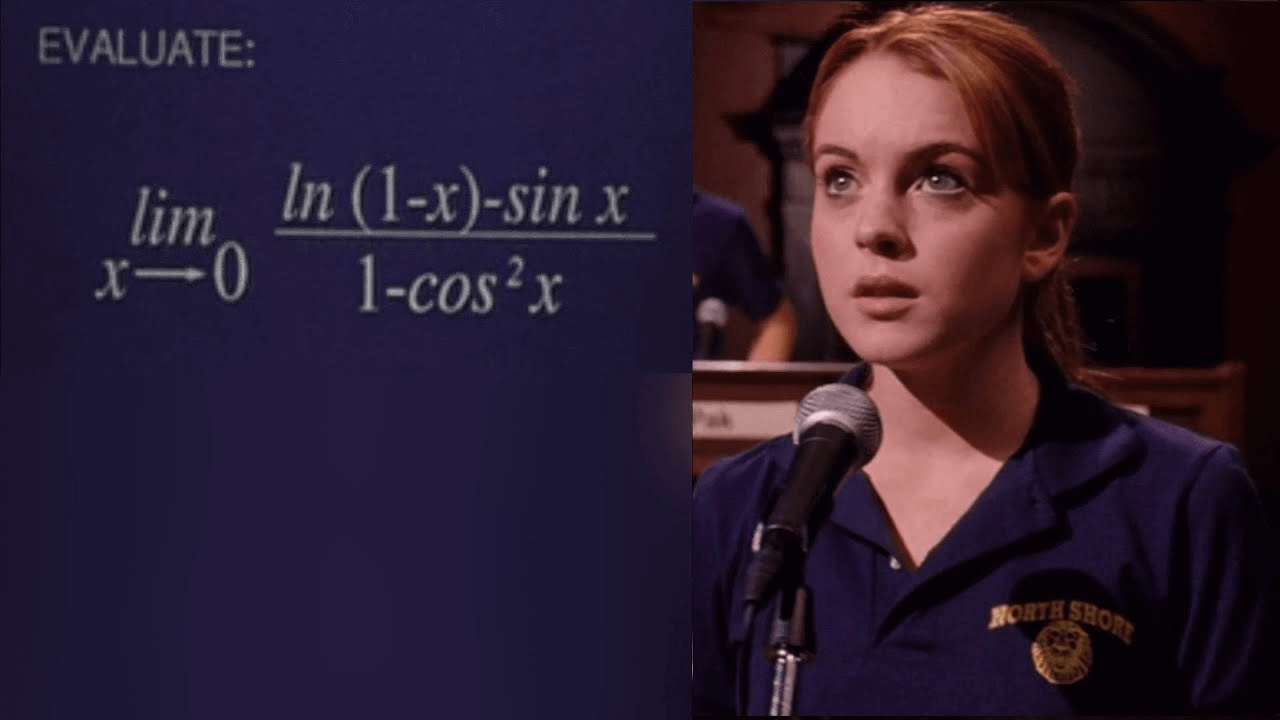

400
Where is the function f(x) = x^4-4x^3+1 concave down?
(0, 2)
400
A particle moves on a number line, and its velocity v(t) in meters per minute is shown in the graph. When t=0 , the particle is at the origin. Where is the particle after 10 minutes?
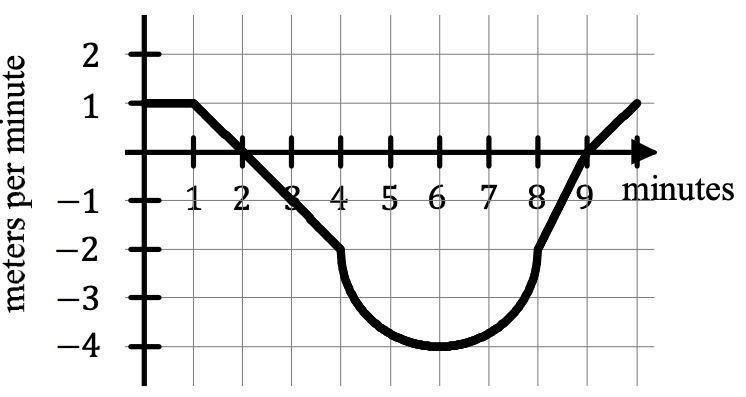
15.28 meters to the left of the origin, or
x=-9-2\pi
400
The base of a triangle is increasing at a constant rate of 2/5 cm/s and its height is decreasing at 1/10 cm/s. At what rate is the area of the triangle increasing or decreasing when its height is 3 cm and its base is 10 cm?
1/10 \text{cm}^2/\text{s}