Origin of Money
Econ 101
Econ 102
Capitalism in America
Poverty
100
What was the first civilization to use coins as currency as far as we know?
The Lydians (people who lived in what is now Turkey) in the 7th Century BCE
100
The law of demand says that when demand (the number of people willing to buy at a high price) increases, supply (the number of people willing to sell at a low price)...
Decreases
100
This is the economics term that means that every time you make a choice you are choosing not to do every other choice you could have made.
Opportunity Cost
100
According to both Waterhouse and Matthew Desmond, American Capitalism learned many lessons, from accounting to management, to treatment of workers, from this immoral business.
Slavery
100
Desmond argues that the United States is too stingy with anti-poverty programs and that it spends more money to support wealthy or middle class people. Name one example of an expensive government program that helps the wealthy.
1) Low taxes on capital gains
2) Homeowner's Tax Credits
3) Subsidized health care through work
4) Subsidized retirement plans
200
True or false: money was invented in order to deal with the "double coincidence of wants" problem created by the barter system, which came first.
False - the "double coincidence of wants" problem was solved by informal systems of debt and credit. Money's real advantage is that it made it easier to trade with people you didn't know.
200
A situation where prices are higher than they should be because one seller controls most of the market for a good is called a...
Monopoly
200
A name for a situation where a resource is available to everyone at a low cost, and as a result everything gets grabbed because people are worried that if they don't take it somebody else will.
Tragedy of the Commons
200
The book "Bowling Alone" by Robert Putnam suggests that as America becomes more consumerist it is losing this thing, which he defines as the networks, norms, and trust within a community that enable people to work together effectively for shared goals, much like physical or human capital, but residing in social relationships and fostering cooperation, information flow, and civic engagement.
Social Capital
200
Desmond points out that being poor is very expensive. Give an example of a way being poor adds extra expenses.
1) You might have to hire a lawyer to get benefits
2) You might have to pay high rent because you can't qualify for a mortgage
3) You have to pay full price for health care or a higher rate for insurance
4) You might have to use payday loans or check cashing services if you can't use a bank, which takes a chunk out of your pay
300
For 100 points each, what 3 things does a thing have to do to count as money?
1) Unit of measurement
2) Store of value
3) Unit of exchange
300
A situation where prices are lower than they should be because there is only one buyer available to wholesalers and they can demand a low price is called...
Monopsony
300
The name for a situation where someone is engaged in economic opportunity that has negative side-effects that cause harm to people not involved directly in the economic activity (for example, oil drillers who destroy an ecosystem)
Externality
300
Neal Postman's book, Amusing Ourselves to Death, is a criticism of consumer culture. Postman argues that by turning ideas and attention into commodities we have made our own culture fundamentally unserious. In modern times, people use Postman to critique the internet, but in his original book Postman was writing about this medium.
Television
300
Has the amount of government funding going to solve the problem of poverty increased or decreased over the last 20 years?
Increased. In 2000 the United States spent about $312.23 Billion in inflation-adjusted dollars on antipoverty programs. Today it's more like $1 Trillion.
400
What are two advantages of paper money over coins?
1) It's much lighter
2) You don't need specific material to be mined in order to get it
3) You can't "cheat" by cutting bits off of it
400
A situation in which a product remains expensive because the buyers for that product can't find any way to replace it even when the price is high and are unable to simply not buy the product is called...
Inelastic Demand
400
This is the word for a situation in which one country can produce all goods more efficiently than its trading partner, but by focusing on the good it can produce most efficiently and allowing the other country to focus on the good it can produce most efficiently, the overall amount of stuff in the world increases, causing prices overall to go down.
Comparative Advantage
400
Gary Cross points out that this US President changed the rules around what could be on television in a way that drastically changed programming for children, resulting in a huge market for toys based on fictional characters.
Ronald Reagan.
400
What is the name of the government program that was turned into "block grants" during the Clinton administration and as a result was used by state governments to fund bizarre things like free cars, musical performances, and football tickets?
Temporary Assistance for Needy Families (TANF)
500
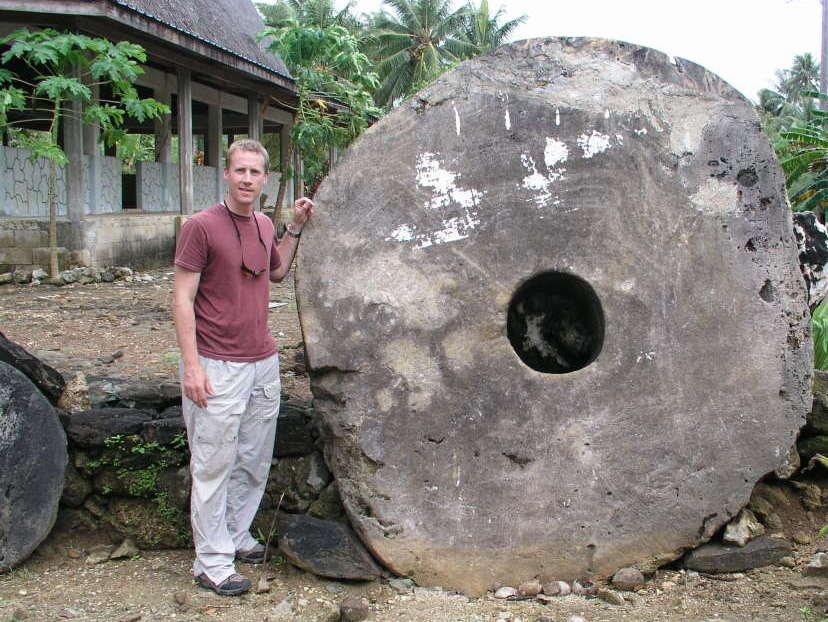 What is this?
It is a Yap Island Coin
500
The job of the Fed, according to Keynes, is to make money scarce if the economy starts moving to fast and make money plentiful if the economy starts to stall. He also thinks the government should be willing to borrow and spend a ton of money if it hits a depression or a recession in order to pull out of the ditch. What is the name for this kind of monetary policy?
Countercyclical
500
The Great Depression is an example of a terrible thing that can happen to an economy, in which prices start to drop because no one can buy anything and as a result people get fired and wages go down because businesses need to make ends meet but then even more people can't buy things so prices drop even more and the whole thing repeats. What is this terrible loop called?
Wage Price Spiral
500
This is the word for an economic system that loves global trade, hates tariffs, believes in letting markets set rules and is skeptical of government regulation, dislikes unions, and is heavily backed by think tanks and lobbying organizations like the Cato Institute, the Heritage Foundation, and the Chamber of Commerce.
Neoliberalism
500
This is the name for a movement that reduces the cost of housing through cooperative ownership of buildings and "sweat equity", which means donating time and labor to fixing up a building rather than paying cash. What is the movement called?
Commoning