Primary Hyperaldosteronism
Cushing Syndrome? Disease? Are they the same thing?
Incidental Adrenal Mass (don't forget to put in in the trauma DC summary)
Pheochromocytoma
Adrenal Cancer (King)
100
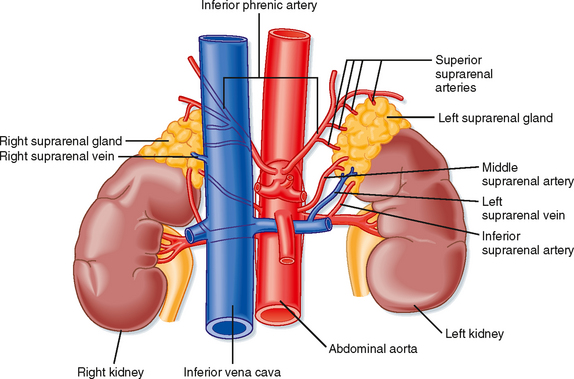
The adrenal gland receives blood from three major sources (ie, origin of adrenal arteries). What are they?
Superior adrenal = inferior phrenic a.
Middle adrenal = Aorta
Inferior adrenal = Renal arteries
100
What is the most common cause of Cushing syndrome?
Exogenous corticosteroids
100
What is the most common cause of primary adrenal insufficiency? Secondary adrenal insufficiency?
Primary --> autoimmune destruction (Addison disease)
Secondary --> Pharmacologic steroid withdrawal
*Secondary adrenal insufficiency usually seen in high supraphysiologic doses for 5 days [>20mg prednisone daily] or low supraphysiologic doses for more than 3 weeks)
100
Embryologic origin:
Cortex?
Medulla?
Cortex = Mesoderm
Medulla = Neural Crest Cells
100
What is the venous drainage of the adrenal glands?
Left = Left renal vein
Right = directly into IVC

200
______________ delivery to the juxtaglomerular apparatus stimulates aldosterone release, which results in __________________ in the kidney
Low sodium delivery to the juxtaglomerular apparatus stimulates aldosterone release, which results in Na+ and Cl- resorption in the distal tubule
Result: Increased extracellular fluid volume and BP (governed by RAAS system)

200
What is the initial testing when working up possible hypercortisolism/Cushing syndrome?
24h urine free cortisol
200
Which enzyme in catecholamine synthesis is only found within the adrenal medulla and organ of Zuckerkandl?
Phenylethanolamine N-methyltransferase (PNMT)
(converts NE --> Epinephrine)
*organ of Zuckerkandl helps regulate BP, etc. as a newborn and usually involutes after birth or by age 2-3

200
_____________ receptor blockade ameliorates the physiologic effects of pheochromocytoma catecholamine secretion. It is important to give this prior to _________ receptor blockade to prevent hypertensive crisis
Alpha
Beta
*unopposed alpha = hypertensive crisis which can lead to acute cardiac decompensation
200
Adrenal cancer may be related to Li-Fraumeni syndrome, which is a mutation in which gene?
p53
*tumor suppressor, helps mediate apoptosis
300
What are the two lab tests (and their values) that, when combined, have > 90% sensitivity for diagnosing primary hyperaldosteronism?
Plasma aldosterone:renin ratio > 30 ng/dL per ng/(mL x h)
Absolute aldosterone of 15 mg/dL
*get 24h urine free cortisol and/or two bedtime salivary cortisol levels to r/o Cushing syndrome
*get plasma free metanephrines to r/o pheochromocytoma
300
You order 24h urine free cortisol, what is the next step if:
1) Urine cortisol > 3x normal?
2) Urine cortisol between 1-3x normal?
1) Probable Cushings -> plasma ACTH
2) Late night salivary cortisol -> if >550 ng/dL then probable Cushings -> plasma ACTH
300
Describe the biochemical workup (2 main tests) that should be performed in a patient with an incidentally discovered adrenal mass...
1) Plasma metanephrines (r/o pheochromocytoma)
2) Overnight low-dose (1mg) Dexamethasone test
*If hypertensive or hypokalemic add plasma aldosterone and renin to r/o aldosteronoma
300
According to SCORE, what is the most commonly used alpha antagonist when treating pheochromocytoma?
Doxazosin (even if no HTN)
*start at low dose, titrate up until patient is orthostatic (SBP drop of 20, DBP drop of 10) over 10-14 days prior to surgery
*doxazosin spares alpha-2, thus has less reflex tachcyardia but phenoxybenzamine works too but $$$
*high salt diet prior to surgery to expand intravascular volume
300
What is the only curable treatment for adrenal carcinoma?
Complete surgical resection (open)
*with en bloc resection of involved organs
*some studies have shown earlier recurrence and poorer survival w/ laparoscopic resection
400
Which blood pressure medications are appropriate for BP control prior to unilateral adrenalectomy for aldosteronoma?
CCB, aldosterone antagonists, ACEi/ARB
*avoid Beta-blockers, clonidine or any other anti-HTN that needs to be weaned
400
DAILY DOUBLE
What is the recommended treatment for ACTH-independent hypercortisolism and what is (are) the major contraindication(s) to MIS approach?
Adrenalectomy
Contraindications: concern for adrenal cortical carcinoma and/or direct tumor extension
Indications: any functional adenoma, size less than 4cm without suspicious features
400
Name at least 4 radiographic features of adrenal incidentaloma that suggest a benign lesion
Small size < 4cm
Homogenous appearance
Low attenuation
> 50% contrast washout after 10-15 minutes
Density < 10 HU on unenhanced CT
Loss of signal on opposed-phase MRI imaging sequences
400
What additional test is indicated in a patient with elevated plasma metanephrines with equivocal 24 hour urine metanephrines?
Clonidine suppression test
*give 0.3mg clonitine and then measure plasma free metanephrines
*failure to suppress normetanephrine levels is a positive test and suspicious for pheochromocytoma
*clonidine does not affect autonomous catecholamine production from pheochromocytoma - it reduces SNS outflow and NE release from SNS nerve endings

400
What drug is used for patients with ACC that is unresectable, high risk for recurrence, and recurrent disease?
Mitotane
*cytotoxin that kills adrenal cortex cells and inhibits steroid synthesis
500
What additional biochemical testing can be done for increased specificity (not localization) in diagnosing primary hyperaldosteronism? (Name at least 3)
1) Saline challenge - 2-3L IV NS over 4-6h then check aldosterone level
2) Oral salt load - 5000mg Na+ POx 3 days then check 24h urine aldosterone excretion
3) Fludrocortisone suppression - q6h x4d then check plasma aldosterone
4) Captopril challenge - 25-50mg one time dose, check plasma aldosterone in 2 hours (draw baseline labs first)
*aldosterone levels that remain elevated in either situation = primary hyperaldosteronism
*Localization: thin-slice CT (3mm) or adrenal vein sampling with one adrenal vein having 4x aldosterone than the other confirms site
500
You have determined a patient has ACTH-dependent Cushing disease. You did the appropriate workup with pituitary MRI and high-dose dexamethasone suppression testing. High-dose dexamethasone suppression testing fails to suppress ACTH levels. What is the most appropriate management for this patient's disease?
Transsphenoidal pituitary microsurgery
*if fails, do bilateral adrenalectomy
500
You are following a patient for a non-suspicious, 2.5 cm non-functioning adrenal mass. You appropriately order a 6 month CT scan, then annually as well as yearly plasma metanephrines and low-dose overnight dexamethasone testing.
What findings during this surveillance interval are indication for adrenalectomy? (3)
1. Interval growth > 1 cm
2. Evidence of hormone hypersecretion on lab testing
3. Symptoms of hormone hypersecretion (eg, Cushing syndrome)
500
In which two instances are either MIBG, FDG PET, or DOPA scanning used when working up pheochromocytoma?
1. Biochemical evidence but non-localizing CT scan or MRI
2. Suspected metastatic pheochromocytoma
*up to 30% of patients with pheochromocytomas will initially present with an incidentaloma on imaging for another reason
500
What are the T stages for ACC (1-4)?
T1 - < 5cm, no invasion
T2 - > 5cm, no invasion
T3 - tumor invasion into fat
T4 - tumor w/ organ invasion