Energy
Energy Forms
Energy Transformation
Heat Transfer
Specific Heat
Let's do Math!
1
Energy is the ability to do _______.
Work
1
The movement of energy through substances in waves.
Sound Energy
1
The Law of Conservation of Energy states that energy cannot be created or destroyed—it can do this.
Transform
1
The average amount of kinetic energy in the particles of an object is called _________.
Temperature
1
Chefs prefer cooking pots made with copper or iron bottoms because metals have a low specific heat, allowing them to do this quickly.
Heat up quickly
1
What is the formula for calculating potential energy?
PE = m x g x h
1
What is the unit of measurement for energy?
Joules (J)
1
A form of electromagnetic radiation emitted by objects like lasers, bulbs, and the sun.
Light Energy
1
A toaster transforms electrical energy into _______ energy.
1. Thermal (heat)
1
Heat transfer is the transfer (movement) of energy between objects at _________ temperatures.
A. The same
B. Greater
C. Different
D. Low
C. Different
1
TRUE or FALSE: It takes different amounts of energy to make the same temperature change in different substances.
TRUE
1
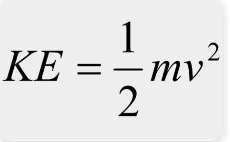
What is the formula for caluclating kinetic energy?
1
What are the 2 main types of energy?
Potential and Kinetic
1
Energy resulting from the flow of electric charges.
Electrical Energy
1
Photosynthesis transforms light energy into _____ energy.
Chemical
1
Thermal energy is always transfered from the ________ object to the _______ object. (Think temperature)
Warmer, Cooler
1
Specific heat is measured in this temperature scale.
Celsius
1
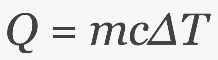
What is the formula to calculate specific heat?
2
What kind of energy is stored in an object due to its position?
Potential Energy
2
Energy that comes from objects in the form of electrical and magnetic waves that can travel through space.
Electromagnetic Energy
2
When a battery-powered flashlight is switched on, this is the complete three-step energy sequence that takes place.
Chemical -> Electrical -> Light
2
Heat transfer through direct contact is __________.
Conduction
2
_________. is the amount of energy required to raise the temperature of a material
Specific Heat
2
There is a bell at the top of a tower that is 5 m high. The bell has a mass of 0.19 kg. The bell has _____________ energy. Calculate it.
Potential, 9.5 J
2
What kind of energy is in motion?
Kinetic Energy
2
_______ energy is energy stored in the bonds of chemical compounds, like atoms and molecules. This energy is released when a chemical reaction takes place.
Chemical
2
Playing a guitar involves transforming mechanical energy from plucking a string into this type of energy.
Sound Energy
2
What is the transfer of energy through empty space (does not require matter)?
Radiation
2
On a hot summer day at the beach, the ocean water feels cold while the sand burns your feet because sand has a much ________ specific heat capacity.
Lower
2
A 0.4 kg cat jumps with a velocity of 4 m/s. Calculate the kinetic energy of the cat.
3.2 J
2
Energy cannot be _______ or ________. (must name BOTH)
created or destroyed
2
A combination of kinetic and potential energy in an object that is used to do work
Mechanical Energy
2
Solar panels gather energy from the sun and transform it into this form of energy.
Electrical Energy
2
Heat ALWAYS moves from the warmer object to the colder object until their temperatures reach ___________.
Equilibrium
2
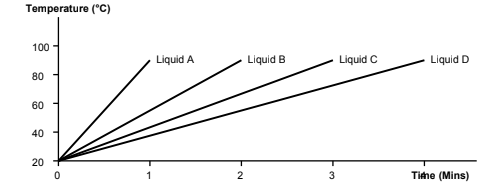
Which liquid would have the highest specific heat?
Liquid D
2
Given that the specific heat capacity of gold is 0.129 J/g°C, how much heat energy is required to raise the temperature of 3.125 g of gold from 20°C to 31°C?
4.434375 J
3
Name 1 of 2 things that energy CAN do according to the Law of Conservation of Energy.
1. Transform
2. Transfer
3
________ energy is produced when particles in a solid, liquid, or gas are in motion. Also produced by friction.
Thermal
3
Inside a car engine, gasoline undergoes a reaction that converts chemical energy into thermal energy and then into this type of energy to move the wheels.
Mechanical Energy
3
This is heat transfer by movement of liquids and gases.
Convection
3
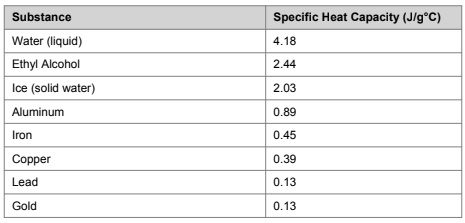
Using the table above, which materials would be considered insulators?
Water, Ethyl Alcohol, Ice
3
Calculate the kinetic energy of a rock that has a mass of 55 kg rolling down a hill with a velocity of 8 m/s.
1760 J
3
The force that two objects exert on each other when they move against each other, resisting movement.
Friction
3
The energy released during nuclear fission or fusion, especially when used to generate electricity.
Nuclear Energy
3
When a glowing glowstick is snapped, a chemical reaction occurs that transforms chemical energy directly into this form of energy.
Light Energy
3
Near the ceiling of a room the air is warmer. The warm air rises because of _________.
Convection
3
Scenario: Baking an apple pie involves a metal tin, pastry crust, and apple filling. When removed from the hot oven, the metal tin is cool enough to pick up with bare hands long before the apple filling is safe to eat.
• Rank the three components (Metal Tin, Pastry Crust, Apple Filling) from lowest specific heat to highest specific heat.
Metal Tin, Pastry Crust, Apple Filling
3
Calculate the potential energy of a 2120 kg car sitting on a hill 30 m higher than ground level.
636000 J
3
The energy in a system remains _______.
Constant (the same).
3
When atoms combine, that is called _______.
Fusion
3
When you slam on the brakes of a speeding bicycle, the bicycle's kinetic energy quickly transforms into _______ energy and this other form of energy in the brake pads and tires.
Sound and Thermal
3
Heated particles begin to move ________ .
Quickly
3
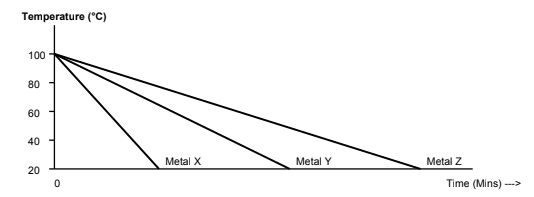
Which metal is the BEST conductor? Why?
Metal X. If it loses heat the fastest, it must gain heat the fastest!
3
Two objects were lifted by a machine. The first object had a mass of 2 kg and was lifted at a speed of 2 m/s. The second object had a mass of 4 kg and was lifted at a rate of 3 m/s. Which object had MORE kinetic energy while it was being lifted? (show your math!)
2nd object - 18 J