Energy Transformations
Heat Transfer
States of Matter
100
Which sequence describes the energy conversions in a car's engine?
- A. chemical to thermal to mechanical
- B. mechanical to thermal to chemical
- C. thermal to mechanical to chemical
- D. kinetic to potential to mechanical
- A. chemical to thermal to mechanical
100
Which would be best categorized as heat transfer by convection?
- A. Wearing a white shirt to stay cool on a summer day.
- B. Noodles rising and falling in a pot of boiling water
- C. Touching a metal spoon that is sitting in a pot of boiling water
- D. Using a heating blanket to get warm
- B. Noodles rising and falling in a pot of boiling water
100
Choose ALL that apply to describe this state of matter: SOLID
a. electrically charged
b. takes shape of its container, retains constant volume
c. maintains fixed/definite volume and shape
d. has both variable volume and shape, expands to fill container
e. highest kinetic energy
f. lowest kinetic energy
g. particles can slip over each other to change places (flow)
h. particles can only vibrate in place
I. particles collide with each other constantly
c, f, h
200
What energy transformation is occuring?
Turning on a battery operated light
A. chemical to radiant
B. gravitational to kinetic
C. elastic to kinetic
D. chemical to thermal
A. chemical to radiant
200
Which would be best categorized as heat transfer by conduction?
- A. Wearing a white shirt to stay cool on a summer day.
- B. Warming your body under the sun in summer.
- C. Feeling the heat from a light bulb with your hand when touching the bulb.
- D. Feeling the heat from a light bulb while holding your hand from 6 inches away.
- C. Feeling the heat from a light bulb with your hand when touching the bulb.
200
Choose ALL that apply to describe this state of matter: LIQUID
a. electrically charged
b. takes shape of its container, retains constant volume
c. maintains fixed/definite volume and shape
d. has both variable volume and shape, expands to fill container
e. highest kinetic energy
f. lowest kinetic energy
g. particles can slip over each other to change places (flow)
h. particles can only vibrate in place
I. particles collide with each other constantly
b, g
300
What kind of energy transformation is occuring?
Rubbing your hands together on a warm day
A. chemical to radiant
B. gravitational to kinetic
C. elastic to kinetic
D. kinetic to thermal
D. kinetic to thermal
300
Which statement would be the best evidence that heat transfer through radiation has occurred and why?
- A. A pan gets hot on a stove. Radiation requires molecule to molecule contact.
- B. On a windy day, you feel colder. This is because more heat is removed from your body.
- C. At several feet from a fire, you still feel the heat. Heat is transferred through the air.
- D. An oven uses fans to heat up the food inside faster. Radiation is the most efficient form of heat transfer.
- C. At several feet from a fire, you still feel the heat. Heat is transferred through the air.
300
Choose ALL that apply to describe this state of matter: GAS
a. electrically charged
b. takes shape of its container, retains constant volume
c. maintains fixed/definite volume and shape
d. has both variable volume and shape, expands to fill container
e. highest kinetic energy (2nd only to plasma)
f. lowest kinetic energy
g. particles can slip over each other to change places (flow)
h. particles can only vibrate in place
I. particles collide with each other constantly
d, e, i
400
What kind of energy transformation is occuring?
Using a gas powered heater to warm a room
A. chemical to radiant
B. gravitational to kinetic
C. elastic to kinetic
D. chemical to thermal
D. chemical to thermal
400
Two iron rods are placed horizontally, touching end-to-end. One end of one rod is heated. After some time, the other rod also feels warm to touch. How did the heat travel from the heated rod to the one that was not heated?
- A. The air over the heated rod traveled to the other rod and made it warm.
- B. Part of the heat was converted to radiation and traveled to the cooler rod.
- C. Electrons within the rods started moving, distributing heat consistently in both rods.
- D. The molecular movement in the first rod transferred energy to the molecules in the second.
- D. The molecular movement in the first rod transferred energy to the molecules in the second.
400
Choose ALL that apply to describe this state of matter: PLASMA
a. electrically charged
b. takes shape of its container, retains constant volume
c. maintains fixed/definite volume and shape
d. has both variable volume and shape, expands to fill container
e. highest kinetic energy
f. lowest kinetic energy
g. particles can slip over each other to change places (flow)
h. particles can only vibrate in place
I. particles collide with each other constantly
a, d, e, i
500
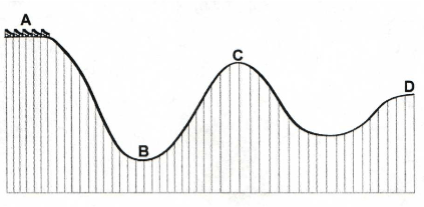
Based on the diagram of a roller coaster car on a roller coaster track, what statement is true?
- A. The car at point A has more kinetic energy than the car at point C.
- B. The car at point C has less kinetic energy than the car at point B.
- C. The car at point C has more kinetic energy than the car at point B.
- D. The car at point D has less potential energy than the car at point B.
- B. The car at point C has less kinetic energy than the car at point B.
500
Which observation would be evidence that heat was transferred by radiation?
- A. A person feels colder when the wind is blowing.
- B. A pan on a stove heats up the food placed in it.
- C. Warm air in the kitchen rises to the second floor of the house.
- D. A car with the windows rolled up gets very hot on a summer day.
- D. A car with the windows rolled up gets very hot on a summer day.
500
Name the phase changes occuring at 1, 2, 3, & 4:
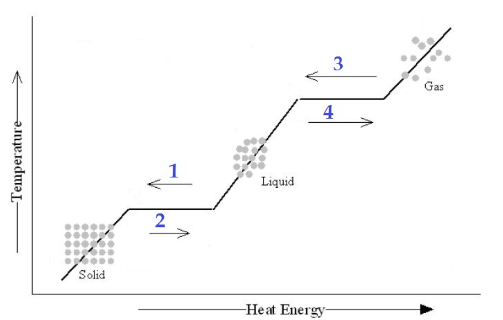
1. freezing
2. melting
3. condensation
4. vaporization/evaporation/boiling