Evolution 1
Evolution 2
Evidence for Evolution 1
Evidence for Evolution 2
Types of Selection
Miscellaneous
100
Which of the following structures can best be explained by sexual selection?
a. A giraffe’s long neck
b. A turtle’s hard shell
c. A spider dancing
d. A non-poisonous butterfly that mimics a poisonous butterfly
c. A spider dancing
100
The theory of evolution suggests that…
a. Extinct species are not related to existing species.
b. Species change over time.
c. Different species can interbreed.
d. Animals that look alike are the most closely related.
b. Species change over time.
100
How can we explain different skin color and features in humans from different regions of the world?
a. For a long time humans have lived in separate gene pools.
b. Each feature and skin color increases biological fitness in that region.
c. Humans did not have the ability to travel long distances until recently.
d. All of the above
d. All of the above
100
The human tailbone is an example of:
a. Vestigial structure
b. Homologous Structure
c. Analogous Structure
d. Natural Selection Structure
a. Vestigial structure
100
Large squirrels can carry large acorns to their burrows, and when acorn supplies are limited, they outcompete smaller and medium sized squirrels.
What type of selection is acting on this population?
Directional Selection
100
What is currently putting the largest selection pressure on organisms now?
a. Humans drastically changing the environment
b. Predators
c. Invasive species
d. Gene flow
a. Humans drastically changing the environment
200
Which of the following is true about variations in a population:
a. They arise from meiosis and reproduction
b. They exist in almost all populations
c. It is necessary for natural selection
d. All of the above
D. All the Above.
200
Darwin repeatedly described evolution as descent with modification, which best describes what Darwin meant?
a. Species give rise to new species very often and very quickly.
b. Closely related species can mate and give rise to new species
c. Species that lived in the past are the ancestors of the species existing today and species change through time
c. Species do not change through time, but some species die out.
c. Species that lived in the past are the ancestors of the species existing today and species change through time
200
Which of the following statements regarding the fossil record is true?
a. Fossil evidence is only available for animals approximately the size of dinosaurs.
b. Fossil evidence is often inaccurate and difficult to study
c. The fossil record links one group of organisms to another.
d. The fossil record shows that the first life forms on Earth were mammal-like creatures.
c. The fossil record links one group of organisms to another.
200
What are vestigial structures?
a. Structures that have different functions, but similar structure.
b. Structures such as a finch’s beak, which define the function of the organism.
c. Structures that are likely to mutate, such as a moth’s color.
d. Structures that were important in an organism’s ancestors, but no longer serve that purpose.
d. Structures that were important in an organism’s ancestors, but no longer serve that purpose.
200
Large squirrels can carry large acorns to their burrows, and when acorn supplies are limited, they outcompete smaller and medium sized squirrels.
Graph the selection type.
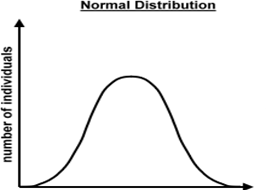
200
Snowshoe hares come in a multitude of shades from brown to white, and are preyed upon by bobcats. The population that lives in snowy areas tend to be white. The population that lives in areas without snow tend to be darker. This is an example of:

a. The environment determining what trait is more advantageous through natural selection
b. The rabbits picking mates based on their color preference (Sexual selection)
c. A behavioral adaptation that helps the rabbits survive in each environment
d. Artificial selection of rabbits by humans
a. The environment determining what trait is more advantageous through natural selection
300
The process of Natural Selection causes evolution. What is changing over time?
a. The acquired traits of a population.
b. The inherited traits of individuals
c. The inherited traits of a population.
d. The acquired traits of individuals
c. The inherited traits of a population.
300
What determines if a trait is advantageous?
a. Variation
b. Sexual Selection
c. Mutations and Meiosis
d. The environment
d. The environment
300
The human tailbone is an example of:
a. Vestigial structure
b. Homologous Structure
c. Analogous Structure
d. Natural Selection Structure
a. Vestigial structure
300
- Two species are believed to have a common ancestor. Which would be the best way to determine if they are related?
a. Comparing functions of anatomy
b. Examining karyotypes
c. Comparing DNA
d. Testing for genetic disorders
c. Comparing DNA
300
Women often have complications during labor while giving birth to very large babies. On the other hand, very small babies tend to be underdeveloped and are most likely to die shortly after birth. This situation results in what kind of selection on birth weight?
a. Directional selection
b. Stabilizing selection
c. Disruptive selection
d. Divergent selection
b. Stabilizing selection
300
Climate change is causing global temperatures to rise and snow to melt in regions where it has always been. Explain what expect to happen to the frequency of both the brown and white phenotype over time.

Brown increases
White decreases
400
Which organism would you expect to have a higher biological fitness?
a. The largest, strongest, fastest animal always has a higher fitness
b. A mosquito that is so small, animals can’t feel it. It can get enough food to survive and reproduce.
c. A strong male gorilla who is able to outcompete other males, but who cannot father any offspring.
d. A large, strong bird with a mutation that has made his beak so large she has difficulty catching and eating the smaller insects.
b. A mosquito that is so small, animals can’t feel it. It can get enough food to survive and reproduce.
400
Which of the following BEST describes the nature of evolution?
a. Evolution is change in the gene pool. Individuals do not evolve – populations evolve.
b. Evolution is a change in an organism because of mutations in his/her DNA.
c. Evolution is the inheritance of acquired characteristics over a very long period of time.
d. Evolution and natural selection are completely random and unpredictable.
a. Evolution is change in the gene pool. Individuals do not evolve – populations evolve.
400
How do the diagrams of the embryos of 6 different species (shown below) provide evidence for evolution?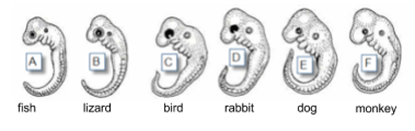
a. They show that at some point in embryological development all embryos have unique qualities, proving that evolution is occurring at all times.
b. They show that at some point in embryological development all embryos have tails, proving that their common ancestor must have also had a tail.
c. They show that at some point in embryological development all embryos look alike, proving that they are from a common ancestor.
d. They show that at some point in embryological development all embryos look different, proving that they are from a common ancestor.
c. They show that at some point in embryological development all embryos look alike, proving that they are from a common ancestor.
400
How do the homologous structures pictured below provide evidence for evolution?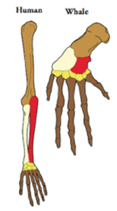
a. Their limbs are used for the same function, but they have different structures because of their common ancestry.
b. Their limbs currently have different functions, but they share the same structure because of their common ancestry.
c. Their limbs are used for the same function and have the same structure due to their common ancestry.
d. Their limbs have different structure and function due to their common ancestry.
b. Their limbs currently have different functions, but they share the same structure because of their common ancestry.
400
What is it called when two species are putting pressure on one another and evolving together:
a. Biological arms race
b. Disruptive selection
c. Biological fitness
d. Gene flow
a. Biological arms race
400
Provide an example of artificial selection by humans and explain how it was achieved:
Answers may vary
Ex. Dogs, humans select dog breeds with desirable traits to mate and create a new breed of dog.
500
List four factors necessary for a population to evolve:
Reproduction
Variation
Competition
Selection
500
Which of the following statements LEAST agrees with our current understanding of evolution?
a. Species change over time.
b. All living organisms evolved from a common ancestor.
c. Evolution occurs through inheritance of acquired characteristics (i.e. building muscle, loss of a limb)
d. Evolution occurs due to natural selection
c. Evolution occurs through inheritance of acquired characteristics (i.e. building muscle, loss of a limb)
500
How are humans are selecting for bacteria with more antibiotic resistance?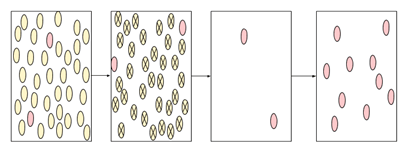
Answers may vary.
500
Salamanders, originally from the same species, migrated to different environments, and over many generations evolved into different species. This is an example of:
a. Divergent Evolution
b. Convergent Evolution
c. Coevolution
d. Stabilizing evolution
a. Divergent Evolution
500
The fastest cheetahs are more likely to survive, and the fastest gazelles are more likely to survive. What type of selection is this:
a. Stabilizing selection
b. Directional selection
c. Disruptive selection
d. Sexual selection
b. Directional selection
500
Elon Musk (the inventor of Tesla) claims that if we are to establish a successful colony on Mars, we will need to bring at least 10,000 people to ensure a large-enough gene pool. Why are small gene pools considered a bad thing?
Small gene pools tend to keep negative or harmful alleles in a population. By bringing a large enough population, you are more likely to get enough variation among individuals to ensure this won’t happen.