Questions 1-5
Questions 6-10
Questions 11-15
Questions 16-20
Questions 21-23
100
1. One of the accepted scientific theories describing the origin of life on Earth is known as chemical evolution. According to this theory, which of the following events would need to occur first for life to evolve?
C. Synthesis of organic molecules
During chemical evolution, organic molecules were synthesized by individual elements. All living things are made from organic molecules, so the presence of these molecules is required for life to exist.
100
6. Which of these would have the least effect on natural selection in a subspecies of giraffes that is geographically isolated from other subspecies of giraffes?
C. chromosome number
Chromosome number is not a factor that influences natural selection. The other three choices represent factors that drive the process of natural selection.
100
11. In his book On the Origin of the Species, Charles Darwin described how species change over time. Which of the following is NOT part of his observations that describes the mechanisms of natural selection?
C. Species today descended with modifications from ancestral species.
This answer represents evolution as a whole, not the process of natural selection
100
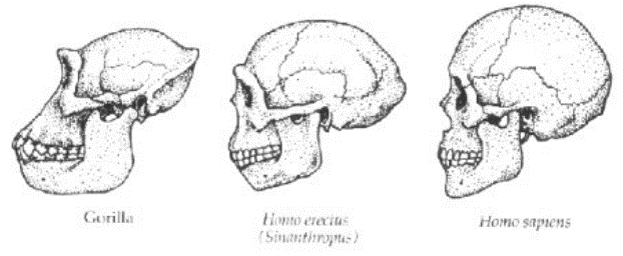 16. Scientists have found evidence that about 2.4 million years ago a gene regulating jaw muscles mutated and may have led to the more graceful human jaw we see today. The diagram below shows the skulls of 3 hominid species.
Which statement below most closely explains the link between jaw size and hominid evolution?
A. The jaws of hominids evolved to be smaller and less protruding over time.
Over time, the jaws of hominid species evolved to be smaller, lighter and less protruding. Scientist are now collecting evidence to support the theory that this change in jaw size allowed for larger brains to develop in hominids.
100
21. Which kingdoms have photosynthetic organisms?
C. protists and plants
Plant-like protists make their own food through photosynthesis, just like plants do.
200
2. Which types of organisms developed first due to the early environmental conditions on Earth?
B. prokaryotic and anaerobic
Prokaryotic organisms are single-celled and would have evolved first. Since atmospheric oxygen was not initially present on Earth, the ability to use anaerobic respiration to produce energy would have been necessary for the first living organisms.
200
7. Mutations within a DNA sequence are
A. natural processes that produce genetic diversity
Random mutations in DNA provide genetic variation in a population of species and allow for natural selection to occur.
200
12. Theodosius Dobzhansky discovered that successful species tend to have a wide variety of genes that do not appear to be useful to the species in its present environment. What did this discovery help explain about genetics and the changes that occur in a species over time?
B. Species with greater genetic diversity adapt more easily to changing environments.
Greater genetic diversity allows for a wide range of environmental changes to occur without harming the population of organisms.
200
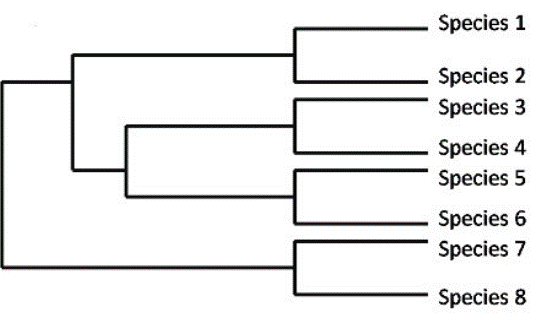 17. Scientists are studying the evolutionary history of a group of plants in the United States, and they developed an evolutionary tree, as shown below.
Which statement can be inferred from the evolutionary tree?
D. Species 5 is most closely related to Species 6.
The divergence of these 2 species is closest together
200
22. Some characteristics of a recently discovered organism are listed in the following table. Based on the given characteristics, this organism would be 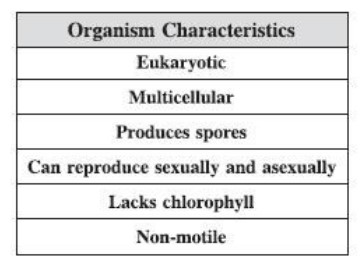 classified in which kindgom?
B. fungi
Fungi do not have chlorophyll because they are heterotrophs. Like us, they have to find food to eat and cannot make it themselves. Being non-motile (cannot move) this presents a challenge so they must produce spores to distribute themselves to new places where food sources are located.
300
3. The Miller-Urey experiment of 1953 was designed to test the hypothesis that lightning supplied the energy needed to turn atmospheric gases into organic molecules such as amino acids. Which of the following describes why the Miller-Urey theory is widely accepted today?
C. The process of synthesizing organic molecules from a mixture of gases has been successfully modeled in the laboratory.
The Miller-Urey experiments have been tested many times in the laboratory and organic molecules have continued to be successfully formed from mixtures of gases.
300
8. Which of the following best illustrates natural selection?
A. An organism with favorable genetic variations will tend to survive and breed successfully.
300
13. The scientific theory of evolution is supported by different types of evidence. The diagrams below show the skeletons of two different animal species. How does comparing the skeletons of these animals provide support for the scientific theory of evolution?
B. It shows possible common ancestry between organisms.
Animals that evolved from a common ancestor will often have similar structures and organs.
300
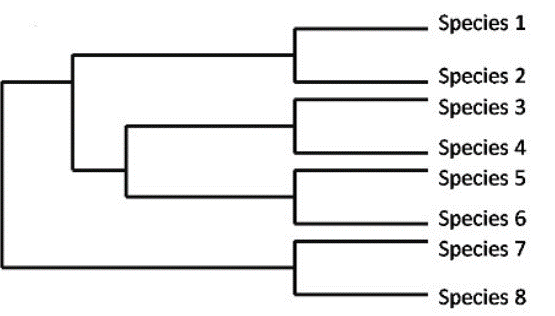 18.Scientists are studying the evolutionary history of a group of plants in the United States, and they developed an evolutionary tree, as shown below.
What information about the organisms best helps the scientists to determine the evolutionary relationships among them?
A. DNA Sequences
Since DNA is passed from parents to offspring, it is the most accurate way of determining evolutionary relationships between species.
300
23. In 1990, Carl Woese introduced the three domain system for classifying living things, after the advancement of DNA analysis allowed for a comparison of species genetic code. Which of the following is the best explanation for why domains were added to the previous system of classification?
D. Some organisms, which were previously characterized together, were determined to be genetically very different.
Using the analysis of RNA developed by Carl Woese, scientists are now able to classify living things based on genetic information instead of expressed characteristics. Genetic information is more specific and can give clues as to the evolutionary ancestry of organisms.
400
4. The diagram below shows a proposed theory of the origin of eukaryotic cells, called endosymbiosis.
Which of the following explains why cells that contained mitochondria-like organelles had an 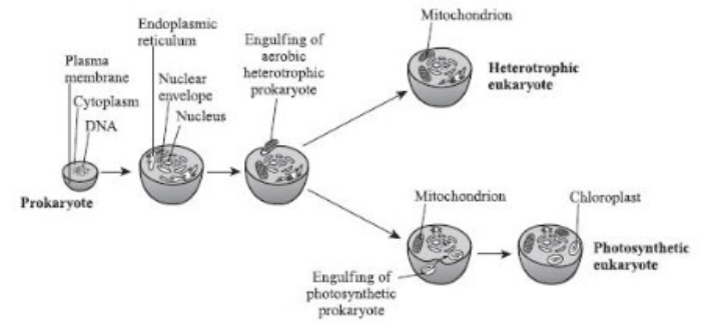 evolutionary advantage?
C. They were able to make more use of available energy
Mitochondria are the organelles which manufacture ATP from organic molecules
400
9. A small population of chimpanzees lives in a habitat that undergoes no changes for a long period. How will genetic drift probably affect this population?
D. It will reduce genetic diversity.
Genetic drift is a change in the frequency of alleles due to change. Typically, genetic drift decreases genetic diversity in a population.
400
14. According to fossil records, the horses that lived 50 million years ago were much smaller, weaker and slower than modern horses. Which process is most likely responsible for the changes that have led to the increased size, strength, and speed in horses?
D. evolution by natural selection
Natural selection is the mechanism of evolution, where animals that are more “fit” for a certain environment will naturally be selected to reproduce more often. Over time, new species have evolved from similar ancestral species.
400
19. Organisms classified as fungi have unique characteristics. Which of the following characteristics is found only in organisms classified in the kingdom fungi?
C. multicellular filaments that absorb nutrients
These filaments, called hyphae extend into the fungi’s food source and absorb nutrients. Fungi are not able to make their own food.
500
5. Over time, the climate of an island became drier, which resulted in changes to the populations of various island finch species. Finch populations with a certain beak shape thrived, while those not having that beak shape decreased. Which of the following describes a necessary condition for these changes in the finch populations to occur?
B. limited food resources
Limited resources are a major driving factor for natural selection. Since there was not enough food for all of the finches, the finches that had beaks which allowed them to get food more easily were more likely to survive and reproduce.
500
10. A small portion of the population that is geographically isolated from the rest of the population runs the risk of decreased.
A. genetic drift
Isolated populations run the risk of genetic drift due to decreased variation in the species.
500
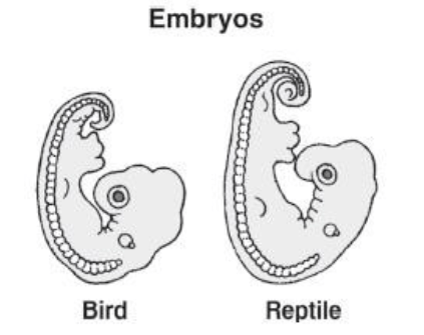 15. The diagram illustrates an embryonic stage of two organisms.
Which of the following can be determined by observing the embryos shown in the diagram?
A. The organisms share a common ancestry.
During the embryonic stage, before organisms develop many specialized structures, embryos with common ancestry will tend to have many of the same characteristics.
500
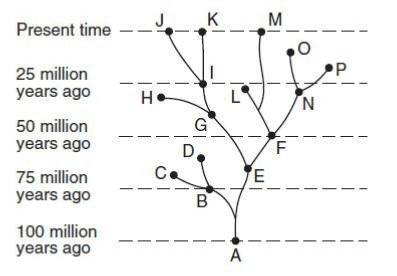 20. The diagram below represents possible evolutionary pathways of certain organisms.
Which species is most closely related to species L?
B. species F
Species L and species N share the common ancestor, species F.