It's all about the layers (3.1)
Who's dating who? (3.2)
It's not my fault (3.4)
A little of this & a little of that (3.1, 3.2, 3.4)
Totally random science trivia
100
List the names of the Earth layers in the chemical classification scheme
crust, mantle, core
100
Explain the difference between relative and absolute age and give an example of each.
Relative age is a comparison without numbers (older/younger/same age) and absolute age is a numerical value (#years).
100
Sketch how the plates interact at a transform boundary and list a geologic feature you would find at this boundary
 Features: Split stream beds, linear valleys, trenches
100
Which is older, the lighter or darker rock? Explain how you knew.

Darker rock
Principle of inclusions - the inclusion is older than the rock it is found in
100
What is the most abundant element in the universe?
Hydrogen
200
List the 3 factors that contribute to the heat in Earth's core
1. Gravitational Compression
2. Accretion
3. Radioactive decay
200
List the relative ages of each event from youngest to oldest:
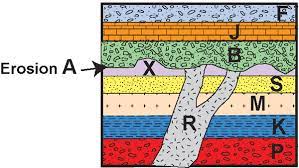
F, J, B, A, R, X, S, M, K, P
200
At which boundary type is new crust formed?
At which boundary type is old crust recycled?
new crust: Divergent
recycled: Convergent
200
What term describes the amount of time it takes for half of a parent isotope to decay into daughter isotope?
half-life
200
What does a mycologist study?
Mushrooms
300
Meteorites contain significantly more iron and nickel than is found on surface rocks.
Explain how this evidence supports the claim that Earth has layers.
Meteorites are made out of the same material that formed Earth so Earth must also have more iron and nickel than is in our crust. This means these elements must be found below the crust in larger proportions and the layers must be different composition than the surface.
300
List the four criteria that an index fossil must meet.
1. Easy to identify
2. Abundant
3. Geographically widespread
4. Present only during a short part of Earth's history
300
What type of plate boundary is pictured below? Include the crust types.

Divergent
Continental & continental
300
What is accretion?
Smaller bodies coming together under the force of gravity to form larger bodies - how Earth formed
300
Where is the smallest bone in the human body found?
Your ear - it's the stapes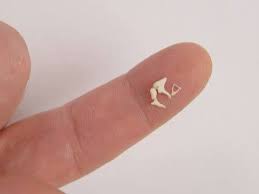
400
Give the physical state of each layer:
Lithosphere
Asthenosphere
Mesosphere
Outer core
Inner core
Solid
Plastic
Solid
Liquid
Solid
400
A rock sample is 2.816 billion years old. If it contains approximately 6.3 % U-235 and 93.7% Pb-207 what is the half life of U-235?
4 half lives have passed so (2.816 / 4)
0.704 billion years or 704 million years
400
Explain what is happening in the picture below and relate it to what you know about plate tectonics.
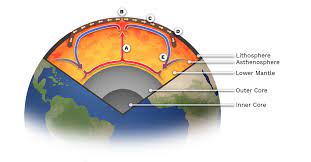
Convection currents are being created in the mantle due to the heat of the core. The hot less dense mantle slowly rises, then cools and becomes more dense and sinks. This movement moves the lithospheric plates.
400
Crocodiles have been around since the Jurassic period over 200 million years ago. Would they make a good index fossil? Explain why.
No because index fossils should only have existed during a short portion of Earth's history and crocodiles have been around a long time.
400
What units are used when measuring electrical resistance?
Ohms
500
Explain why shadow zones exist for S and P waves and how this gives evidence for Earth's layers.
S waves have a shadow zone because they can't travel through liquids.
P waves have a shadow zone because the are refracted at the boundaries due to the changing density of the materials.
This provides evidence for a liquid layer in Earth and layers with different densities
500
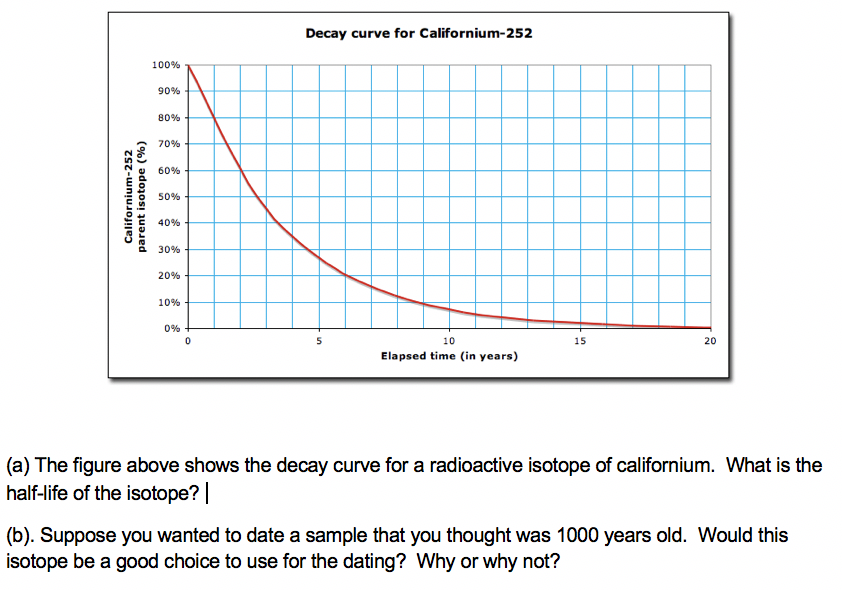
a) 2.7 years
b) no - there wouldn't be enough Cf-252 left after that many years because the half life is only 2.7 years.
500
An oceanic to continental convergent boundary lines the west coast of South America between the Nazca and South American plates. Predict what you would observe on each of the four maps we examined in class at this boundary.
Maps: Seismology, Volcanology, Sea Floor age, Topography
Seismology: Dense earthquake activity, with shallow earthquakes progressing to deep earthquakes as you move inward on the continental plate
Volcanology: Dense volcano activity in a line about 60-100 km inland (continental volcanic arc)
Sea Floor age: Older sea floor meeting the continental boundary, sea floor getting younger as you move further westward away from the continent
Topography: Deep trench along the boundary in the ocean, line of mountains inland where volcanic activity is occurring (Andes mountains)
500
List the geologic features you would find at convergent oceanic to oceanic boundary and provide a real world example of one of these features.
Deep trenches (Mariana trench)
Volcanic island arcs (Aleutian islands, Japan, Philippines)
Earthquakes
500
How fast is the speed of light?
300,000,000 m/s or 670,800,000 mph