Chapter 1
Chapter 2
Chapter 3
Chapter 4
Vocabulary
100
What is the difference between basic and applied sciences?
Basic = expands knowledge
Applied = aims to solve immediate problem
100
Which is/are the reactant(s)?
N2 and H2
100
What makes something organic?
Organic refers to molecules containing carbon atoms, typically bonded to hydrogen, oxygen, or nitrogen.
100
What is a cell?
Smallest unit of life
100
Van der waals interactions
weak attractions due to change in electron density
200
What is the difference between Inductive and Deductive reasoning?
Inductive = Observations that lead to a conclusion
Deductive = Principal or law to forecast result
200
What is an isotope?
Isotopes are different versions of the same chemical element. They all have the same number of protons and electrons, but varying numbers of neutrons in their nuclei.
200
What is this functional group?
Methyl Group
200
Ch 3 bonus: worth 200 pts
Name the 5 main components of an amino acid
1) Amino group
2) Center Carbon
3) R group
4) Hydrogen
5) Carboxyl group
200
heat capacity
amount of heat energy needed to raise the temperature of a specific object or substance by 1 degree C or K
300
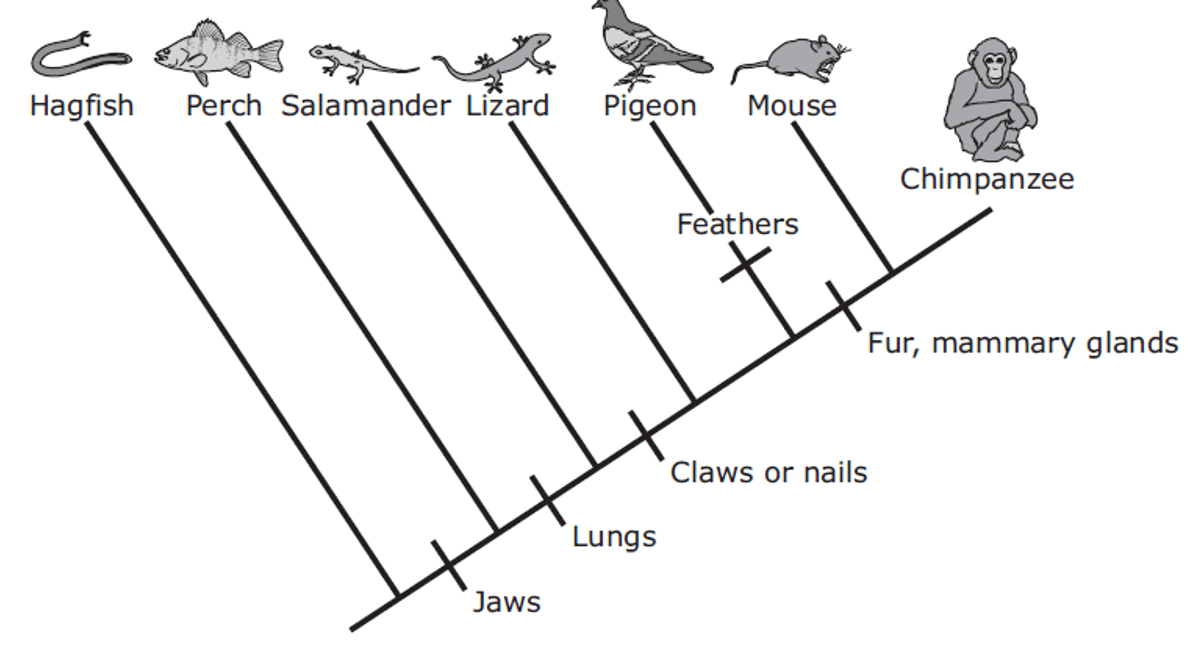
All the animals to the right of the hagfish would have the common characteristic of -
Jaws
300
What is a valance shell?
A valence shell is the outermost energy level of an atom.
300
What are the 4 basic macromolecules?
1) Carbohydrates
2) Lipids
3) Proteins
4) Nucleic Acids
300
What do eukaryotic cells have that prokaryotic cells lack?
A nucleus
300
polymers
large molecules made by covalently bonded monomers
400
List the levels of organization. (Minimum 9)
Atoms, Molecules, Macromolecules, Organelles, Cells, Tissues, Organs, Organ Systems, Organisms, Ecosystems, Biosphere.
400
Define Ionic vs Covalent bond?
Ionic bonds form when electrons are completely transferred from one atom to another, creating oppositely charged ions that attract each other. Covalent bonds form when atoms share pairs of electrons to achieve stability
400
What are the 3 components of a nucleic acid?
(Bonus for added 100pts) What are the Pyrimidine and Purine bases? Name them.
- A nitrogenous base
- A pentose sugar
- A phosphate group
Pyrimidines: CUT
Purines: AG
400
What is the purpose of the endomembrane system?
to synthesize, modify, package, and transport proteins and lipids
400
Trans vs Cis Isomers
Cis and trans are prefixes used in chemistry to describe the spatial arrangement of atoms within molecules
- Cis: Functional groups or similar atoms are located on the same side of a molecular plane or double bond.
- Trans: (Latin for "across" or "the other side"): Identical or similar functional groups are positioned on opposite sides
500
Name 3 properties of life
Order, Sensitivity or Response to Stimuli, Reproduction, Growthy and Development, Regulation, Homeostasis, Energy Processing
500
Bonus: Worth 800pts!!!
Identify what subatomic units affects identify, charge, and weight of an atom.
protons = identity and weight
electrons = charge
neutrons = weight
500
Label the phospholipid
- Phosphate
- Glycerol
- hydrophilic head
- hydrophobic tails
- saturated and unsaturated fatty acids
500
What are the three components of cell theory?
1) cells are the basic unit of life
2) all living organisms are made of cells
3) all cells come from pre-existing cells
500
Cohesion vs adhesion
cohesion: the attractive force that holds similar molecules together
adhesion: the molecular attraction between dissimilar substances