Ch. 4 - Carbon
Ch. 5 - Macromolecules
Ch. 5 - Macromolecules II
Ch. 6 - The Cell
Ch. 6 - The Cell II
100
How many bonds can Carbon form in total and why?
4 bonds; There are 4 valence electrons, where the valence shell can hold 8.
100
What chemical process builds macromolecules?
Dehydration Reaction/Synthesis
100
What is the generic formula for a sugar?
CH2O; Cn(H2O)n
100
What organisms compose prokaryotic cells?
Bacteria & Archaea
100
What are microvilli and what do they do?
Outwards projections of the cell membrane that increase the cell's total surface area.
200
What shape describes the 3D shape of a methane molecule?
Tetrahedral/Tetrahedron
200
Which macromolecule is not a polymer and why?
Lipids are a diverse set of molecules that are all hydrophobic. Therefore, different lipids are composed of different parts. For example, triglyceride is made of glycerol & fatty acids, while steroids are composed of four fused carbon rings.
200
What is the difference between a saturated and unsaturated fat? What physical form are they in room temperature?
Saturated fats do not have double bonds in their fatty acids, while unsaturated fats do. At room temperature, saturated fats are solid and unsaturated fats are liquid.
200
What is the process where cells engulf & consume something, & what organelle assists with this function?
Phagocytosis; Lysosomes perform autophagy
200
What are the differences between cilia and flagella?
Flagella are larger, fewer in quantity (one or a few per cell), primarily for cell movement
Cilia are smaller, larger in quantity, and move materials surrounding cells
300
What are hydrocarbons and what are their properties?
Organic molecules consisting only of Carbon & Hydrogen; Are hydrophobic & Release a lot of energy in reactions.
300
What functions do proteins serve?
Enzymes catalyze reactions, Storage of amino acids, Hormones control bodily functions, Contraction and movement, Immune/Defensive functions, Transport substances, Respond to chemical stimuli, Provide structure and support
300
Describe secondary protein structure.
Hydrogen bonds in the polypeptide backbone form to create an Alpha Helix or Beta Pleated Sheet.
300
What are some differences between eukaryotic and prokaryotic cells?
Prokaryotes: No nucleus, No membrane-bound organelles, DNA in free nucleoid region, Smaller
Eukaryotes: DNA enclosed in nucleus, Has membrane-bound organelles, Larger
300
What organelles would you expect to find in a plant cell, but not an animal cell?
Cell Wall, Plasmodesmata, Chloroplast, Central Vacuole
400
What is the main property of a phosphate group and what is it used for?
Contributes negative charge; When attached, allows molecules to interact with water and release energy
400
What are the main types of polysaccharides, what do they do, and how do they differ in structure?
Storage Polysaccharides - Stored Energy, Ex.: Glycogen, Starch
Structural Polysaccharides - Physical Structure, Ex.: Cellulose, Chitin
The glycosidic linkages are different between storage & structural polysaccharides.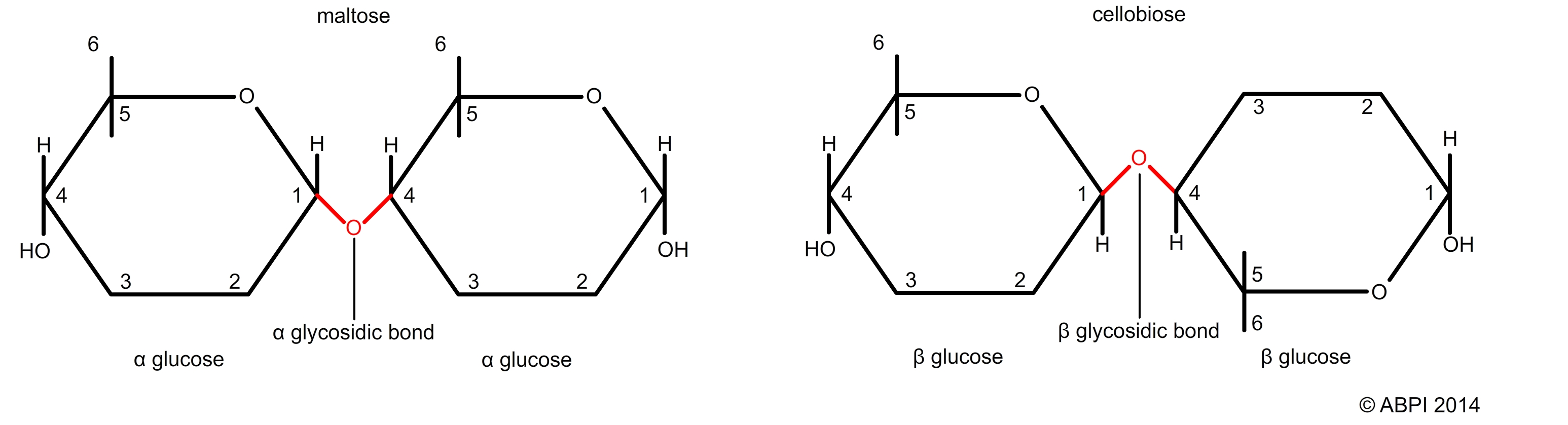
400
What are the nitrogenous bases for the nucleic acids and what are their complements?
Cytoside, Thymine (DNA), Uracil (RNA), Adenine, Guanine
C-G, A-T, A-U
400
What does the Smooth Endoplasmic Reticulum (ER) do?
Lipid synthesis, Carbohydrate metabolism, Detoxification of drugs & poisons, & Calcium storage
400
Why do muscle cells have more mitochondria than other cells?
Mitochondria is the organelle responsible for energy production within cells (ATP generation), and muscle cells require more energy for their function.
500
Draw a carboxyl group. What is the main property of carboxyl?
Acts as an acid by donating an H+

500
What are the monomers for nucleic acids and what are their components?
Nucleotides; Composed of a Phosphate group, Pentose sugar (Deoxyribose in DNA, Ribose in RNA), and a Nitogenous base (Pyrimidines - C, T, U, Purines - A & G)
500
How do we describe the structure of DNA?
2 polynucleotide strands wind around an imaginary axis to create a Double Helix; the 2 strands run in opposite directions, making it Antiparallel.
500
What are the different types of cell junctions and what do they do?
Plasmodesmata - Connect plant cells to allow transfer of water & solutes.
Tight junction - Tightly seal neighboring cells to prevent leakage.
Desmosome - Protein filaments that act like a rivet to fasten cells into sheets.
Gap Junction - Cytoplasmic channels between cells that allow materials to pass.
500
Describe the structure of a nucleus.
Has a nuclear envelope, composed of 2 membranes with pores on them. Inside of the nucleus is chromatin, which is the complex of DNA & proteins that make up chromosomes. In the middle is the nucleolus, which contains rRNA for protein synthesis in ribosomes.