All about ALKENES
Elimination
What's the Major Product?
Mechanisms
RANDOM
Nomenclature
100
True or false. The more substituted the alkene the more stable.
True.
100
True or false. The product of an elimination reaction is an alkene.
True. DUHHHHHHHH
100
What is/are the product(s) when this molecule is treated with ozone (O3) in DMS?
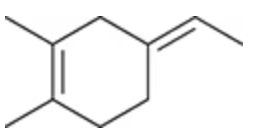
Cut all the double bonds in half and add an oxygen :)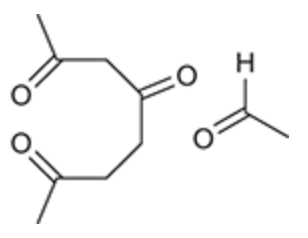
The byproducts of the reaction are carboxylic acids.
100
Draw the mechanism.
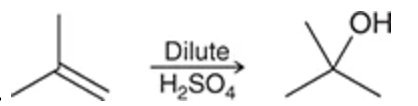
I will see.
100
True or false. Hydrogenation of alkenes to alkanes requires and metal catalyst, such as Ni or Pd.
True. Yes ma'am
100
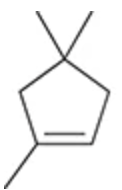
Draw me.
1,4,4-trimethyl-1-cyclopentene
200
What is the substitution pattern of all the alkenes in this molecule?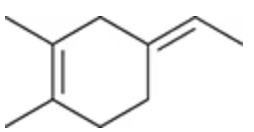
Quaternary (left) tertiary (right)
200
Does the elimination reaction of 1-bromo-1,2-dimthylcyclohexane treated with water follow an E1 or E2 mechanism?
E1: the carbocation is tertiary and therefore more stable. The leaving group will leave before being forced off.
200
What's the major product of this reaction?
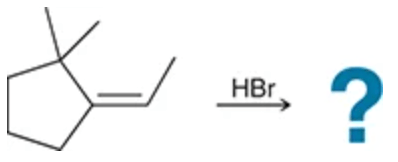
The hydrohalogenation addition is a markovnikof addition, that is not stereospecticfic. This is why you would see a racemic mixture of products.
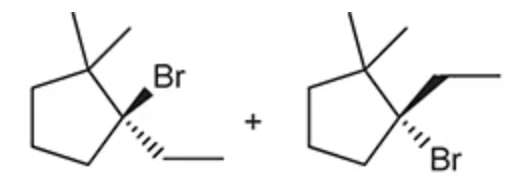
200
Draw a mechanism for this transformation
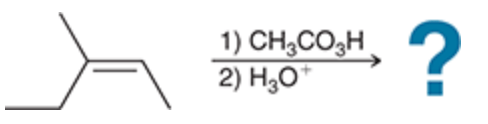
Let me see.
First step: Peroxyacetic acid forms the epoxide (four curly arrows)
Second step: Pronation of the epoxide by the acid, the anti attack opening the epoxide, ending with a proton transfer
(this form a trans diol "di": two "ol": alcohol)
200
True or false. In order to perform the reversible acid-catalyzed hydration reaction to favor the alkene reactant I would use a dilute acid.
False. It would be a concentrated acid due to Le Chatelier's principle. Concentrated acid means there is less H2O and the reaction would want generate more water.
200
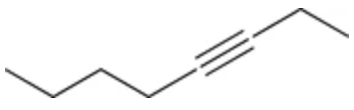
Draw me.
3-octyne
300
True or false. The cis conformation of an alkene is less sterically hindered and therefore more stable.
False. It is more sterically hindered and therefore less stable. Think about this when you are coming up with you major products for elimination reactions.
300
Does the elimination reaction of 2-bromo-3-methylbutane treated with a ethoxide favor an E1 or E2 reaction?
secondary organohalide with a strong base favor the E2
300
What's the major product?
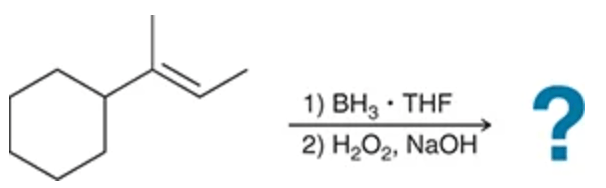
Anti-markovnikof addition of water.
The OH will add on the less substituted carbon.
Also a syn addition The Hydrogen and hydroxide add on the same face.
300
Draw a mechanism for this transformation.
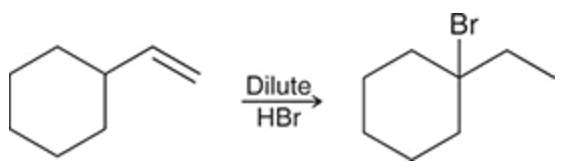
I will look.
300
How many p orbitals are shown in the proper valence-bond diagram of this molecule?
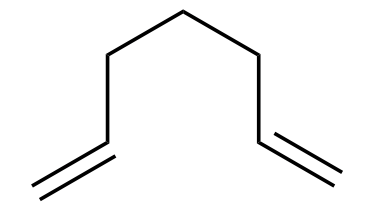
12. My trick is to count hydrogens
300
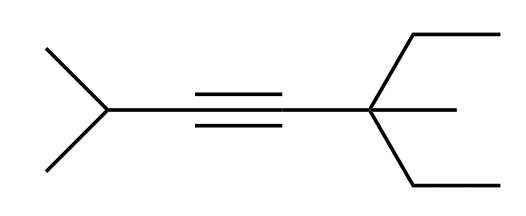
Draw me.
5-Ethyl-2,5-dimethyl-3-heptyne
400
True or false. The E isomerism of an alkene is interchangeable with saying the trans conformation. Having both of the heavy groups on opposite faces of the alkene.
True. E-similar to trans. Z- similar to cis
400
Draw all the products of reaction and indicate the major product.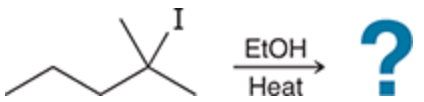
Elimination reaction with all beta protons, and the more substituted and least sterically hindered product is the major product.
400
What is the major product?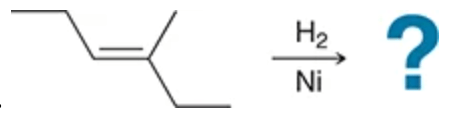
Forms a chiral center, so it will create a racemic mixture.
syn addition (hydrogens add on the same face )
400
Suggest a mechanism for the following transformation:
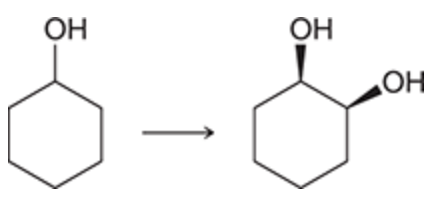
1) concentrated acid H2SO4 (this creates the alkene)
2) OsO4 (syn addition of the diol)
400
True or false. 1-ethylcyclohexene will go under rearrangement of the carbon skeleton during the hydrobromination addition over the alkene.
FALSE. Hell to the nah
400
What's my IUPAC name?
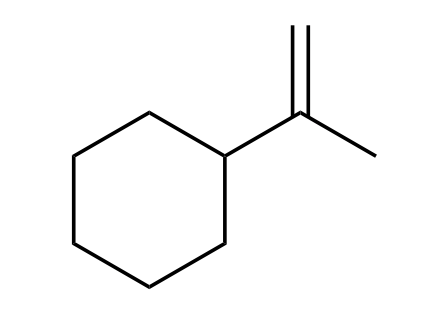
2-cyclohexyl-1-propene :)
500
What conditions favor the addition reaction over the reversible elimination reaction, according to the law of thermodynamics?
Low temperature. If done in conditions with a high temp. the reaction will favor elimination which is the alkene.
500
In the elimination reaction of the cis 1-bromo-2-methylcyclohexane which proton will transfer to the base. (Hint: Draw the seehorse projection)
I will show you.
500
When 3-ethyl-2-hexene is treated with molecular bromine (Br2) in presence of water (H2O) what is the major product?
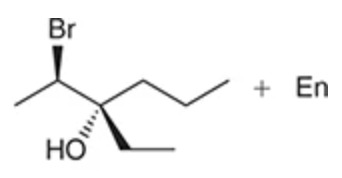
Anti addition of the bromine and hydroxide.
Formation of a chiral center, there will be a racemic mixture of enantiomers.
500
Draw a major product for this reaction and then draw the mechanism.
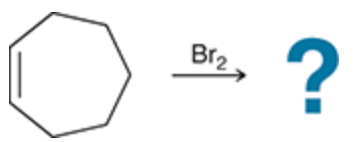
I will look.
500
Propose a synthesis strategy for this reaction.
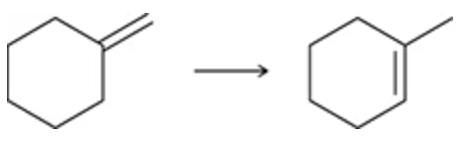
1) HBr (Hydrohalgenation -markovnikof addition)
2) NaOMe (Strong Base- elimination rxns)
500
What is my IUPAC name?
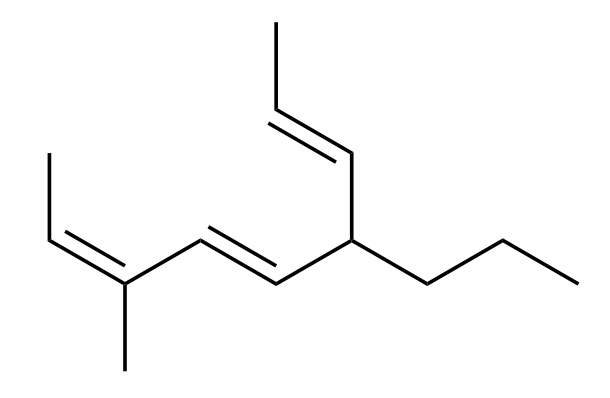
(3Z,4E,7E)-6-propyl-3-methyl-2,4,7-nonatriene