Principles of Ecology
Population Ecology
Community Ecology
Conservation
Terms
100
How are the terrestrial biomes of earth categorized?
Rainfall, Temperature, Animals, Vegetation, Location
100
List density dependent and density independent factors.
DD-competition for resources, predation, disease
DI-natural disater, climate changes, seasonal effects
100
A parastic worm that lives in the intestine of cows would be a ____parasite but a leech that grows on the skin of an animal is a ____ parasite
endo, exo
100
Diversity represents differences in what areas?
genetic, species, and ecosystem
100
Define ecology
The scientific study of interactions between organisms and their environment.
200
Which biome describes an environment that is warm year-round, with a dry and wet season. Many large mammals can be found here.
Savanna
200
Describe characteristic of K vs. R selected species. Give an example of each.
R-These organisms typically live in unstable, unpredictable environments & are able to reproduce rapidly (exponentially). They do not take care of their young & are subject to predation. Ex. plants, frogs, insects.
K-These organisms occupy stable environments, are larger in size and have longer life expectancies. They produce, during their life spans, fewer offspring, but place a greater investment in each. Ex.Elephants
200
Why is disturbance important?
tends to promote earlier successional stages which leads to greater diversity
200
Define minimum viable population and effective population size.
MVP-minimum size a population can sustain itself
EPS-breeding potential of a population, accounts for genetic variation and reproduction capacity.
200
Define immigration vs. emmigration
Organisms move into a population. Organisms move out of a population
300
In which marine zone would you find the majority of bottom feeding organisms and small crustaceans?
Benthic Zone
300
What conclusion could you draw from this graph?

When the zebra population increases, it causes the lion population to also increase after as more zebras mean more food and vise versa with decrease.
300
In the marine ecosystems sharks are in small abundance in comparison to other organisms, however, they have a high impact on the ecosystem. Therefore sharks are an example of a
Keystone species
300
What are the methods of large scale conservation?
Fragmentation & edges, corridors, protected zones,
300
What is semelparity vs. iteroparity?
semelparity- death occurs after reproduction. Reproduce one time
iteroparity-repeated reproduction
400
Describe what a rain shadow is.
Desert biome is created due to being behind a mountain and rain is blocked by the mountain and wind patterns as it flows from the front of the mountain to the back.
400
What are the three types of Survivorship curves. Give an example organism for each
Type I-Long lifespan, large mammals
Type II-50/50 chance, relatively equal probability of death at all stages of life. Small mammals are bird.
Type III-High mortality early in life. Many offspring but few survive. Plants, invertebrates, fish
400
Given these community. Richness would be_____ and relative abundance of hawks would be______ for 1 and _____ and _____. Community 2 has higher ______

C1-3, 4
C2- 3,10
Relative abunace
400
Describe the small population approach to conservation versus declining population approach.
Translocation of small populations
Intervene before MVP
400
What is the difference between Batesian mimicry and Mullerian mimicry?
Batesian-harmless mimics harmful
Mullerian-two harmful species look similar
500
You are on a plane and get dropped at a location that is between 30S and 30N latitude (midlatitudes). What biome would you be in and list some characteristics that you help you to confirm where you were?
Desert. Small animals like rodents and lizards, small amount of vegetation, mineral rich soil, Dry & hot with minimal rainfall.
500
You do a study on koalas in Australia and find that there are 15 koalas per acre. This is a measurement of ______. All 15 are found in one tree so they show _____ dispersion. Koalas have long lifespans and are so would be ____ survivorship and ______ type of population growth.
density, clumped, type I, K selected
500
Given this foodweb. Foxes are ______ , carrots are______, and Bird are______.
Secondary consumers, primary producers, primary consumers
500
The map shows the amount of land needed to protect the grizzly bear population in western Wyoming. Assuming there is an increase in park size in the future, you can predict that
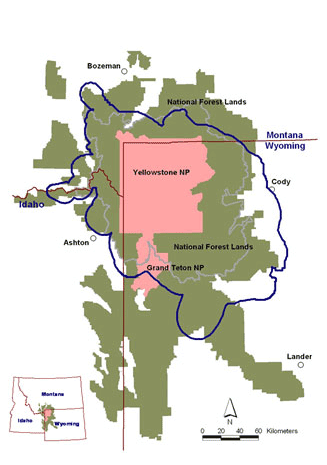
Grizzly bear population will remain with a better habitat
500
Describe the extinction vortex.
small population stuck due to inbreeding, genetic drift which causes loss of diversity leading to lower fitness and lower reproduction causing an even smaller population.