EXCRETION BASICS
THE KIDNEYS & URINE FORMATION
WATER BALANCE & ADH
BLOOD GLUCOSE REGULATION
TEMPERATURE REGULATION
100
What is excretion?
The removal of metabolic waste from the body.
100
What is the functional unit of the kidney?
The nephron
100
What is osmoregulation?
Control of water balance by osmosis.
100
Which organ controls blood glucose?
The pancreas
100
What is normal human body temperature?
37°C/ 98.6°F
200
Name two metabolic waste products produced by the body.
Urea, carbon dioxide, water, or mineral salts (any two).
200
What process occurs in Bowman's capsule?
Ultrafiltration
200
Which hormone controls water balance?
Antidiuretic hormone (ADH).
200
Which hormone lowers blood glucose?
Insulin
200
What is the difference between heat and temperature?
Heat is energy (kJ); temperature measures hotness (°C).
300
Why is excretion important for cells?
Waste buildup becomes toxic and damages tissues; excretion maintains optimal conditions.
300

What is the name of the part labeled "7"?
Adrenal Gland
300
What happens to urine when ADH levels are high?
More water is reabsorbed; urine becomes concentrated.
300
Which hormone raises blood glucose?
Glucagon
300
What is vasodilation?
Widening of arterioles to increase heat loss.
400
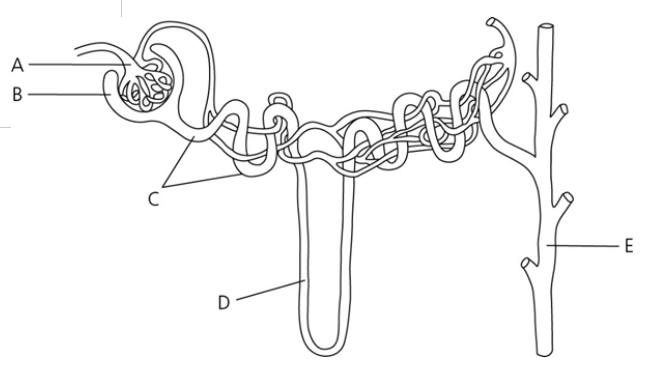
What is the name of the part of the nephron labeled "C"?
Proximal Convoluted Tubule
400
Compare the blood entering and leaving the kidney.
Entering blood has more urea and oxygen; leaving blood has less urea, less oxygen, and correct salt/water balance.
400
Describe what happens when blood water content is too high.
Hypothalamus does not stimulate ADH → less water reabsorbed → more dilute urine produced.
400
Explain what happens when blood glucose rises after a meal. How does the body lower the glucose levels?
Beta cells release insulin → glucose converted to glycogen in liver → blood sugar returns to normal.
400
Explain how sweating cools the body.
Sweat evaporates using heat from the body, lowering body temperature.
500
What is a hypertonic solution?
The solution is concentrated.
500
Describe in detail how urine is formed, including all major nephron processes.
Ultrafiltration forms filtrate → selective reabsorption (glucose, salts, water) → loop of Henle creates concentration gradient → distal tubule & collecting duct adjust water via ADH → remaining fluid becomes urine.
500
Explain how the hypothalamus works to regulate water balance.
Changes in blood concentration is detected → hypothalamus sends signals → ADH released → increases permeability of distal tubule & collecting duct → water reabsorbed → normal balance restored.
500
Name the two layers in the Epidermis
Cornified layer & Malpighian layer
500
Describe the full negative feedback mechanism that regulates body temperature when a person becomes too cold.
Hypothalamus detects drop → nerve impulses sent → vasoconstriction reduces heat loss → shivering increases respiration and heat production → temperature returns to normal.