Evaluate and Simplify with Exponents
Evaluate and rewrite with Radicals
Identify and Graph Functions
Growth/Decay/ Geometric Sequences
Solve Equations
100
Evaluate each:
(2)^3
15^0
8
1
100
Find the value of
(root(4)(16))^7
128
100
Is the following a linear, exponential, or neither. Explain.
y=2(3)^x
Exponential because it is in the form:
y=ab^x
100
Give the next three terms of the geometric sequence
0.25,0.75,2.25,6.75, ...
Multiply by 3
20.25, 60.75, 182.25
100
Solve for x:
3^x=3^5
x=5
200
Evaluate each:
5^-3
(-3)^4
1/125
81
200
Find the value of
(root(4)(-25))^3
Not possible
200
Is the following a linear, exponential, or neither. Explain.
y = 3x - 5
Linear because it is in slope-intercept form.
200
State whether the following is growth or decay, then give the initial amount and the rate of growth/decay as a percent:
f(t)=25(1.1)^t
Growth
Initial: 25
Rate of growth: 10%
200
Solve for x:
5^(3x-2)=5^(x+4
x=3
300
Simplify the expression:
x^3y^2 * x^4y^-2
x^7
300
Write in fractional exponential form
(root(5)(32.4))^7
32.4^(7/5)
300
Is the following a linear, exponential, or neither. Explain.
y=4x^2
Neither because it does not form a straight line and is not an exponential
300
State whether the following is growth or decay, then give the initial amount and the rate of growth/decay as a percent:
f(t)=100(0.925)^t
Decay
Initial Amount: 100
Rate of Decay: 7.5%
300
Solve for x:
4^x=2^(x+5)
x=5
400
Simplify the expression:
((2x^2)/y^3)^4
(16x^8)/y^12
400
Write in radical form:
(-15.4)^(5/9)
(root(9)(-15.4))^5
400
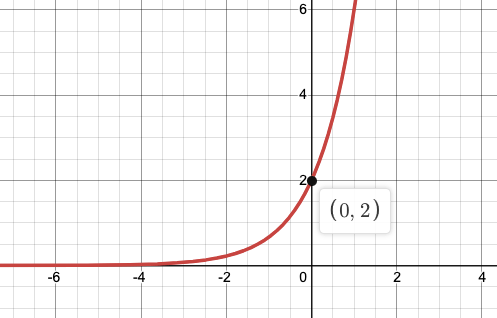
Graph:
y=2*3^x
400
Give the next three terms of the geometric sequence:
35, -7, 7/5, -7/ 25
7/125, -7/625, 7/3125
400
Solve for x:
9^(x+2)=27^x
x=4
500
Simplify the following expression:
(2x^4y^2z^5)/(4xy^6z^0)
(x^3z^5)/(2y^4)
500
Find the value of:
(root(5)(-243))^3
-27
500
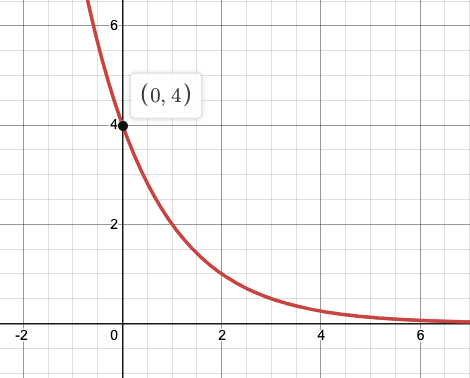
Graph:
y=4(1/2)^x
500
Set up the function for compound interest given the situation.
I invested $8000 into an account with a 5% interest rate. It will be compounded monthly.
Then find the value of the account after 5 years
B(t)=8000(1+0.05/12)^(12t)
B(5)= $10,266.87
500
Solve for x:
3^(2x)=(1/9)^(x+2)
x=-1