Exponential Growth
Exponential Decay
Graphing exponential functions
Compound Interest
Solving exponential equations
100
Ex 1: Initially, there are 5 bacteria in a dish. Every hour, the number of bacteria doubles. Write an exponential function and find the number of bacteria after 5 hours.
y=5(2)^x
What is 160 bacteria?
100
4. A car is worth $35,000 when Jacob first bought it. The value is depreciating by 8% each year. The amount that the car is worth in 6 years:
F=35000(1-.08)^6
What is $21222.43 ?
100
15. State the transformations and the asymptote.
y=5^(x+2)-4
horizontal shift left 2 spaces
vertical shift down 4 spaces
asymptote y=-4
100
7. Kaylee invests $10,000 into a bank account with 3.2% yearly interest compounded semi-annually. How much money would she have in her account after 20 years? How much interest did she earn?
F=10000(1+.032/2)^(2*20 F=$18868.98
Interest=$8868.98
100
Rewrite with the same base,set exponents equal and solve for x.
2^x=64
2^x=2^6
x=6
200
3. A petri dish has 50 bacteria initially and is growing by 5% each hour.The amount of bacteria after 6 hours.
F=50(1+.05)^6
What is 67 bacteria?
200
6. The element phosphorus-32 has a half-life of 14 days. If there is initially 30 grams of phosphorus-32, how much would be remaining after 4 weeks?
F=30(1/2)^(14/28)
F=21.21 grams
200
State the a,h, and k values, then list the transformations, asymptote, & whether they represent growth or decay.
y=(1/2)^(x+3)+6
a=1
h=3 horizontal shift left 3 spaces
k=6 vertical shift up 6 spaces
y=6 is the asymptote
The function represents decay
200
8. How much money will you have in 10 years if you invest $5000 compounded monthly at 1.2% interest rate?
$5637.15
200
Rewrite with the same base and set exponents equal.Then solve for x.
3^(x-1)=81
3^(x-1)=3^4
x-1=81
x=5
300
A population of 30 bacteria doubles every hour.
The amount of bacteria after 120 minutes.
y=30(2)^2
What is 120 bacteria?
300
A car worth $28,000 depreciates 15% per year.
a) Write a decay model.
b) What is the value after 5 years?
a) F=28000(1-.15)^t
b) $12,423.75
300
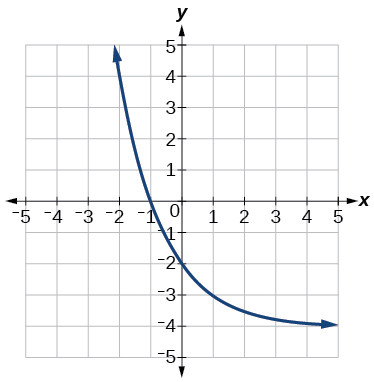
Complete the following characteristics from the graph:
Domain, Range, Growth or Decay, asymptote, y-intercept
Domain: (-oo,oo)
Range: (-4,oo)
Growth or decay: Decay
asymptote: y=-4
y intercept: (0,-2)
300
9. How much money will you have in 8 years if you invest $4000 at 3.5% compounded quarterly? How much interest did you make?
F= $5286.08
Interest=$1286.08
300
Rewrite with the same base and set exponents equal.
Then solve for x.
5^(2x)=125^(x+6)
5^(2x)=5^(3(x+6))
2x=3x+18
x=-18
400
- A town has a population of 12,000 and grows at a rate of 4% per year.
a) Write the growth function.
b) What will the population be in 8 years?
a) F=12000(1+.04)^t
b) 16422
400
A substance that starts with 600 grams decreases by 8% per hour.
a) Write an equation for the amount remaining after t hours.
b) How much remains after 10 hours?
a)F=600(1-.08)^t
b)260.63 grams
400
14. State the transformations and the asymptote for the following function:
y=2(3)^(x-5)+2
vertical stretch (a=2)
horizontal shift right 5 spaces
vertical shift up 2 spaces
asymptote: y=2
400
10. Marcus invests $15,000 into an account with 2.5% interest rate compounded continuously. How much money would he have in his account after 18 years?
$23524.68
400
Rewrite with the same base and set exponents equal.
Then solve for x.
9^x=3^(x+4)
2x=x+4
x=4
500
A population of bacteria starts at 500 and doubles every hour.
a) Write an exponential model at t hours.
b) How many bacteria are there after 12 hours?
a) y=500(2)^t
b) 2,048,000 bacteria
500
A medication has a half-life of 4 hours. If 200 mg are administered, how much remains after 8 hours?
F=200(1/2)^(8/4)
F=50 mg
500
12. State the a,h, and k values, then list the transformations, asymptote, & whether they represent growth or decay.
y=-2(3)^(x-5)+7
a=-2 reflection over the x-axis, vertical stretch
h=5 horizontal shift to the right 5 spaces
k=7 vertical shift up 7 spaces
y=7 is the asymptote
the function represents exponential growth
500
11. Dash invested $10,000 at 3% interest compounded continuously. How much will he have after 8 years?
$12712.49
500
Rewrite with the same base and set exponents equal.
Then solve for x.
16^x=8
2^(4x)=2^3
4x=3
x=3/4