Exponentials 1
Exponentials 2
Exponentials 3
Logarithms 1
Logarithms 2
100
e^-0.5
0.6065
100
y=2(4/3)^x
State whether the function is growth or decay and why.
Growth because b>1
100
Identify the y-intercept
y=2*(1/2)^x
(0,2)
100
Write the following in logarithmic form.
3^2=9
log39 = 2
100
Write the following in logarithmic form
y=b^x
logby=x
200
Find the growth or decay factor of the following rate of change.
-50%
0.50
200
If I invest $125 at 0.5% into an account with continuous compounding, how much will I have after 10 years?
$131.41
200
Identify the transformations in the function.
y=-(1/3)^x-1
X-axis reflection
Down 1
200
Write the following in exponential form.
log2(1/2) = -1
2^-1=1/2
200
logx(1/4)=2
x=1/2
300
If I invest $500 at a 1.5% interest rate, how much will I have after 3 years?
$522.84
300
Write an exponential function whose graph goes through the following points.
(0,2) and (2, 8)
y=2(2)^x
300
Identify the horizontal asymptote of the following.
y=4^x
y=0
300
Evaluate the following.
log5(1/5)
-1
300
Identify the asymptote of the following:
y=log(x-2)+3
VA: x=2
400
Cobalt-50 is a radioactive isotope used in cancer treatment. It has a half-life of about 5.27 years. If a treatment center gets 50 grams of this substance, how much will remain after 2 years?
38.44 grams
400
If I invest $350 at 4% into an account that compounds monthly, how much will I have after 2 years?
$379.10
400
Graph the function and state the domain and range, horizontal asymptote and y-intercept.
y=2^(x+2)-1
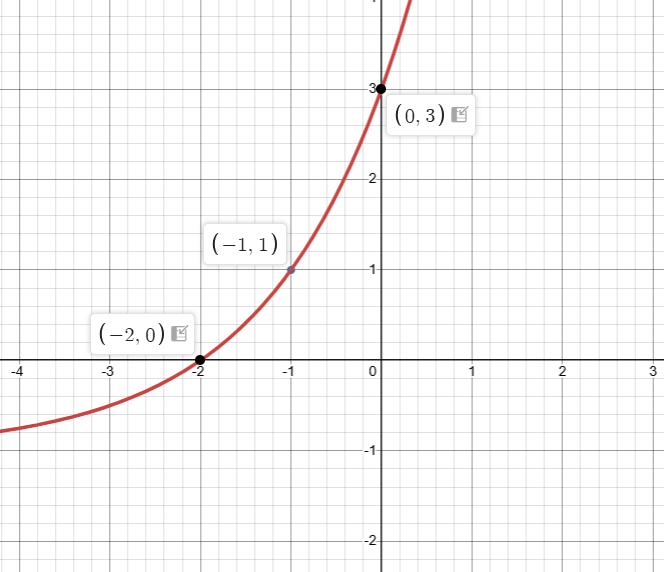
Domain: All real numbers
Range: (-1, infinity)
HA: y=-1
Y-intercept: (0,3)
400
log16(1/8) = x
x=-3/4
400
Graph the following and identify the domain, range and asymtote.
y=log(x)
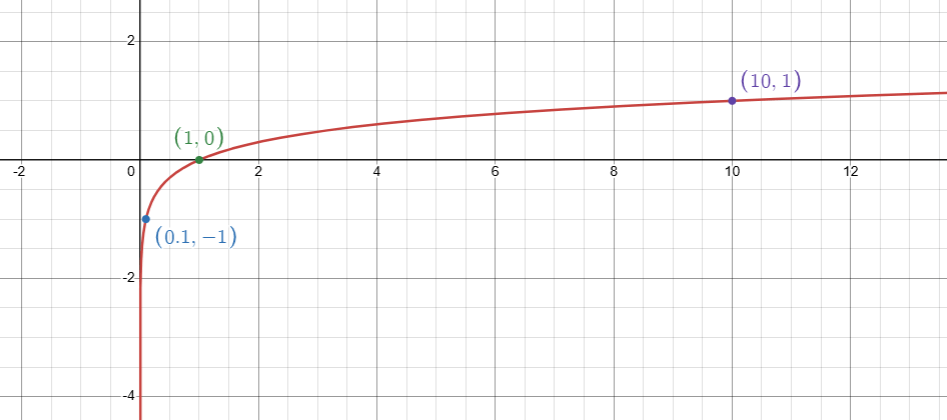
Domain: (0, infinity)
Range: All real numbers
VA: x=0