Geographic Principles
Migration
Government
Toss Up
100
A map that shows basic information like physical locations and political boundaries.
Reference Map
100
Temporary permission to stay within a country
Visa
100
A government led by a small group who are distinguished by their wealth, fame, or military power.
Oligarchy
100
What type of thematic map is this?
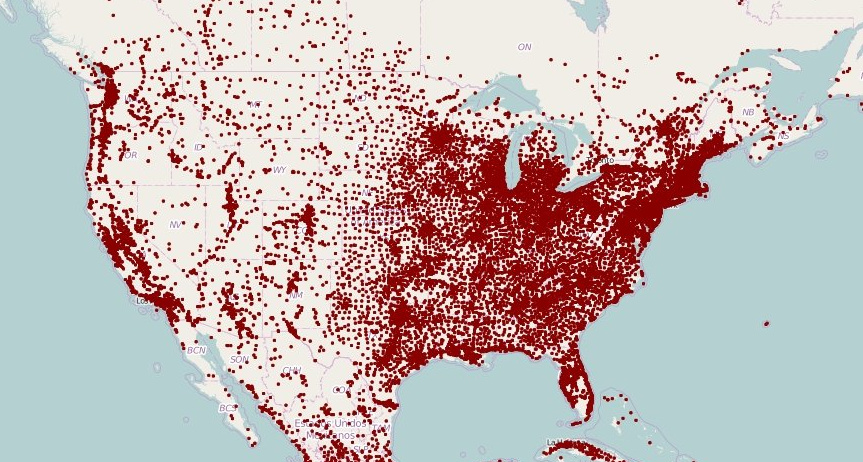
Dot density
200
A map that presents data across physical space to illustrate trends.
Thematic Map
200
The a migrant who is seeking safety that has not been granted legal protections (yet).
Asylum seeker
200
Name the three branches of the U.S. Government
Legislative
Executive
Judicial
200
What type of thematic map is this?

Choropleth
300
The distortion that occurs when trying to represent a round object, like the Earth, as a flat object.
Map Projection
300
Legal permission for a migrant to permanently stay in a country.
Green Card
300
Name three functions of any government. Meaning, the reasons we have governments.
Maintain social order
Provide security
Regulate the economy
Promote public welfare
Interact with foreign governments
300
The acquisition of talented/skilled workers from other countries.
Brain Gain
400
The study of maps and the science of making them.
Cartography
400
Money sent from a guest worker back to family members living in the worker's country of origin.
Remittances
400
A type of government in which one leader rules according to religious principles.
Theocratic Monarchy
400
A politician currently in office who is running for re-election
Incumbant
500
What is a Legend?
A key that indicates common landmarks or datapoints.
500
Name three of the six "Laws of Migration"
Most move only a short distance.
Each migration flow produces a counter-flow of migrants.
Long-distance migrants tend to move to major cities.
Rural residents are more migratory than those in towns.
Females are more migratory than males.
Economic factors are the main reason for migration.
500
The process of one nation establishing control over another sovereign territory by sending settlers and exploiting its resources
Colonization
500
A term used to refer to the areas of the world that are permanently inhabited by humans.
Ecumene